

Third-Party Risk Management in 2026: Build an Audit-Ready Vendor Security Program
Third party risk management has become one of the most critical gaps in enterprise security, and the numbers make that urgency undeniable. In 2025, 97% of organizations experienced at least one supplier-related security incident, a sharp rise from 81% the previous year according to BlueVoyant’s State of Supply Chain Defense report. The average organization now works with 286 vendors, a 21% year-over-year increase. And Verizon’s 2025 Data Breach Investigations Report found that third-party involvement in breaches jumped to nearly 30%, double the rate from 2024.
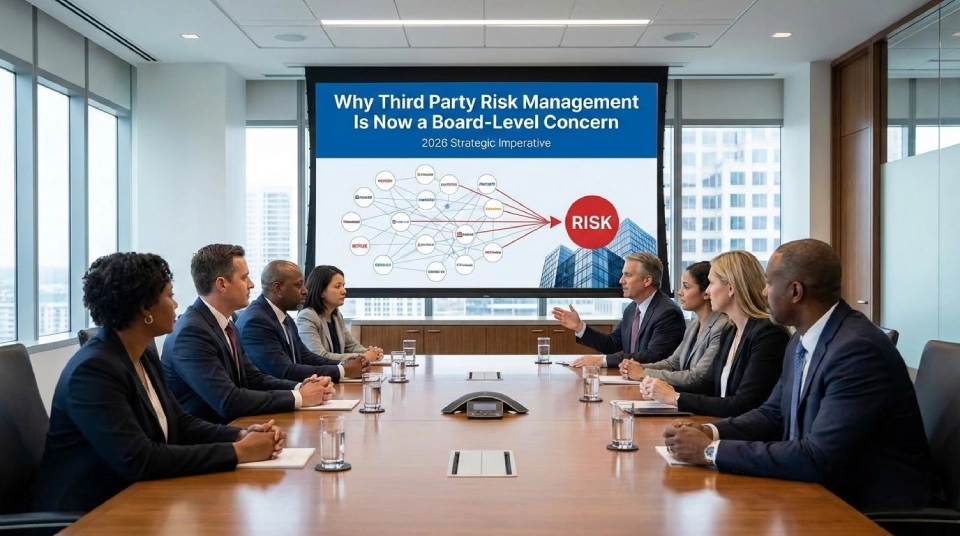
Why Third Party Risk Management Is Now a Board-Level Concern
Third party risk management has moved from a procurement checkbox to an enterprise-wide strategic priority because vendor vulnerabilities now directly determine an organization’s security posture, regulatory standing, and operational continuity.
The average organization shares confidential data with nearly 300 vendors. Each one is a potential entry point for attackers. When a breach originates from a third-party system, the average remediation cost reaches $4.8 million, higher than the cost of breaches caused by internal systems alone.
Regulators have taken notice. The EU’s DORA regulation places sharper requirements on ICT third-party risk in financial services. NIS2 elevates supply chain security as a core requirement across critical industries. Cyber insurance providers now demand documented evidence of active vendor oversight before issuing or renewing policies. Audit committees want visibility into critical vendor exposures before something goes wrong, not after.
Why Traditional Vendor Risk Assessments No Longer Work
Annual questionnaires and one-time assessments create the appearance of oversight without delivering actual risk reduction, and attackers are exploiting exactly that gap.
Consider the numbers. Only 4% of organizations have high confidence that their vendor questionnaires accurately reflect a third party’s real security posture. Yet 75% of organizations still use customized questionnaires as their primary assessment method according to Whistic’s 2025 TPRM Impact Report.
The core problem is timing. An annual review captures a vendor’s security status at one point in time. Certifications expire. Staff changes. Technology configurations drift. A vendor that passed assessment in January may represent a serious risk by June, with no one in your organization aware of the change.
Manual questionnaires also only cover what vendors choose to disclose. They provide documentation of stated intentions, not evidence of actual security controls.
The Core Components of an Audit-Ready TPRM Program
Audit-ready third party risk management requires four foundations: clear vendor risk tiering, defined cross-functional governance, continuous monitoring, and documented evidence trails.
Risk tiering groups vendors by the sensitivity of data they access, the criticality of services they provide, and the operational impact if they fail or are breached. High-risk vendors receive deeper scrutiny and more frequent review. Lower-risk vendors go through streamlined processes that free resources for where they matter most.
Cross-functional governance ensures that IT, security, legal, procurement, and business stakeholders share ownership of vendor risk rather than leaving it in one silo. 64% of TPRM programs currently sit outside the security function in finance, legal, or procurement according to BlueVoyant, which is why many programs prioritize compliance paperwork over actual risk reduction.
Continuous monitoring replaces point-in-time assessments with ongoing visibility into vendor security posture, certification status, and emerging threat indicators. Organizations using automated monitoring tools identify risks weeks or months before they would surface in an annual review.
Documented evidence trails are what make a program audit-ready. Every assessment, every finding, every remediation action needs to be recorded in a format that auditors, regulators, and insurance providers can review quickly and confidently.
Building a Vendor Inventory That Reflects Reality
You cannot manage risk for vendors you do not know exist, and most organizations have a significant shadow IT problem.
79% of organizations lack visibility into their fourth-party ecosystems, meaning the vendors their vendors use, according to industry research. That gap creates attack paths that formal TPRM programs never examine.
Building an accurate inventory means:
- Auditing procurement, IT, and finance records to surface all active vendor relationships including SaaS tools purchased by individual departments
- Mapping data flows between internal systems and every third party that touches sensitive information
- Categorizing each vendor by data access level, service criticality, and operational dependency
The inventory is not a one-time project. Vendor ecosystems grow continuously. A process for capturing new vendor relationships at onboarding, and removing offboarded vendors, keeps the inventory reliable rather than outdated.
Continuous Monitoring and Contractual Controls
Continuous monitoring and strong contract language work together: monitoring tells you when something changes, and contracts define what happens when it does.
Automated security posture monitoring tools track vendor risk ratings, scan for new vulnerabilities in vendor systems, and alert teams when a vendor’s security status changes between formal review cycles. 85% of organizations have now integrated vendor-specific incident response protocols into their broader security plans according to Optiv’s 2025 TPRM governance research.
For contracts, the clauses that matter most in 2026 include:
- Defined breach notification timeframes that align with regulatory requirements in your jurisdiction
- Incident response requirements that specify what a vendor must do, and by when, when a security event occurs
- Right-to-audit provisions that give your organization the ability to verify vendor security controls independently
- Security and privacy obligations specific to the data types the vendor accesses
- Termination rights tied to material security failures or regulatory non-compliance
Security requirements that are not in the contract are voluntary. Treat every vendor agreement as a security document, not just a commercial one.
Preparing for Regulatory Audits and Compliance Requirements
Regulators are no longer asking whether you have a TPRM program. They are asking whether it works.
Documentation of due diligence processes, assessment results, remediation timelines, and ongoing monitoring activities forms the evidence base that auditors examine. Organizations that manage TPRM through spreadsheets and email threads struggle to produce this evidence under audit pressure. 64% of organizations now use a dedicated TPRM software platform, up 19% year over year according to Secureframe research, and that investment directly reduces audit preparation time.
Key compliance-related requirements shaping TPRM in 2026:
- DORA requires financial services organizations to maintain documented ICT third-party risk registers and demonstrate active oversight
- NIS2 requires organizations in critical sectors to address supply chain security as part of their cybersecurity programs
- GDPR and CCPA continue to impose data processing obligations that flow through to vendor contracts and assessments
- SEC cybersecurity disclosure rules require publicly listed companies to assess and disclose material cybersecurity risks including those from third parties
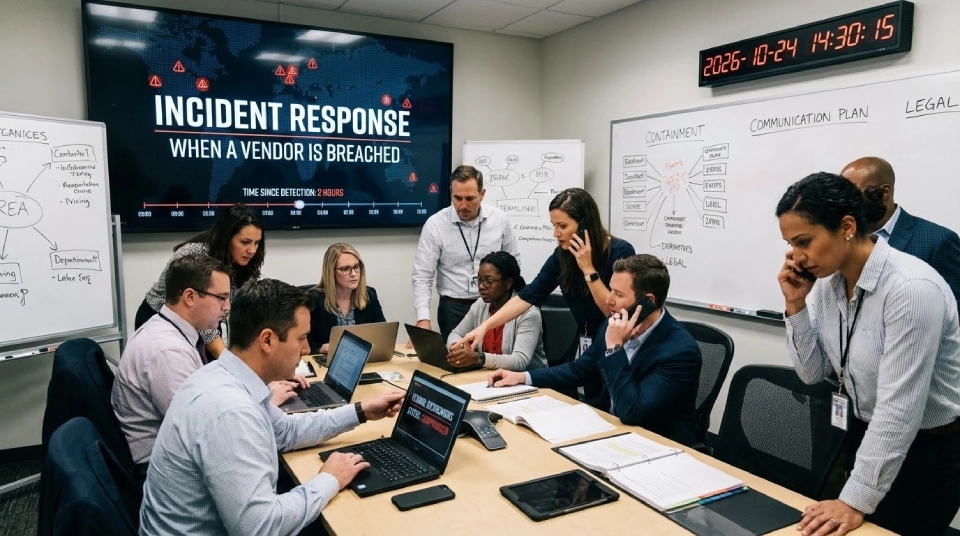
Incident Response When a Vendor Is Breached
When a vendor incident occurs, your organization’s ability to respond quickly depends entirely on preparation that happened before the breach.
Organizations without vendor-specific incident response plans spend critical early hours understanding who to call and what authority they have, rather than containing the impact.
An effective vendor breach response framework includes:
- Clear escalation paths that define who inside your organization is notified and at what incident severity threshold
- Pre-agreed communication protocols with vendors covering what information they must share with you and how quickly
- Playbooks for the most likely vendor incident scenarios including ransomware, data exposure, and service outage
- Defined business continuity options for critical vendor dependencies so operations can continue while an incident is being resolved
Common Mistakes That Undermine TPRM Programs
Three patterns consistently prevent TPRM programs from reducing actual risk even when budgets and staffing are adequate.
Treating TPRM as a procurement function limits it to onboarding and contract management without ongoing security oversight. Vendor risk does not end when a contract is signed. It continues and changes throughout the vendor relationship.
Overreliance on vendor self-attestations creates a false sense of assurance. Vendors have a strong incentive to respond positively to security questionnaires. Self-reported compliance is not the same as verified security posture.
Failing to update risk profiles as vendor services evolve means that a vendor assessed for one type of access continues to be treated at that risk level even after taking on access to more sensitive systems or data. Risk profiles need to reflect what vendors actually do, not just what they did at onboarding.
Measuring TPRM Effectiveness and Building Maturity
TPRM metrics should measure risk reduction, not just program activity.
Useful KPIs for a maturing program include:
- Percentage of high-risk vendors with active, documented mitigation plans
- Time to complete initial vendor assessments for new onboarding
- Percentage of vendors with continuous monitoring coverage versus point-in-time only
- Audit findings and the average time to remediate identified gaps
- Vendor inventory completeness as a percentage of known IT spend
Building maturity incrementally works better than attempting enterprise-wide transformation at once. Start with the highest-risk, highest-impact vendors where investment delivers the most protection. Implement governance structures and tooling that can scale. Add lower-risk vendor tiers to the program as capacity allows.
90% of organizations are moving toward centralized risk management according to EY research, and the programs making that transition successfully are the ones that proved value with a focused pilot before expanding scope.
What Sustainable Third Party Risk Management Looks Like in 2026
TPRM becomes a strategic capability when it is integrated into enterprise risk management, supported by automation, and treated as continuous rather than periodic.
Software supply chain attacks are projected to cost businesses $60 billion in 2025, rising to $138 billion by 2031 according to Cybersecurity Ventures. That trajectory makes the case for sustained investment clear.
Organizations that treat TPRM as a strategic capability rather than a compliance obligation build vendor relationships with transparency at their foundation, respond to incidents faster and with less damage, and enter regulatory audits with confidence rather than urgency.
Contact Webvillee to explore how a structured approach to third party risk management can be designed around your organization’s vendor ecosystem, compliance obligations, and security priorities in 2026.