

Why Speed Matters Now More Than Ever
Your competitors aren’t waiting. In today’s market, product engineering reduce time to market has become the difference between leading and following. Companies that launch features and products faster capture market share, generate revenue sooner, and build customer loyalty before competitors can respond.
This isn’t about having the most funding or the largest team. It’s about having the right methodology and practices that allow smaller teams to move at startup speed while maintaining enterprise quality. Product engineering is that methodology. It’s the structured approach that transforms how organizations develop software, enabling them to compete effectively regardless of size.
In this guide, you’ll discover how product engineering works, why it matters for competitive advantage, and how mid-sized companies can implement it without complete organizational overhaul.
What Is Product Engineering and How Does It Enable Speed?
Product engineering is a structured approach to software development that combines smart architecture, proven development practices, and organized team workflows to deliver products faster without sacrificing quality.
Many organizations confuse product engineering with simply hiring more engineers. It’s not. Product engineering is a methodology. It’s about building the right way from the start rather than moving fast and fixing problems later. The difference matters enormously.
Here’s what product engineering actually includes:
- Smart Architecture: Building systems with modular components that teams can develop independently. This eliminates the bottleneck of multiple teams waiting for single components to be completed.
- Structured Approach to Development: Clear coding standards, reusable components, automated processes. Everyone follows the same practices, which means less rework and faster integration.
- Faster Product Development Practices: DevOps methodologies that move deployment from quarterly to weekly or daily. Small batch releases reduce risk and accelerate feedback.
- Organized Teams: Clear ownership of features and systems. No ambiguity about who’s responsible for what or where decisions get made.
This structured approach is what enables speed. It’s not about working harder or longer hours. It’s about working smarter from day one.

How Does Product Engineering Reduce Development Cycles?
Product engineering reduces development time through modular architecture, reusable components, automated testing, and clear processes that eliminate delays caused by poor planning, rework, and quality issues.
The traditional development cycle looks like this: plan for weeks, build for months, test at the end, discover problems, rework, delay launch. This cycle creates unnecessary friction. Product engineering removes that friction through several specific practices.
Modular Architecture means your codebase is organized into independent components. Team A can work on the payment system while Team B builds the customer portal without stepping on each other. Integration happens smoothly because the architecture was designed for it.
Reusable Components eliminate duplicate work. Instead of every team writing authentication code or payment processing logic, you build it once, test it thoroughly, and reuse it across projects. This compounds over time: your second product launches faster than your first, not slower.
Automated Testing catches problems immediately instead of waiting for the QA phase. Developers write tests as they code. The system runs thousands of tests automatically on every change. Problems surface in minutes, not weeks into testing.
Clear Processes replace ad hoc decisions. Code reviews happen consistently. Deployment follows the same steps every time. Knowledge isn’t stuck in individual people’s heads. This allows teams to move fast without chaos.
These practices work together to product engineering reduce development time significantly. Organizations using product engineering typically cut development cycles from 6-12 months to 3-6 months for major features. For smaller changes, the difference is even more dramatic: from weeks to days.
If you want to explore how product engineering practices would apply to your specific product roadmap, a structured product engineering approach from an experienced partner can accelerate your timeline dramatically.
What’s the Business Impact of Faster Time to Market?
Faster product launches translate directly to competitive advantage, captured market share, increased revenue, and faster return on your product investments.
Consider the business reality: when two companies are racing to capture a market opportunity, first-to-market wins. They acquire customers, establish market position, and build brand recognition before competitors launch. Late-to-market players then spend years trying to catch up.
The financial impact is concrete:
- Revenue Growth: When you launch 6 months ahead of competitors, you have 6 months of revenue generation before they start competing. That’s not a small advantage.
- Market Share: Early market entrants capture 30-40% market share while latecomers struggle to reach 15%. The first mover builds customer loyalty and relationships that are hard to displace.
- Faster ROI: Your investment in product development pays back faster. You move from development cost to revenue generation sooner, improving overall business economics.
- Competitive Positioning: Companies known for launching quickly and frequently gain reputation advantages. Customers see them as innovative and responsive.
- Customer Acquisition: Early-stage products acquire customers at lower cost. Later entrants must spend more on marketing to convince customers to switch.
Time to market business impact extends beyond the single product. Organizations that move fast train faster teams, attract better talent, and build momentum that compounds across multiple product launches.
The consequence of moving slow is equally clear: late market entry rarely recovers. You’re always playing catch-up. Customers have already chosen competitors. Your product development investment doesn’t generate expected returns.
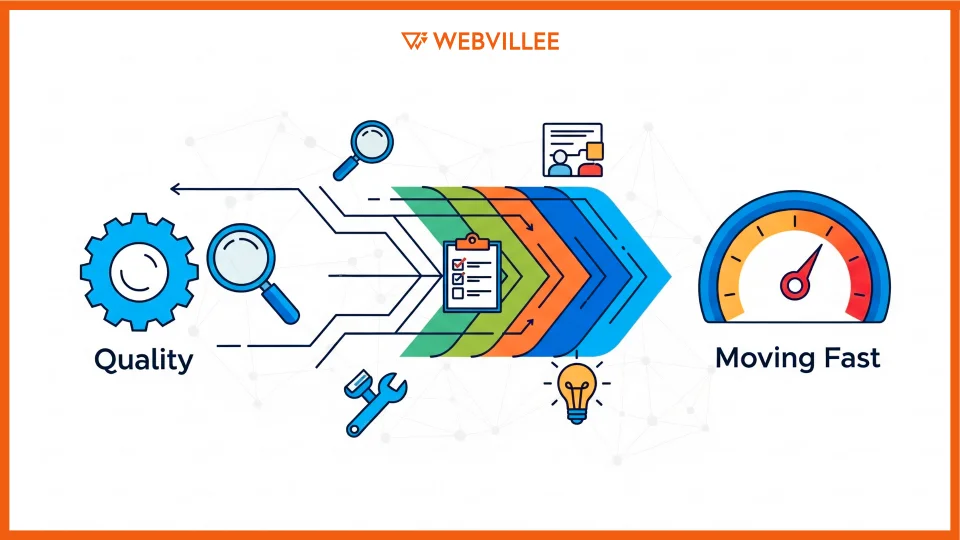
How Does Product Engineering Maintain Quality While Moving Fast?
The common misconception is that speed and quality trade off against each other. Product engineering proves they don’t have to. Automated testing, code reviews, modular architecture, and continuous integration enable teams to maintain quality while moving quickly.
In traditional development, speed and quality feel like opposing forces. Team lead: “We need to launch in 3 months.” Quality lead: “That’s not enough time to build it right.” Both are thinking linearly: more features equals more time. More time equals better quality.
Product engineering breaks this tradeoff through specific practices:
- Automated Testing: Instead of manual testing at the end (which takes weeks), computers run thousands of tests continuously. The system catches problems immediately. This maintains quality while enabling speed.
- Code Quality Standards: Every code change goes through automated checks. Does it meet styling standards? Does it duplicate existing code? Are there potential security issues? These checks happen before humans review the code, eliminating entire categories of problems.
- Continuous Integration: Every code change integrates into the main codebase multiple times per day. Problems surface immediately instead of accumulating until final integration. This is where the real quality comes from: small changes are easier to fix than large integration nightmares.
- DevOps Practices: Deployment processes are automated and repeatable. You’re not deploying software differently each time. Consistency reduces errors and maintains reliability.
These practices maintain product engineering quality while enabling faster development. Quality doesn’t drop; it gets maintained through different mechanisms. Instead of extensive manual testing at the end, you prevent problems from being created in the first place.
What Role Does Agile Methodology Play in Product Engineering?
Agile methodology enables rapid feedback, quick course correction, and iterative improvement, which reduces risk and enables product engineering to deliver value faster.
The Agile methodology and product engineering work together, but they’re not the same thing. It is about how you organize work and gather feedback. Product engineering is about how you build and organize code. Both matter for speed.
Within an agile product development context, here’s what works:
- Sprint Cycles: Work in 1-2 week cycles. Build something, test it, show it to stakeholders. Get feedback. Adjust course. Instead of building for 6 months and launching something nobody wanted, you adjust direction every 2 weeks.
- Iterative Development: Start with the core product functionality. Launch to real users. Gather feedback. Build the next layer. Each iteration involves real users, not hypothetical planning. This dramatically reduces the risk that you’re building the wrong thing.
- Rapid Course Correction: Midway through your product development, you discover the market wants something different. With agile, you adjust course in the next sprint. With traditional waterfall, you’re locked into your original plan for 6 more months.
- Continuous Delivery: Your changes deploy to production continuously. You’re not building for 6 months, then deploying once. You’re deploying multiple times per week. This means getting feedback fast and adjusting faster.
Agile methodology is what makes product engineering velocity sustainable. Without agile practices, you’d just be building faster in the wrong direction. With agile, you build fast in the right direction, and you adjust if conditions change.
How Do Mid-Sized Companies Implement Product Engineering?
Implementation doesn’t require wholesale organizational transformation. Most mid-sized companies adopt product engineering incrementally, starting with their highest-impact product or feature, then expanding from there.
Many mid-sized organizations believe they’re too small for enterprise practices or too large to adopt startup practices. Product engineering implementation actually sits in the middle. You don’t need to transform everything overnight.
Here’s a realistic incremental adoption approach:
- Start with One Product: Select your highest-impact product or feature. This is where you can demonstrate value fastest. Don’t try to retrofit ten products simultaneously.
- Build the Foundational Practices First: Establish automated testing practices. Document coding standards. Create modular architecture principles. These foundations matter more than tool selection.
- Expand Gradually: Once your first product team is executing with product engineering practices, expand to the next product. Each expansion is easier because you’ve learned what works in your organization.
- Organizational Change Management: This part gets underestimated. You’re asking teams to work differently. Some will embrace it immediately. Others will resist. Plan for change management alongside technical implementation. It matters.
- Implementation Roadmap Development: Don’t wing it. Create a clear roadmap. Months 1-3: establish practices on Product A. Months 3-6: expand to Product B. Months 6-9: evaluate and adjust. This transparency helps teams understand expectations.
Most mid-sized companies see results from product engineering implementation within 6-9 months. You’re not waiting years for transformation. You’re seeing faster feature deployment, higher quality, and improved team satisfaction relatively quickly.
The key is starting with realistic scope and expanding as you build capability.
What Are the Common Roadblocks to Implementing Product Engineering?
The biggest obstacles to product engineering adoption aren’t technical; they’re organizational. Legacy systems, skills gaps, unclear architecture, and lack of executive alignment often delay implementation.
Understanding common roadblocks helps you plan better.
Here’s what typically gets in the way:
- Legacy Systems and Technical Debt: Your existing systems weren’t built with modular architecture. Integrating new practices with old systems creates friction. Solution: Start new projects with product engineering practices rather than retrofitting everything.
- Skills Gaps: Your team may not have experience with DevOps, automated testing, or modular architecture. You need training or new hires. Solution: Combine internal training with external expertise. Bring in a partner for the first product, then transfer knowledge to your team.
- Unclear Architecture and Organizational Barriers: Different departments own different systems. There’s no cohesive vision of how things fit together. Product engineering requires clarity about overall architecture. Solution: Start with architectural clarity before diving into implementation.
- Executive Misalignment: Leadership isn’t convinced that product engineering matters. They see it as engineering overhead rather than competitive advantage. Solution: Demonstrate financial impact. Show how faster launches drive revenue. Make the business case explicit.
- Lack of Resources: You can’t hire new people for product engineering work. Your team is already stretched. Solution: Prioritize ruthlessly. Pick the highest-impact product. Redirect resources from low-impact work temporarily.
These roadblocks are surmountable. They just require planning and awareness. Organizations that acknowledge these barriers upfront navigate them much more successfully.
How Does Product Engineering Support Scalability as You Grow?
Building products quickly matters now; building products that scale matters later. Product engineering creates scalable architecture that supports growth without requiring complete rewrites as demand increases.
Many companies face this problem: they launch a product successfully. Users love it. Demand grows rapidly. The system that was perfect for 1,000 users buckles at 100,000 users. Now you need a complete rewrite, and your competitive advantage disappears while you rebuild.
Product engineering handles both speed and scalability through architecture decisions:
- Scalable Architecture: From day one, you design systems to scale. Not over-engineered, but built with growth in mind. Databases designed for growth. APIs designed for load. Infrastructure that can expand as demand increases.
- Product Scaling Without Rewrites: As your user base grows, you don’t rebuild. You add capacity, optimize databases, add caching layers. The core architecture holds. You’re scaling the existing system, not replacing it.
- Cloud-Based Infrastructure: Product engineering typically involves cloud infrastructure that scales automatically. When you get traffic spikes, infrastructure expands automatically. When demand drops, infrastructure contracts. You only pay for what you use.
- Modular Architecture Benefits: The same modularity that enables speed also enables scalability. You can optimize bottleneck components independently. If your payment system is the constraint, you optimize that system without touching everything else.
Organizations using product engineering scale from thousands of users to millions without catastrophic rewrites. Your earlier competitive advantage (being first to market) continues compounding as you grow.
What Does ROI Look Like From Product Engineering Investment?
Product engineering investment pays back in multiple ways: faster feature deployment, higher product quality, reduced maintenance costs, and increased revenue from faster market entry. ROI typically appears within 6-12 months.
Let’s make the financial case concrete. When you implement product engineering, you’re making an investment. You’re buying training, potentially hiring new people, and initially slowing down to implement new practices.
What’s the payback?
- Faster Revenue Generation: Your products launch 3-6 months faster. That 3-6 month acceleration means 3-6 months of revenue generation before competitors launch. For a software product generating $1M annually, that’s $250K-$500K of additional revenue from speed alone.
- Reduced Development Costs: Automated testing, code reuse, and clear processes reduce rework. You’re not rebuilding components multiple times. Your cost per feature decreases.
- Reduced Maintenance Costs: Higher quality code means fewer bugs in production. Fewer production emergencies mean lower support costs and less reactive firefighting.
- Product Engineering ROI calculation: If you invest $500K in product engineering implementation and get $1M in additional revenue plus $200K in cost savings, your ROI is 240% in the first year. Most organizations see payback within 6-12 months.
Time to Value:
Quick implementation means you’re not waiting years for transformation. You see results within months.
- Month 1-3: Establish practices, initial training
- Month 3-6: First product launches with new practices, velocity increases
- Month 6-9: Cost benefits and revenue acceleration become visible
- Month 9-12: Clear ROI picture emerges
Product engineering investment is among the highest-ROI investments mid-sized companies can make. The business case is compelling.
How Do You Choose the Right Product Engineering Partner?
Not all development partners understand product engineering. You need a partner with architecture expertise, proven agile experience, track record with mid-sized companies, and genuine commitment to building your team’s capability.
Choosing a product engineering partner is different from choosing a typical development vendor. You’re not just hiring people to build features. You’re hiring expertise, methodology, and commitment to building your organization’s capability.
Here’s what to evaluate:
- Architecture Expertise: Can they design systems that scale, support modularity, and enable fast development? Ask about projects they’ve architected. Understand their philosophy on architecture decisions.
- Agile Methodology: Do they practice agile genuinely or just use agile terminology? Ask about their sprint practices, feedback loops, and course correction processes. Observe how they work.
- Proven Track Record with Mid-Sized Companies: Enterprise partners have different problems and constraints than mid-sized companies. You need someone who understands your context. Ask about similar companies they’ve worked with.
- Commitment to Building Your Capability: This matters. The wrong partner builds features for you and then leaves, and you’re back to square one. The right partner transfers knowledge, builds your team’s skills, and positions you for success after they leave.
- Production Engineering Services Assessment: Ask specifically about how they approach product engineering. Do they have a documented methodology? Can they articulate it clearly? Do they have evidence it works?
The right partnership accelerates your product engineering adoption significantly. You get expertise that would take years to hire and train. You avoid mistakes that other organizations have already made. You’re not starting from zero.
Your Path Forward
Time-to-market is no longer a nice-to-have advantage; it’s a business requirement for competitive survival. Product engineering is the proven approach to achieving speed sustainably while maintaining quality and supporting growth.
Here are the key takeaways:
- Product engineering is a structured approach combining smart architecture, proven development practices, and organized teams. It enables speed without sacrificing quality.
- Speed in product development translates directly to competitive advantage, market share, revenue growth, and faster ROI on your investments.
- Product engineering adoption doesn’t require complete transformation. Mid-sized companies implement incrementally, starting with high-impact products and expanding gradually.
- ROI typically appears within 6-12 months, with faster launches, reduced costs, and increased revenue offsetting the initial investment.
Your competitive window is limited. Every quarter your competitors aren’t ahead is an advantage you keep. The organizations that master product engineering today will dominate their markets tomorrow. The organizations that move slowly will struggle to catch up.
If your organization is ready to explore how product engineering can accelerate your product roadmap, let’s discuss your specific situation. Contact Webvillee to schedule a consultation with our product engineering specialists who can assess your current state, identify opportunities, and create an implementation roadmap that fits your organization.