

Get Your Free Technology Modernization Audit: 15 Critical Issues We Check Across Your Stack
A technology modernization audit is a process of structured examination of your entire technology stack with the aim of identifying security issues, integration issues, performance issues, and technical debt before they become business-critical issues. In most cases, the true state of the entire technology stack is discovered when something fails in the system, the project is delayed, or the modernization process is halted in the middle of the project. According to McKinsey research, the technical debt of the average company falls in the range of 20-40% of the entire technology stack of the company. Webvillee’s free technology modernization audit tells you where your entire technology stack is today and where it will be if no action is taken.
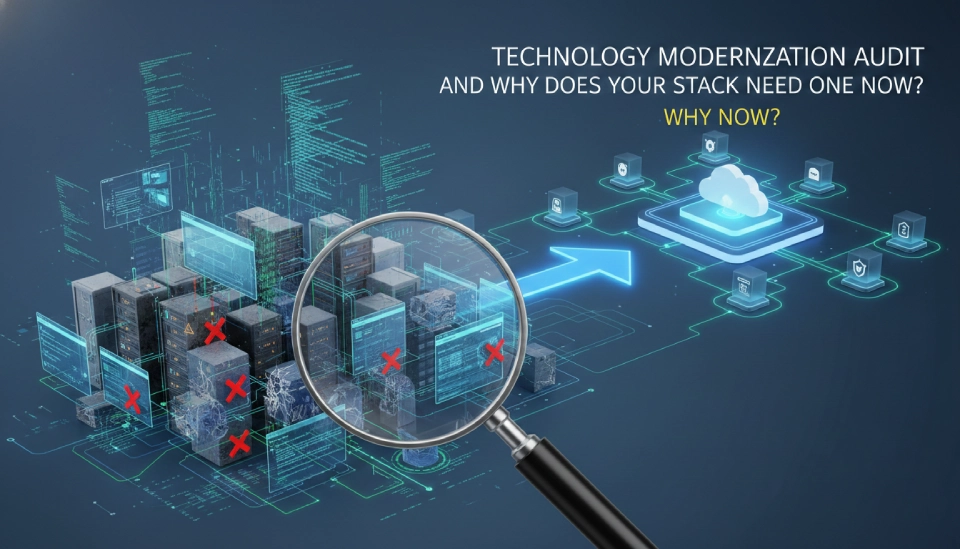
1. What Is a Technology Modernization Audit and Why Does Your Stack Need One Now?
A technology modernization audit is a comprehensive look at all aspects of your stack to identify hidden risks, redundant systems, and technical debt that are currently bleeding your budget and slowing down every project your team tries to ship.
While most IT leaders have a good intuition for areas of their stack that are not performing well, few have a well-documented and prioritized view of which issues are currently bleeding their budgets and which are blocking their next phase of growth.
The extent of the problem is massive across most enterprise stacks:
- CIO Dive, citing a SnapLogic survey of 750 IT decision-makers, found legacy tech upgrades cost the average business $2.9 million in 2023, with nearly two thirds spending more than $2 million annually just to maintain and upgrade outdated systems
- McKinsey’s technical debt research found that 60% of CIOs report their technical debt has increased materially over the past three years, and 10% to 20% of the budget earmarked for new products is diverted to resolving debt issues before any new work can begin
- Gartner’s 2024 analysis confirms that companies proactively managing technical debt improve delivery speed by 25% on average compared to those carrying it forward
A technology modernization audit turns that general awareness into a specific, prioritised map. That map is what Webvillee produces, free, in 14 working days.
2. What Are the 15 Critical Issues Webvillee Checks Across Your Stack?
Webvillee checks 15 issue categories across five domains: infrastructure health, security posture, integration integrity, performance and scalability, and modernisation readiness.
The 15 checks are structured to surface the issues most directly affecting cost, security, and your ability to deliver new capabilities on time.
Infrastructure Health
- Legacy system dependency mapping. Which systems are running on end-of-life platforms, unsupported frameworks, or vendor-discontinued software.
- Technical debt concentration. Where debt is highest and what it costs annually to continue carrying it.
- IT budget allocation vs maintenance ratio. The percentage of your IT budget consumed by maintenance rather than innovation.
Security Posture
- Unpatched vulnerability identification. Systems with known, unresolved security exposures representing active risk right now.
- End-of-life software exposure. Components operating without vendor security support or patch coverage.
- Compliance gap assessment. Where the current stack fails to meet current regulatory or data protection requirements.
Integration Integrity
- Integration point failure risk. Point-to-point integrations that are brittle, undocumented, or held together by workarounds.
- Data silo identification. Critical business data trapped in systems that cannot share it across the rest of the stack.
- API health and coverage. Systems that lack API access and therefore cannot participate in automation or future modernisation work.
Performance and Scalability
- Bottleneck identification. Systems creating performance constraints that are affecting business operations today.
- Scalability ceiling mapping. Where current infrastructure will fail when the organisation hits its next growth milestone.
- Redundancy and waste. Tools in the stack that duplicate functionality, carry unnecessary licensing costs, or have adoption rates too low to justify their spend.
Modernisation Readiness
- Cloud readiness assessment. Which workloads are genuine migration candidates and what that would deliver in cost and performance terms.
- AI and automation readiness. Which parts of the stack can support AI integration today and which need structural change before they can.
- Modernisation sequencing. The order in which issues should be addressed to deliver the fastest risk reduction and earliest return on investment.
KPMG’s IT internal audit planning guidance for 2025 confirms that legacy technology risk, cloud governance, and AI readiness are now the top three IT audit priorities for enterprise organisations. Webvillee’s audit addresses all three directly.
3. Why Does Technical Debt Accumulate Silently Until It Becomes a Crisis?
The technical debt builds silently because each piece of technical debt is individually reasonable, but no one adds up the total cost until a modernization project fails or a security incident starts the discussion.
The pattern repeats in all companies, big and small, in all industries. A system is patched rather than upgraded because it would slow the release of a product. An integration is hardcoded because it would take two sprints to implement it correctly. A license is not cancelled because no one is really sure what it is used for.
VentureBeat’s analysis of legacy modernisation,citing a top bank’s experience with MongoDB, discovered that out of a $16 million IT budget, $15 million was being entirely consumed by legacy system maintenance. What was left over for innovation was a paltry $1 million.
Individual actions are sensible in themselves. Collectively, they’re the reason why:
- New features take three times longer to ship than they should
- Security fixes require regression testing to prevent impacting adjacent systems
- Every modernization project has scope creep, where it’s more expensive than it should be
- AI and automation projects always seem to die at the integration layer
Raconteur’s analysis of tech stack auditing confirms that the most valuable outcome of an audit is not the problem list. It is the prioritised modernisation roadmap that gives IT leaders a defensible sequence of action to present to the business. Webvillee delivers both.
4. What Does the Webvillee Technology Modernization Audit Process Look Like?
Webvillee carries out the audit through a series of structured discovery sessions, review of the architecture documentation, and technical analysis, culminating in the delivery of a prioritized findings report within 14 working days.
The audit process follows a series of steps:
Stage 1: Discovery (Days 1-5) Webvillee collaborates with your in-house IT lead to identify every system, integration, and dependency across the technology stack. This phase identifies the full scope of what exists before the assessment even starts.
Stage 2: Analysis (Days 5-10) Each of the 15 check categories will be evaluated against the latest best practice standards, business objectives, and existing modernization roadmaps where applicable.
Stage 3: Findings Report (Days 10 to 14) Webvillee’s prioritised findings report will include:
-
Which of the 15 issues are present and at what severity level -
The estimated cost and risk profile of each unresolved issue -
Recommended modernisation sequence and phased investment options -
An executive summary written in plain language for CTOs, CFOs, and board members
The report is not a standardised report developed using a template. It is written by the same Webvillee architects who will be responsible for any future implementation project. It is not a hypothetical report based on a future state. It is a report based on actual delivery constraints.
5. What Do Most Technology Modernization Audits Actually Uncover?
The vast majority of audits reveal three to five critical issues not previously documented, at least one security exposure currently in action, and a concentration of technical debt in one or two systems where disproportionate IT resource effort is being spent.
The findings that are most consistently revealed in all enterprise stack audits are fourfold:
Undocumented dependencies Systems are much more tightly coupled to the rest of the stack than any current documentation indicates. This makes modernization much more costly than originally estimated.
Active security exposure Vulnerabilities that have not been addressed due to unpatched software running in an environment that has not been formally risk assessed. Research conducted by RecordPoint on their legacy system solutions confirms that two out of every three CTOs list complex dependencies and technical debt as their biggest challenge when trying to address security exposure.
Invisible budget drain Licensing costs, maintenance contracts, and unnecessary tools that are consuming budget dollars without a corresponding increase in value. CIO Dive’s article on SnapLogic’s research found that over three in every five IT leaders report that their data stack is currently being negatively impacted at a moderate to severe level due to technical debt, including code that is no longer relevant and no one is responsible for retiring.
Modernization blockers Specific areas that will prevent cloud migration, AI implementation, and platform consolidation until they are addressed. These are the problems that cause modernization initiatives to stall when so much money has already been spent.
6. Who Should Request the Free Webvillee Technology Modernization Audit?
This audit is most valuable for CTOs and IT leads who are planning a modernisation programme, preparing a business case for board-level investment, or experiencing repeated delivery failures they cannot fully explain with current stack visibility.
Webvillee’s audit is specifically designed for organisations that:
- Are preparing to migrate infrastructure to cloud and need to understand which systems will resist migration and why
- Are planning AI or automation implementation and need to confirm which parts of the stack can actually support it
- Have experienced repeated cost overruns or timeline failures in IT delivery and need a documented root cause analysis
- Are approaching a major platform contract renewal and want an independent view before committing to another multi-year agreement
- Have grown through acquisition and now operate a mixed stack with unknown integration quality and undocumented dependencies
McKinsey’s research on AI-enabled IT modernisation enterprises that addressed technical debt at the same time as migration efforts saw 30% to 50% reductions in operational overheads compared to those that didn’t audit their state first. It is not the audit that causes the problems in your stack. It is that the audit makes the cost of inaction computable before that cost is inevitable.
Key Takeaways
- The purpose of a technology modernization audit is to identify the hidden technical debt, security exposure, integration issues, and scalability challenges before they lead to project failures or security breaches.
- McKinsey research has shown that technical debt comprises 20%-40% of the overall technology landscape in most enterprises, which means 10%-20% of the budgets allocated to developing new products are spent on technical debt before the actual development process starts.
- The upgrade costs of legacy tech for the average business stand at $2.9 million annually, with close to two thirds of businesses incurring over $2 million in costs alone to maintain and upgrade their outdated infrastructure.
- Webvillee identifies 15 critical areas, including infrastructure health, security exposure, integration integrity, performance, and modernization readiness.
- The process is done in 14 working days, without the need to access the production environment, by the same architects who would lead the subsequent upgrade process.
- The audit process identifies three to five undocumented critical issues in most cases, at least one security exposure, and a high technical debt concentration.
- Businesses that fixed their technical debt before embarking on their cloud and AI migration journey saw 30%-50% fewer operational costs compared to those who did not.