

Composable Architecture: Building Enterprise Systems That Adapt in Days, Not Months
Composable architecture represents a new way to build enterprise systems composed of separate, interchangeable parts rather than an integrated system. For a CMO or marketing organization, this means your technology stack can change as easily as your campaigns, channels, and consumers’ needs. In fact, as a marketing organization, your technology stack can now change as quickly as your campaigns and consumers’ needs without waiting months for IT to catch up. According to Gartner, organizations that implement a composable architecture outperform their competition by 80% in speed to market for new feature deployment. The traditional approach to enterprise systems is becoming a competitive disadvantage.
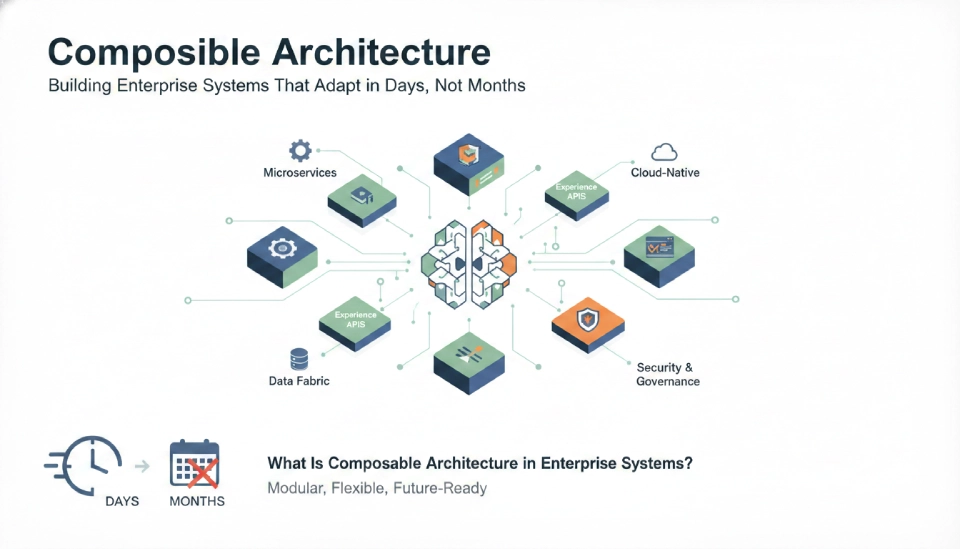
What Is Composable Architecture in Enterprise Systems?
With composable architecture, your enterprise technology stacks are composed of separate modules, each of which does one thing well, connected to each other with APIs. You can change, add, or remove parts of your technology stacks without affecting the other parts.
A good analogy for this is building blocks instead of carving a single block of stone.
Each of these modules, referred to as a Packaged Business Capability (PBC), operates independently and communicates with other modules through standardized interfaces. This is the essence of what we call MACH in the industry. MACH is an acronym for Microservices, API first, Cloud native, and Headless.
What makes a system composable?
- Components that can be deployed individually
- No single vendor locks you in
- Communicate with services via APIs
- Ability to add functionality without affecting the system
According to the MACH Alliance 2025 Global Research, 61% of enterprise technology stacks will be MACH-based by 2026, with 8 in 10 organisations reporting a positive outlook toward the approach.
Why Are Legacy Enterprise Systems Failing Marketing Teams?
A monolithic system packages everything together. This means if you try to change something, you risk breaking everything else. This makes every marketing campaign update, every new channel rollout, and every personalization feature a multi-month IT project.
Marketing is a fast game. Legacy technology isn’t.
Some of the most common pitfalls CMOs encounter when working with traditional technology:
- New campaign features take quarters, not weeks, to deploy
- Content updates in one market break something in another
- Personalisation at scale requires changes across the entire platform
- Vendor lock-in means you use tools that are good enough, not the best available
Personalization at scale means changing the entire platform, not just one part
Vendor lock-in means you’re using tools that are good enough, not necessarily the best
IBM’s composable architecture researchhas termed this phenomenon “the chaos of connectivity” – years of point-to-point integrations creating costly-to-change systems that hold the entire business back.
The result is a marketing team that moves at the speed of its slowest system.
How Does Composable Architecture Make Enterprise Systems Faster to Change?
Because each component operates in isolation, you can change your checkout process, replace your CMS, or add a new personalization platform without affecting the rest of the system.
This is the basic business imperative of composable architecture: it allows the pace of your business to be decoupled from the pace of your infrastructure.
What this might look like in practice:
- Launch a new campaign microsite in days using existing components
- Replace an underperforming email solution without migrating the platform
- Add AI-powered personalization to selected touchpoints without affecting the rest of the system
- Run A/B tests on each component without affecting the rest of the system
Gartner’s research on composable enterprise adoption confirms that early adopters can deliver feature deployment speeds that are 80% faster than those of organisations that continue to use monolithic architectures.
This gap is compounded. As organisations delay adopting a composable system, so too does their relative deployment speed lag behind.
What Business Results Do Companies See From Composable Architecture?
Organisations that adopt composable architecture are finding it helps them go to market quicker, reduce the cost of integration, and achieve measurable revenue benefits due to the flexibility in their systems.
The data is also consistent across industries:
- Gartner predicts 70% of all organisations will use composable technology by 2026
- Accenture research has shown companies with high interoperability in their systems achieve up to 5% higher revenue growth
- Financial companies using composable business models are predicted to achieve 30% higher revenue than their peers using traditional approaches by 2025, as reported by ProcessMaker’s composable enterprise analysis
- O’Reilly’s “Microservices Adoption” report reported a 92% success rate in adopting microservices, allowing organisations to achieve 40 to 60% faster delivery rates
The most important number for a CMO to know is how fast their team can test, launch, and iterate a new campaign experience. Being able to launch in days rather than months is a significant structural advantage in the market.
What Are the Core Components of a Composable Architecture Stack?
Webvillee builds composable stacks using this framework, connecting best-of-breed tools across CMS, CRM, analytics, and commerce into a unified architecture your marketing team can actually move quickly in.
The framework that a composable stack is built upon consists of four layers: content, commerce, data, and experience, where every layer has a best-of-breed tool that communicates through APIs.
The most common framework that most enterprises operate under is MACH:
- Microservices: Each business function has its own service that operates independently
- API-first: Each component has its own API that exposes its functionality
- Cloud-native SaaS: Scalability of infrastructure without the need for physical hardware
- Headless: Frontend and backend operate separately so that you can serve experiences across any channel without having to rebuild the underlying infrastructure
Webvillee operates on a framework that allows it to build composable stacks by connecting the best-of-breed tools in the market for a unified architecture that your marketing team can actually move quickly in.
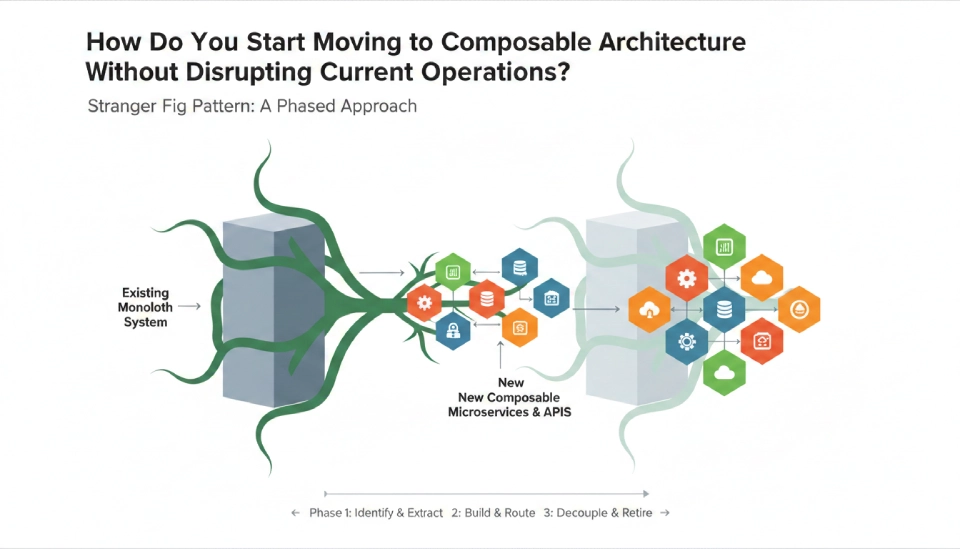
How Do You Start Moving to Composable Architecture Without Disrupting Current Operations?
The answer is to start from the edges, not the core. Start replacing one component at a time, starting from that part of your stack that is causing you the most friction for your marketing team right now.
The benefits of a phased approach:
- Begin with your frontend/content layer, where you can minimize operational risk
- Leave your core systems running until you know this new layer is successful
- Leverage your existing API infrastructure to tie this new component in
- Measure your deployment speed and campaign cycle times before and after
Alokai’s composable commerce research This is confirmed by the above statement, which suggests that by starting with a particular business area while maintaining the core business, teams learn and build confidence before moving further.
The biggest mistake that the enterprise makes is that it tries to migrate the business completely. This composable model has been designed for incremental adoption.
What Are the Real Challenges of Adopting Composable Architecture?
Composable architecture introduces new complexity in vendor management, API governance, and team skills. It is faster to change once built, but it takes planning to build well.
Common challenges to plan for:
- Dealing with multiple vendors as opposed to one platform partner
- Maintaining the stability of the APIs between the various components as the individual tools change
- Developing the skills required to manage the distributed system
- The gaps in the governance process in a relatively new stack where standardization is not as high as it could be
The MACH Alliance 2025 research states: “The top challenges facing organisations in the next 12-18 months are migration: the process of moving applications to a MACH architecture from a non-MACH architecture is difficult and time-consuming if not managed correctly.”
The challenges are not insurmountable, however. The companies that succeed in overcoming the challenges are the ones that approach the process as a business change rather than a technical one.
Key Takeaways
- Composed architecture allows for the development of flexible technology infrastructures composed of loosely coupled elements that communicate with one another through APIs, replacing the rigid “all-in-one” technology platforms that dominated the past decade or so.
- Early adopters of composed architecture roll out new features 80% faster than organisations running on rigid technology infrastructures.
- By 2026, 70% of organisations will be using composed technology infrastructures, according to Gartner.
- The most immediate beneficiaries of composed architecture will be the marketing function, where the ability to roll out new campaigns more quickly, offer more flexibility in personalisation, and avoid vendor lock-in will be highly valued.
- The best way to get started with composed architecture is by the “edge-first” approach, where a single high-friction component is replaced without affecting the underlying infrastructure.
- The most common barriers to adopting composed architecture are vendor-related, API-related, and people-related, not technology-related.