

AI Transformation vs Digital Transformation: What Every Business Leader Needs to Know
AI transformation vs digital transformation is one of the most misunderstood distinctions in enterprise strategy today. Leaders are using these terms interchangeably, and that confusion is quietly leading organizations to make the wrong investment at the wrong time, with the wrong expectations attached.
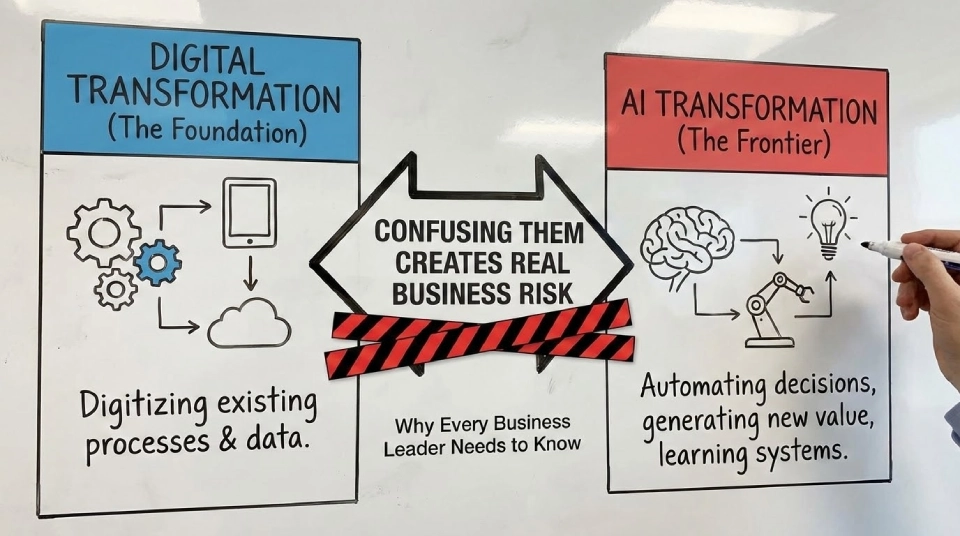
Why Confusing AI Transformation vs Digital Transformation Creates Real Business Risk
Most executives know they need both, but treating AI transformation and digital transformation as the same initiative leads to misaligned priorities, wasted investment, and AI deployments that fail because the foundation was never built.
73% of companies have already adopted AI or are actively planning to, according to Glide’s State of AI in Operations 2025 report. Yet only 34% are using AI to truly reimagine their businesses, according to Deloitte’s 2026 enterprise AI study. The majority are still optimizing what already exists.
That gap between AI adoption and AI transformation is where confusion does the most damage.
What Digital Transformation Actually Means for a Business
Digital transformation is the process of redesigning how an organization operates by replacing manual, disconnected, or legacy systems with modern digital technology.
The goal is operational efficiency, business agility, and better customer experiences. It includes moving infrastructure to the cloud, modernizing ERP and CRM platforms, connecting siloed systems, and digitizing paper-based processes.
Key outcomes of digital transformation include:
- Faster workflows with fewer manual handoffs
- Real-time data visibility across departments
- Scalable operations that grow without adding proportional headcount
- Lower maintenance costs from retiring legacy systems
Digital transformation is primarily about making existing operations work better. It automates repetitive tasks and connects systems that were previously disconnected.
What AI Transformation Means and How It Differs
AI transformation goes beyond digitizing processes. It embeds intelligence into operations so systems can predict, decide, and adapt, not just execute.
Where digital transformation automates, AI transformation augments. The difference is the difference between a system that processes an order faster and a system that recommends the next best action before the order is even placed.
AI transformation requires organizations to move from:
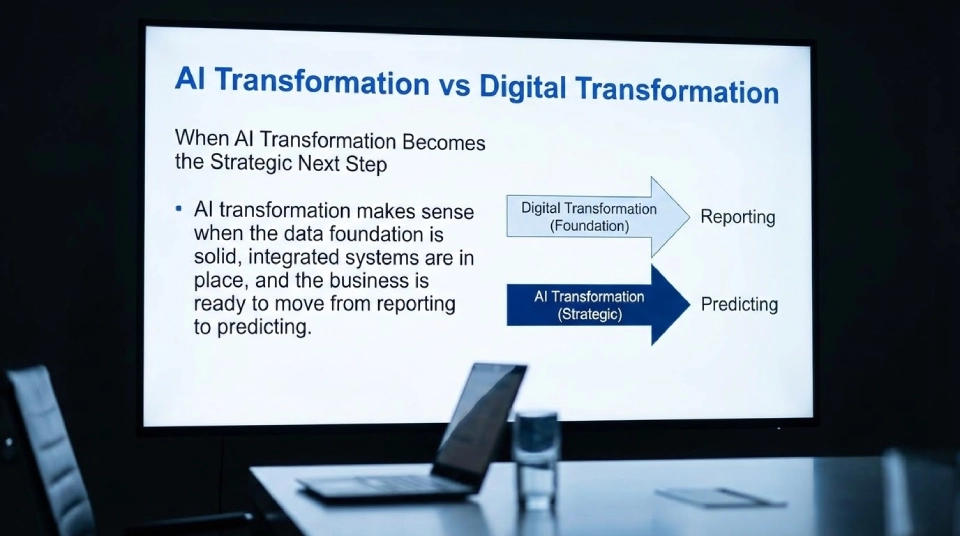
- Reporting what happened to predicting what will happen next
- Rule-based automation to judgment-based decision support
- Structured workflows to adaptive, learning systems
52% of companies that have integrated AI into their operations report a transformational impact, compared to just 28% who expected that outcome before implementation, according to Glide. The impact exceeds expectations precisely because AI does not just improve existing processes. It creates entirely new capabilities.
Efficiency vs Intelligence: The Core Objective Difference
Digital transformation delivers operational excellence. AI transformation delivers smarter outcomes. Both matter, but they solve different business problems.
Think of it this way: digital transformation ensures your business runs correctly. AI transformation ensures your business thinks and responds more effectively.
The two objectives overlap in the middle. A well-executed digital transformation builds the integrated, clean data environment that AI needs to function reliably. But the end goals diverge. Efficiency is a baseline. Intelligence is a competitive advantage.
Organizations that try to jump straight to intelligence without building operational efficiency first consistently struggle. 74% of companies struggle to scale AI value despite widespread adoption, with 95% of IT leaders citing integration issues as a core barrier, according to Integrate.io’s 2026 enterprise transformation research.
Data: The Bridge Between Both Transformations
Clean, integrated, trusted data is the prerequisite for AI transformation, and digital transformation is what builds it.
This is the most practical reason why the sequence between the two matters. AI systems are only as reliable as the data feeding them. Organizations with fragmented systems, inconsistent data formats, and no unified view of operations cannot build AI that performs reliably under real business conditions.
83% of business leaders say stronger data systems would accelerate AI adoption and support scalable business models, according to EY’s 2024 research. Digital transformation builds that data backbone: cloud platforms, integrated APIs, centralized data repositories, and consistent data standards across business units.
Strong Digital Transformation programs that prioritize data infrastructure are what make AI transformation viable, not optional.
Investment and ROI: What Each Approach Delivers
Digital transformation ROI comes from cost reduction, process efficiency, and operational risk reduction. AI transformation ROI comes from competitive advantage, revenue growth, and faster decision-making.
These are different financial stories that require different conversations with leadership.
Digital transformation investments pay off through:
- Reduced IT maintenance costs from retiring legacy systems
- Lower error rates and rework from automated workflows
- Faster delivery cycles and time to market
- Improved compliance through better data control
AI transformation investments pay off through:
- Revenue growth from personalization and predictive capabilities
- Better decisions made faster with less reliance on manual analysis
- New products and services that were not possible without intelligence
- Long-term competitive differentiation
Deloitte’s 2026 enterprise AI report notes that 74% of organizations hope to grow revenue through AI initiatives in the future, but only 20% are already doing so. The revenue case for AI is real but takes longer to materialize than efficiency gains, making sequencing and patience both essential.
When to Prioritize Digital Transformation First
Organizations should prioritize digital transformation when legacy systems dominate, data is fragmented, or teams lack basic operational visibility.
If your teams are still reconciling data across spreadsheets, managing multiple disconnected systems that do not talk to each other, or struggling to get accurate reporting without manual effort, then AI will not solve these problems. It will inherit them.
Signs that digital transformation should come first:
- Core business processes depend on systems more than five years old with no integration layer
- Finance, operations, and sales teams work from different data sources and reach different conclusions
- Forecasting and reporting require significant manual effort to produce
- Leadership cannot get a unified view of business performance without compiling it manually
When AI Transformation Becomes the Strategic Next Step
AI transformation makes sense when the data foundation is solid, integrated systems are in place, and the business is ready to move from reporting to predicting.
This is where organizations begin to compete on insight rather than just execution. The conditions for AI transformation readiness include:
- A centralized or well-integrated data platform with trusted, clean data
- Cloud infrastructure that can support AI workload requirements
- A culture comfortable with data-driven decisions at operational levels
- Clear business use cases where prediction or personalization creates measurable value
Companies that begin AI initiatives in this state succeed far more often. MIT’s GenAI Divide report found that specialized vendor partnerships succeed 67% of the time at enterprise scale, while internal builds with fragmented foundations succeed only a third as often.
How Digital and AI Transformation Work Together
Digital transformation is the structural backbone. AI transformation is the intelligence layer built on top of it. Together they create an enterprise that operates efficiently and thinks strategically.
The mistake most enterprises make is treating these as parallel programs with separate budgets, separate teams, and separate roadmaps. That separation creates duplication, confusion about priorities, and AI projects that stall because the data or integration work they depend on was never completed.
A unified approach looks like this:
- Digital transformation establishes cloud infrastructure, integrated systems, and data standards
- AI initiatives are sequenced to launch as each data domain becomes reliable enough to support them
- Both programs share KPIs tied to business outcomes, not just technology milestones
- The same executive sponsors own accountability for both programs
McKinsey notes that transformations succeed when they start with the business problem, not the technology, and that principle applies equally to both types of transformation.
Common Missteps When Organizations Jump Straight to AI
Three patterns consistently derail enterprise AI initiatives that skip the digital transformation foundation.
Deploying AI on fragmented systems: When AI tools connect to inconsistent, incomplete, or untrustworthy data, output quality suffers immediately. Teams lose confidence in the system, adoption stalls, and leadership questions the investment.
Expecting AI to fix poor process design: AI amplifies what already exists. A broken process powered by AI becomes a faster broken process. Process redesign must happen before or alongside AI deployment.
Underestimating governance and trust requirements: AI systems that make or influence decisions need clear accountability, audit trails, and human oversight frameworks. Only one in five companies has mature governance for autonomous AI agents, according to Deloitte’s 2026 report. That gap creates risk that compounds as AI usage scales.
Building a Unified Transformation Roadmap
The most effective approach assesses current maturity across systems and data, then designs a phased roadmap that connects digital and AI initiatives into a single, measurable program.
Organizations that separate these programs consistently take longer to see results. Those that align them around shared business outcomes move faster and waste less.
The path forward includes:
- Assessing where systems are integrated and where they are still siloed
- Identifying the data domains that are clean enough for AI today and the ones that need digital work first
- Designing AI use cases in order of data readiness and business impact
- Establishing governance structures that cover both programs from the start
The intelligent enterprise is the outcome of both transformations working in sequence and in alignment. Neither program alone delivers it.
Contact Webvillee to explore how a structured approach to digital and AI transformation can be designed around your organization’s current maturity and business priorities.