

How Webvillee’s Skills Transfer Program Builds Your Internal Team During Implementation
A skills transfer program with the IT implementation partner is a structured approach where the implementation partner actually trains your team while building the solution, not after the solution is built and deployed. In most IT projects, the solution is built and deployed, and then the IT partner leaves. Webvillee’s approach is different in the sense that your team is trained and has the working knowledge of the solution built in each phase of the project. So, when the project is over, your team has the working knowledge of the solution. McKinsey research has shown that 70% of digital transformation initiatives don’t meet their goals. One of the major reasons cited is the lack of training. However, the solution is not more documentation. It is actually training your team while building the solution.
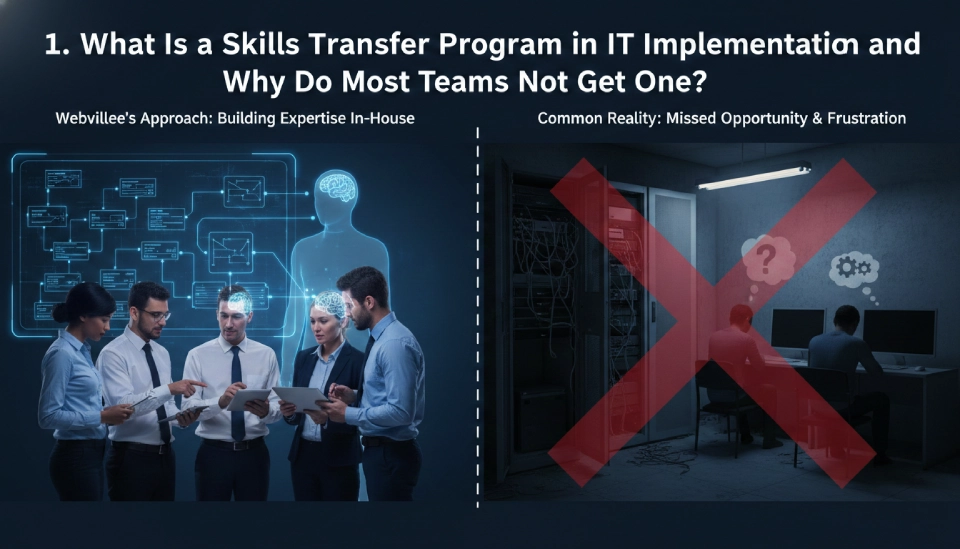
1. What Is a Skills Transfer Program in IT Implementation and Why Do Most Teams Not Get One?
A skills transfer program integrates knowledge sharing into all steps of the implementation process, so your internal team can use, run, and expand the solution on their own at the end of the project.
Training is typically not a key part of any IT implementation project. You have a demo, you have a user manual sent over, and then the vendor leaves. You’re left with a team that can use the solution but doesn’t understand the solution well enough to fix it, change it, or expand it without having to call the vendor back.
This creates a dependency that costs money and hurts the organization every time something needs to be changed.
The core problem is that:
- 45% of employees report that new software is implemented without adequate training, as research has found and as is highlighted in the digital transformation article by MeltingSpot
- Employees will stop using new technology if they do not understand its relevance or receive hands-on support, as is found by 63% of them
- 70% of all software implementations fail not because of technological issues, but because of user adoption issues
Webvillee has integrated skills transfer from day one in the project plan. It is not something tacked on at the end. It is something threaded through every sprint, milestone, and decision point.
2. How Does a Skills Transfer Program Reduce Long-Term Vendor Dependency?
If your team understands how it was built and why decisions were made, they can support and enhance it without going back to the original vendor each time something needs to be changed.
Vendor dependency is one of the least understood costs of IT implementation. It is not listed on your invoice for the project. It grows over time in support agreements, change requests, and internal delays waiting for another team to take action.
The World Economic Forum’s Future of Jobs Report 2025 projects that 39% of existing skill sets will be disrupted or become obsolete between 2025 and 2030. For the IT teams, it means that the systems that are created today need to have internal champions that understand the system well enough to continue to enhance it.
Webvillee’s skills transfer program tackles the issue of skills transfer directly by:
- Providing a dedicated internal team member as a ‘shadow’ on every workstream
- Documenting decisions in plain language as they are made, not at the end of the project
- Conducting working sessions where the Webvillee team talks through the decisions behind the architecture, not just the outcomes
- Conducting a review of the capabilities at every milestone to ensure that knowledge transfer has happened, not just delivery:
The end result is that the internal team is ready to manage the system on day one after go-live, not needing six months of hand-holding after the project to reach operational confidence.
3. What Does Webvillee’s Skills Transfer Program Actually Look Like in Practice?
Knowledge transfer in Webvillee follows a parallel workstream to project delivery, with knowledge transfer outputs at every phase in the form of checkpoints, shadow pairing, and documentation, rather than a single session at the end of the project.
There are four consistent layers in the Webvillee program, regardless of the project implementation type:
Layer 1: Shadow Pairing Each Webvillee engineer or specialist has a nominated person in the internal team with whom they will be paired. This person in the internal team is not a passive observer. They are a participant in the project, making decisions, writing code where necessary, and understanding the rationale behind every build decision.
Layer 2: Documented Decision Logs All architectural and technical decisions are documented in plain language at the point of the actual decision. This is not a technical specification produced at the end of the project. It is a live document that provides a description of what was built, the reason it was built in that way, and the alternatives that were considered.
Layer 3: Skills Checkpoints At each project milestone, Webvillee conducts a structured assessment of what the internal team now knows and can do on their own. Gaps are then closed in the next sprint, not at project close.
Layer 4: Capability Handover Assessment At project close, the internal team undertakes a structured capability assessment. If gaps are identified, Webvillee closes them before the project closes.
This is not a training program that is bolted on to a delivery project. This is delivery and capability building in parallel.
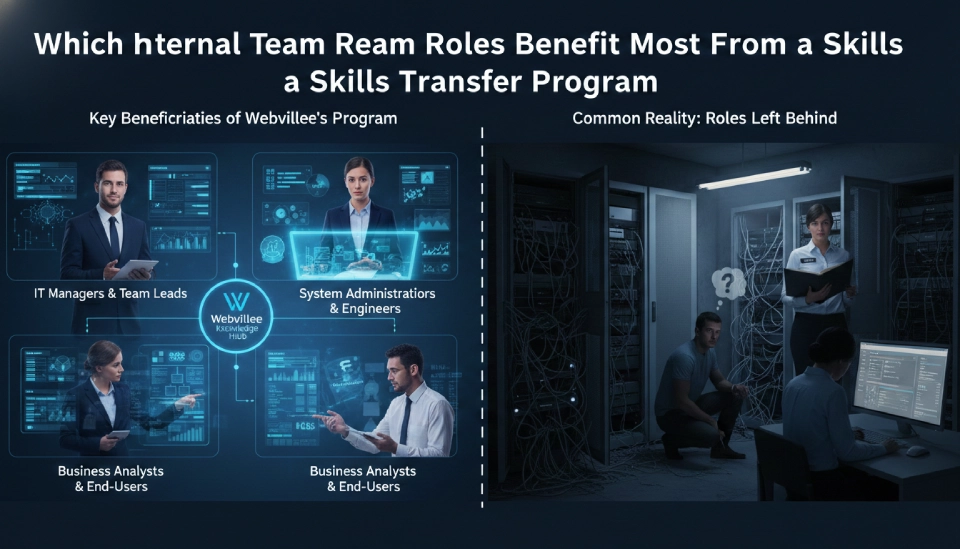
4. Which Internal Team Roles Benefit Most From a Skills Transfer Program?
The roles that benefit the most are the ones who own the system post-go-live, i.e., the IT lead, in-house developers, system administrators, and the technical project manager who will handle change requests.
The mistake made here is to focus all knowledge transfer on the end users. While the end users do need to know how to use the system, the folks who really need to know how to use the system are the ones who own the system post-go-live and are tasked with maintaining, enhancing, and debugging the system when something goes wrong.
Webvillee’s skills transfer program focuses specifically on:
- Internal IT leads and system owners: Familiar with the system’s architecture, integration points, and infrastructure decisions
- In-house developers: Able to modify, extend, and maintain the codebase without having to re-write the code
- Technical project managers: Familiar with the system so that they can accurately scope the changes before they go external
- DevOps and operations team members: Familiar with the system’s deployment and rollback procedures in case something goes wrong
Gartner’s research on workforce upskilling finds that 58% of the workforce will require new skills to effectively perform their jobs due to technology changes. For IT teams in the middle of a project, the best and quickest way to bridge that gap is through embedded training, not traditional classroom training after the project is completed.
5. How Does a Skills Transfer Program Affect IT Implementation Timelines and Costs?
In a well-run skills transfer program, implementation timelines are not extended. Instead, post-launch support costs are minimized by developing internal skills that negate the requirement for continued vendor engagement in operations.
The biggest concern that IT leaders seem to harbor is that a training workstream, in addition to all the other implementation activities, will delay the implementation. Experience, however, has shown that this is not necessarily the case.
When the internal team understands what is being built, they:
-
- Identify problems early on, owing to their knowledge of system architecture
- Make better decisions regarding changes in scope, owing to their knowledge of technical issues
- Minimize rework due to poor communication between vendor and internal stakeholders
- Do not require significant post-launch support, owing to their ability to resolve issues independently
Research from the World Economic Forum and confirms that organisations that focus on internal capability development are more agile and able to react to technology change. For CTO and IT lead roles responsible for managing budgets for implementation, the investment in a skills transfer program is quickly returned through reduced vendor costs post-go-live and a more rapid route to independence.
Webvillee defines the skills transfer workstream as a distinct element of each project, with its own set of milestones and deliverables, ensuring that its cost and time are not hidden in a support contract at the end of a project.
6. How Do You Measure Whether Skills Transfer Has Actually Happened?
Skills transfer is measured by checking if the internal team can actually perform the operations on their own and not by checking if they have attended the sessions and been provided with the documents.
While attendance and documents are the inputs, the output is the capability. They are two different things, and the mistake of equating the two is the reason most organisations end up with a trained team but still unable to run the system themselves.
Webvillee has three measures in place to ensure that true knowledge transfer has taken place:
- Task-based assessments: Does the internal team have the capability to run the 10 most common operational and maintenance tasks without any support?
- Scenario testing: Does the internal team have the capability to identify and resolve the three most likely failure points without having to involve Webvillee?
- Change request scoping: Does the internal IT lead have the capability to accurately scope and document a new change request without any support from the original implementation team?
If any of the above fails in the assessment phase, the engagement does not end until they are fixed.
The World Economic Forum’s Future of Jobs Report notes that half of all employees have now completed some form of upskilling, up from 41% in 2023. The organisations driving that number are the ones embedding learning into active work, not scheduling it as a standalone event.
Key Takeaways
- A skills transfer program runs alongside implementation, not after it. Knowledge handed over at go-live is too late to prevent vendor dependency.
- 70% of software implementations fail due to poor user adoption, and 45% of employees say new software is introduced without adequate training. Skills transfer directly addresses both.
- Webvillee’s program operates across four layers: shadow pairing, decision logging, milestone checkpoints, and a capability handover assessment.
- The roles that need deep capability are not end users. They are IT leads, in-house developers, system administrators, and technical project managers.
- Skills transfer does not slow implementation. It reduces post-launch support costs and removes the need for ongoing vendor involvement in routine operations.
- Genuine transfer is measured by task-based assessments and scenario testing, not by session attendance or documentation delivery.
- Reskilling internally saves organisations 70% to 92% compared to the cost of external hiring for the same capability, according to research cited by Corporate Navigators.