

GenAI Pilot to Production: A Practical Enterprise Launch Checklist
Moving GenAI pilot to production is where most enterprise AI investments go quiet. According to MIT’s GenAI Divide: State of AI in Business 2025, 95% of enterprise generative AI pilots deliver zero measurable return on investment despite billions in global spending. The problem is rarely the technology. It is almost always the gap between a working demo and a production-ready system.
Why GenAI Pilot to Production Fails Before It Starts
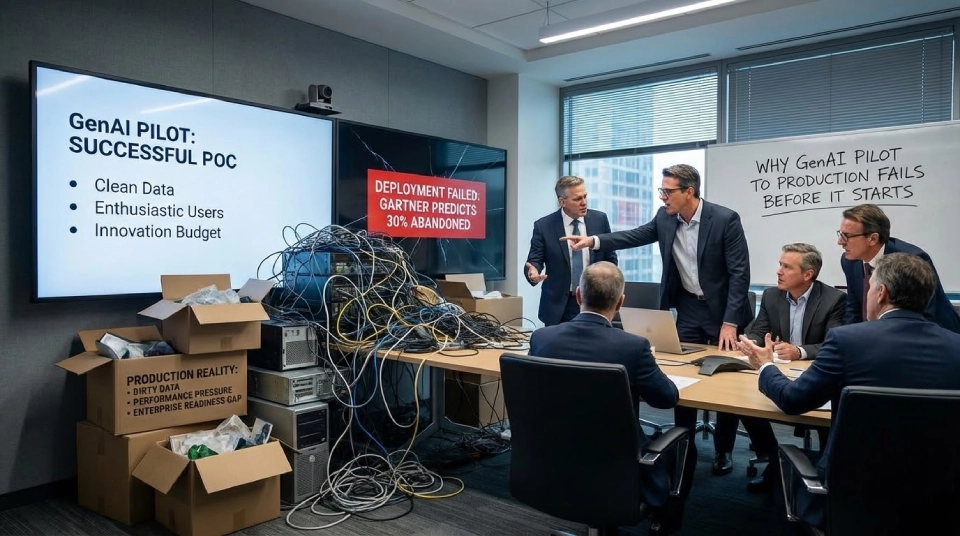
Most GenAI pilots fail to reach production because organizations confuse a successful proof of concept with enterprise readiness, and these are two very different things.
A pilot runs on clean, controlled data with a small group of enthusiastic users and an innovation budget with no performance pressure. Production is the opposite of all three.
Gartner predicts 30% of GenAI projects will be abandoned entirely after the proof of concept phase. The jump from demo environment to real-world deployment exposes gaps that no amount of prompt engineering can close.
What Actually Changes at Production Scale
Three things shift fundamentally when you move beyond the pilot:
- Data goes from curated test sets to messy, inconsistent, real enterprise data
- Users expand from a handful of volunteers to an organization-wide audience with varying skill levels and expectations
- Budget accountability moves from innovation spending to operational cost justification with clear ROI requirements
Large enterprises take an average of nine months to scale an AI initiative, compared to just 90 days for mid-market firms. That timeline gap is not a technology problem. It is a governance and readiness problem.
Build the Business Case Before You Scale Anything
Scaling a GenAI initiative without a clear business case is the fastest path to wasted spend and executive frustration.
MIT’s research found that more than half of enterprise AI budgets flow into sales and marketing pilots, while the highest ROI consistently appears in back-office operations including document processing, compliance workflows, and internal automation.
Before moving forward, your business case should answer three questions:
- What specific business metric will this improve, and by how much?
- How does this connect to cost reduction, revenue growth, or risk reduction?
- Who owns the outcome at the executive level, and is funding secured beyond the pilot phase?
If any of these questions lack a clear answer, the production launch will stall.
Data, Governance, and Security Readiness
GenAI systems are only as reliable as the data feeding them, and 64% of organizations cite data quality as their top AI implementation challenge.
Before scaling, your organization needs honest answers to the following:
- Is your data clean, consistent, and accessible across relevant systems?
- Are there sensitive records, personally identifiable information, or regulated data in scope?
- Do you have documented data lineage so teams can trace what information influenced any AI output?
- Are access controls in place to prevent unauthorized data exposure through AI queries?
77% of businesses express concern about AI hallucinations, and 47% of enterprise AI users reported making a major business decision based on inaccurate AI output in 2024. Data governance is what prevents these outcomes at scale.
Architecture, Integration, and Security Controls
Embedding GenAI into enterprise systems requires more than a working API connection. It requires architecture decisions that hold up under real demand.
When planning your production architecture, three areas need deliberate attention:
Integration depth: GenAI tools that do not connect deeply to your actual workflows produce generic outputs. Specialized vendor solutions succeed 67% of the time at scale, compared to a 33% success rate for internal builds, largely because integration quality drives adoption.
Security and misuse controls: Role-based access permissions, prompt injection safeguards, and incident response plans for AI-related failures are not optional additions. They are production requirements. Define who can access what, and what happens when something goes wrong.
Scalability and monitoring: Build in performance monitoring from day one. Tracking response quality, usage patterns, and system load prevents the slow degradation that often goes unnoticed until business impact becomes visible.
Strong Product Engineering practices applied to GenAI deployments ensure your architecture is built for long-term reliability, not just initial launch performance.
Human Oversight and User Adoption
76% of enterprises now include human-in-the-loop processes specifically to catch AI errors before they reach business decisions, making human oversight a non-negotiable part of any production deployment.
Define clearly, before launch:
- Which outputs require mandatory human review before action is taken
- What the escalation path looks like when high-risk outputs need expert judgment
- How automation and human accountability are balanced across different use cases
Adoption requires the same attention as architecture. Organizations that invest 70% of AI resources in people and processes consistently outperform those focused only on technology.
Address the three things that slow user adoption:
- Skills gaps: Train users on what the system can do, what it cannot do, and how to interpret its outputs
- Resistance: Communicate the business reason for the change, not just the feature list
- Unrealistic expectations: Set honest benchmarks so early users are not disappointed by limitations that the team already knows exist
Build feedback loops where users report confusion, errors, or missed expectations. These loops improve the system faster than any technical optimization.
Performance Monitoring, Cost Management, and Compliance
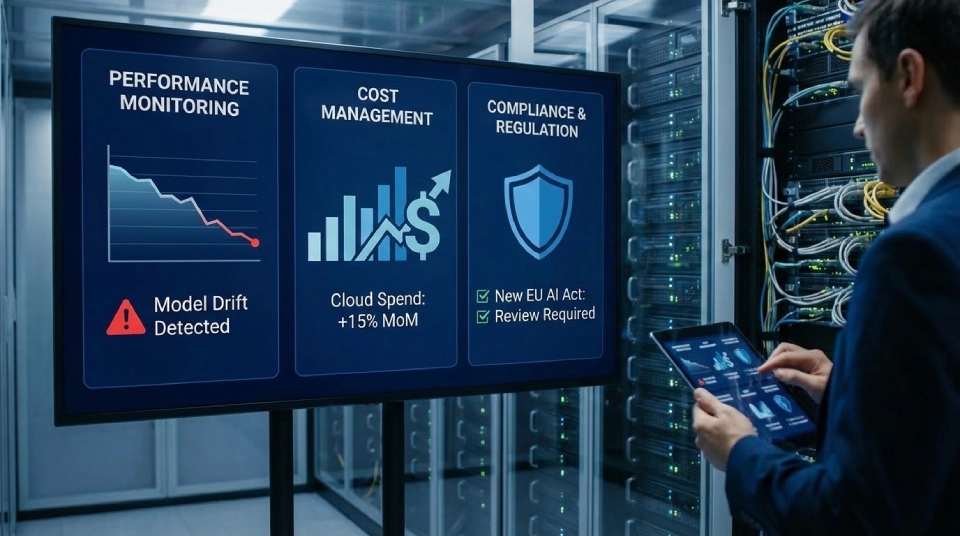
Production GenAI systems need continuous monitoring because model performance degrades over time, costs can accelerate unexpectedly, and regulations continue to evolve.
On performance: track accuracy, usage volume, and business impact metrics from launch. Establish a regular cadence for reviewing whether the system is delivering the outcomes the business case promised. Adjust when it is not.
On cost: GenAI operates on consumption-based pricing. Without visibility into API calls, compute usage, and user activity, costs can scale faster than value. Define spending thresholds, set alerts, and build forecasting into your operational model before costs become a leadership concern.
On compliance: map your GenAI use cases to relevant industry regulations from the start. Document decision trails so audits are manageable. The regulatory environment around AI governance is developing quickly, and organizations with clean documentation are far better positioned to adapt than those scrambling to reconstruct records.
The Enterprise GenAI Production Checklist
Before any production launch, confirm the following:
Business alignment:
- Measurable outcomes defined and agreed upon
- Executive sponsor identified with long-term funding secured
- Use case tied to a specific operational, revenue, or risk metric
Data and governance readiness:
- Data quality assessed and remediated where needed
- Sensitive information identified and controlled
- Data lineage and traceability documented
Technical architecture:
- Integration tested under realistic load conditions
- Scalability and failover plans validated
- Performance monitoring tools active before go-live
Security and compliance:
- Access controls and role-based permissions confirmed
- Prompt injection and misuse safeguards implemented
- Incident response plan documented and tested
Operations and monitoring:
- Baseline metrics established for ongoing comparison
- Cost tracking and spend alerts configured
- Optimization review cycle scheduled
User enablement:
- Training completed covering both capabilities and limitations
- Feedback channels open before launch, not after
- Communication plan delivered to all affected teams
Common Pitfalls That Derail Enterprise GenAI Launches
The three patterns most responsible for failed production launches:
Scaling too fast without governance: Moving quickly without access controls, data standards, or accountability structures creates compliance exposure and erodes trust across the organization faster than the technology can deliver value.
Underestimating integration complexity: The last mile between a GenAI system and your actual enterprise workflows is almost always more complex than the pilot suggested. Teams that budget time and resources for integration work hit production. Teams that assume it is simple do not.
Treating GenAI as a standalone tool: 42% of companies abandoned most AI initiatives in 2025, up from 17% the year before. Many of those abandonments trace back to deploying AI as an isolated add-on rather than embedding it as a component of a broader operational system.
What Sustainable GenAI Success Looks Like in Production
Sustainable production success means stable performance under real enterprise demand, clear accountability across teams, and demonstrable business value that leadership can report with confidence.
The 5% of organizations that cross from pilot to production impact share common patterns. They focus on one high-value use case rather than spreading across dozens. They empower business unit leaders to drive adoption, not just central IT teams. They commit to adaptive systems that evolve with feedback rather than static tools deployed and forgotten.
Transformation through AI is not a single deployment decision. It is an ongoing capability built through deliberate architecture, strong governance, and relentless focus on the business outcomes that justified the investment in the first place.
Contact Webvillee to explore how a structured approach to GenAI deployment can take your initiative from proof of concept to production results that appear on your P&L.