

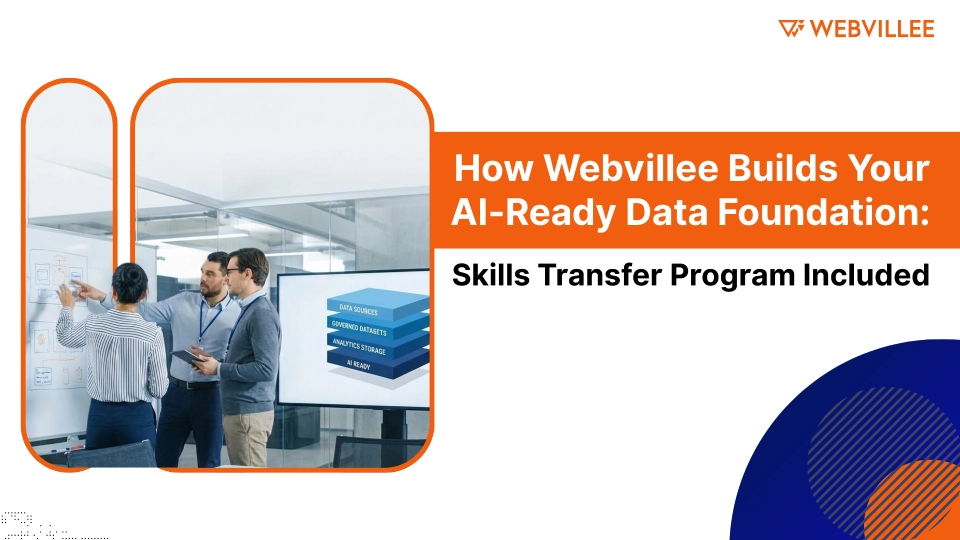
How Webvillee Builds Your AI Ready Data Foundation: Skills Transfer Program Included
AI ready data foundation success depends on more than technology implementation. Webvillee builds trusted data architectures while transferring skills to your teams, turning external expertise into lasting internal capability that sustains AI initiatives beyond initial deployment.
Why Most AI Initiatives Fail Before the AI Ready Data Foundation Is Built
Most AI initiatives fail because organizations focus on models and tools while ignoring the hidden dependency every AI strategy has on data readiness that determines whether intelligent systems deliver value or waste investment.
Research shows that only 26% of chief data officers worldwide feel confident their data can support new AI enabled revenue streams. This confidence gap reveals a fundamental truth about AI adoption.
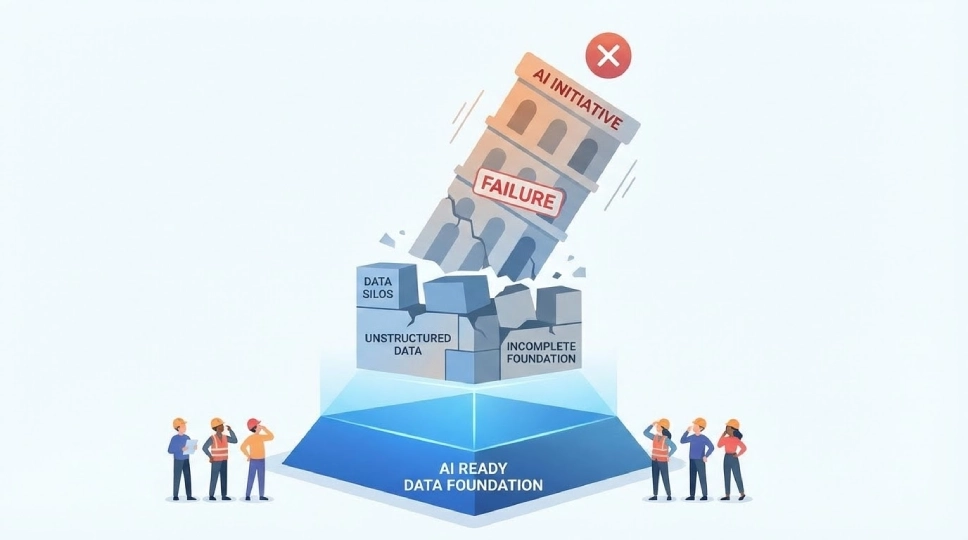
Why Tools and Models Cannot Compensate for Weak Data Foundations
Gartner predicts that 30% of generative AI projects will be abandoned by 2025 due to poor data quality, inadequate risk controls, or unclear business value. Advanced models cannot overcome data that is fragmented, inconsistent, or ungoverned.
Organizations invest heavily in sophisticated AI tools. But when data pipelines were optimized for dashboards rather than machine learning, even the most powerful models fail to deliver meaningful business outcomes.
How AI Success Starts Long Before Experimentation Begins
Fewer than one in five organizations report high maturity in any aspect of data readiness. Most struggle with integration, quality, and governance challenges that must be solved before AI experimentation produces value.
Business leaders cite data quality and availability as major challenges to accelerating AI adoption. When asked about fastest growing investment areas, 72% prioritize data foundations and pipelines over model development.
What an AI Ready Data Foundation Really Means
An AI ready data foundation moves beyond data availability to data usability through structure, trust, and access that enables AI systems to consume, learn from, and act on information at enterprise scale.
Data availability means information exists somewhere in your systems. Data usability means AI models can find it, understand it, trust it, and use it to make decisions that drive business outcomes.
The Difference Between Storing Data and Operationalizing It
Stored data sits in databases, data lakes, and applications across your enterprise. Operationalized data flows seamlessly to decision points where humans and AI systems need it.
Key differences include:
- Stored data has inconsistent definitions across systems
- Operationalized data uses standardized definitions everyone trusts
- Stored data requires manual extraction and transformation
- Operationalized data flows automatically through governed pipelines
- Stored data quality is unknown until problems surface
- Operationalized data has verified quality and documented lineage
Why AI Readiness Is About Structure, Trust, and Access
Structure means data is organized so AI models can process it efficiently. Trust means confidence in data accuracy, completeness, and governance. Access means the right people and systems can reach needed information without barriers.
Research reveals that less than 15% of enterprise data is AI ready, meaning it is accessible, labeled, and structured for decision making. The remaining 85% exists but cannot power intelligent systems without significant preparation.
The Common Data Challenges Blocking AI Adoption in Enterprises
Enterprise AI adoption faces data challenges from fragmented information across systems and teams, inconsistent definitions and formats without clear ownership, plus low confidence in data quality and reliability.
Fragmented data creates silos where critical datasets remain trapped in CRMs, ERPs, SaaS tools, and departmental systems that do not communicate.
Inconsistent Definitions, Formats, and Ownership
Different teams define the same business concepts differently. Customer information appears in multiple formats. Nobody owns data quality or governance responsibilities clearly.
According to McKinsey, 70% of organizations adopting generative AI experience difficulties with data governance, integrating data into AI models, and insufficient training data quality.
Low Confidence in Data Quality and Reliability
When teams lack confidence in data accuracy, they waste time validating information instead of using it. AI models trained on unreliable data produce unreliable predictions that undermine trust in intelligent systems.
This lack of confidence creates hesitation that slows AI adoption even when technology capabilities exist.
Webvillee’s Approach to Building an AI Ready Data Foundation
Webvillee builds AI ready data foundations by starting with business outcomes rather than technology stacks, aligning data architecture with real AI use cases, then designing foundations that scale as AI maturity grows.
Starting with business outcomes means understanding which decisions AI will support before designing data structures. This approach ensures foundations serve actual needs instead of theoretical possibilities.
Aligning Data Architecture with Real AI Use Cases
Organizations identify high value AI opportunities first. Digital Transformation initiatives succeed when data architecture maps directly to decision making requirements rather than generic best practices.
Real use cases reveal which data sources matter, what quality standards apply, and how information needs to flow across systems and teams.
Designing Foundations That Scale as AI Maturity Grows
Initial foundations support first AI applications while accommodating future expansion. Scalable design balances immediate needs with long term flexibility.
This prevents organizations from rebuilding foundations repeatedly as AI capabilities mature across the enterprise.
Step One: Assessing Data Readiness and Business Priorities
Assessment starts by identifying high value AI opportunities first, mapping existing data sources to decision making needs, then uncovering gaps in quality, governance, and accessibility that block progress.
High value opportunities deliver measurable business impact through efficiency gains, cost reduction, revenue growth, or risk mitigation.
Mapping Existing Data Sources to Decision Making Needs
Mapping reveals which data exists, where it lives, who owns it, how current it is, and whether quality meets AI requirements. This inventory shows readiness gaps clearly.
Typical discoveries include valuable data trapped in legacy systems, inconsistent definitions across departments, and missing governance frameworks.
Uncovering Gaps in Quality, Governance, and Accessibility
Quality gaps include missing values, inaccurate records, duplicate entries, and outdated information. Governance gaps mean unclear ownership, inconsistent standards, and missing compliance controls.
Accessibility gaps prevent teams from reaching data they need when they need it, even when information exists somewhere in the enterprise.
Step Two: Designing a Scalable Data Architecture for AI
Scalable architecture creates unified data layers across systems while balancing centralization with flexibility, ensuring performance, security, and future expansion capabilities.
Unified data layers connect information from CRMs, ERPs, data warehouses, and specialized systems into coherent structures that AI models can access efficiently.
Balancing Centralization with Flexibility
Complete centralization creates bottlenecks that slow business teams. Complete decentralization creates chaos that AI cannot navigate.
Balanced approaches provide centralized governance with distributed access, allowing teams to work efficiently while maintaining consistency.
Ensuring Performance, Security, and Future Expansion
Performance requirements ensure AI systems access data fast enough to support real time decisions. Security controls protect sensitive information while enabling appropriate access.
Future expansion means architectures accommodate new data sources, additional AI use cases, and growing data volumes without complete redesign.
Step Three: Data Quality, Governance, and Trust Enablement
Trust enablement establishes consistent definitions and standards, embeds governance without slowing teams down, then builds confidence in data used for AI decisions through verified quality.
Consistent definitions mean everyone interprets customer, product, transaction, and performance information identically across departments and systems.
Embedding Governance Without Slowing Teams Down
Governance frameworks define data ownership, quality standards, access controls, and compliance requirements. Effective governance protects organizations without creating bureaucratic friction.
Automated governance tools enforce policies consistently while allowing teams to work at business speed.
Building Confidence in Data Used for AI Decisions
Confidence comes from documented lineage showing where data originated, how it transformed, who owns it, and what quality checks applied. This transparency enables trust in AI outputs.
When teams trust data quality, they adopt AI recommendations confidently instead of second guessing intelligent system insights.
Step Four: Preparing Data for AI and Advanced Analytics
Preparation structures data for machine learning and automation, enables real time and batch data pipelines, then ensures traceability and reliability across the lifecycle.
Machine learning requires data in specific formats with proper labeling, appropriate feature engineering, and balanced training sets that represent real world scenarios.
Enabling Real Time and Batch Data Pipelines
Real time pipelines support decisions that require immediate response. Batch pipelines handle large scale processing for analytics and model training.
Modern architectures support both patterns, allowing organizations to choose appropriate approaches for different use cases.
Ensuring Traceability and Reliability Across the Lifecycle
Traceability tracks data from source through transformation to consumption. Reliability means pipelines deliver accurate, complete, and timely information consistently.
Organizations achieve traceability through automated lineage tracking, version control, and comprehensive metadata management.
Why Skills Transfer Is Critical to Long Term AI Success
Skills transfer prevents dependency on external partners by building internal capability that sustains AI readiness, turning data foundations into assets teams can manage and evolve independently.
External partners provide expertise to build initial foundations. Skills transfer ensures organizations maintain, improve, and expand those foundations without ongoing external dependency.
Why AI Readiness Fails Without Internal Capability Building
Research shows that only 28% of employees know how to use their company’s AI applications despite widespread organizational investment. This knowledge gap undermines AI adoption regardless of technology quality.
Organizations that treat data readiness as a one time project discover that foundations degrade over time without internal expertise to maintain them.
Turning Data Foundations Into a Sustainable Asset
Sustainable foundations require teams who understand architecture decisions, governance frameworks, and operational procedures. These teams evolve systems as business needs change.
Internal capability transforms external consulting engagements into lasting competitive advantages rather than temporary improvements.
Inside Webvillee’s Skills Transfer Program
Webvillee’s skills transfer program provides hands on enablement for data and IT teams through knowledge sharing across architecture, governance, and operations that builds confidence to manage and evolve foundations.
Hands on enablement means working alongside Webvillee experts on real systems rather than attending generic training sessions disconnected from actual implementations.
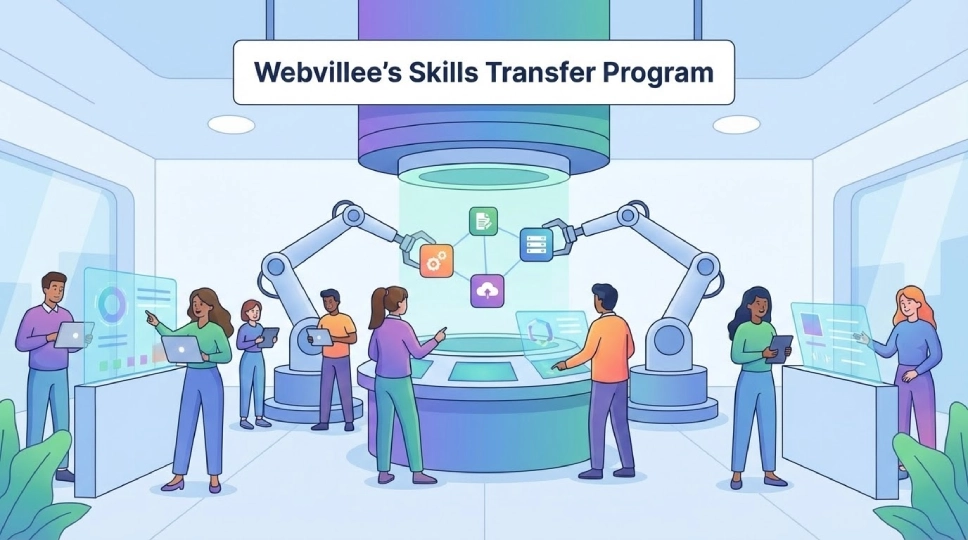
Knowledge Sharing Across Architecture, Governance, and Operations
Architecture knowledge covers design decisions, technology choices, and integration patterns. Governance knowledge addresses policies, standards, and compliance requirements.
Operational knowledge includes:
- Monitoring data quality and pipeline health
- Troubleshooting common issues independently
- Adding new data sources to existing frameworks
- Evolving architectures as requirements change
- Maintaining security and compliance controls
Building Confidence to Manage and Evolve the Data Foundation
Confidence develops through supervised practice where teams handle real scenarios with expert guidance. This approach builds capability faster than theoretical training alone.
Teams gain expertise through progressive responsibility, starting with supervised tasks and advancing to independent management as skills mature.
How Skills Transfer Accelerates AI Adoption Across Teams
Skills transfer accelerates adoption by reducing friction between business and technical users, enabling faster experimentation and iteration, plus creating shared ownership of AI outcomes across departments.
Reduced friction means business teams understand data constraints while technical teams understand business priorities. This mutual understanding speeds decision making.
Enabling Faster Experimentation and Iteration
Teams with strong data skills experiment confidently because they understand what is possible, what requires effort, and what violates governance constraints.
Faster iteration happens when teams can answer their own questions about data availability, quality, and accessibility instead of waiting for central IT responses.
Creating Shared Ownership of AI Outcomes
Shared ownership means business, data, and IT teams collaborate on AI success rather than pointing fingers when initiatives stall. This accountability drives better results.
Organizations with strong internal capabilities report significantly higher AI adoption rates and faster time to value from intelligent systems.
Measuring Success of an AI Ready Data Foundation
Success measurement tracks indicators of data maturity and usability, observes how readiness translates into faster AI initiatives, then monitors business impact beyond technical metrics.
Data maturity indicators include governance coverage, quality scores, lineage completeness, and automated pipeline reliability.
How Readiness Translates Into Faster AI Initiatives
Organizations with strong foundations launch new AI use cases in weeks instead of months. They spend time on model development rather than data preparation.
Faster launches happen because teams access trusted data through established pipelines rather than starting from scratch for each new initiative.
Tracking Business Impact Beyond Technical Metrics
Business impact includes:
- Revenue improvements from better predictions
- Cost reductions through intelligent automation
- Risk mitigation from enhanced compliance
- Customer satisfaction gains from personalization
- Operational efficiency through optimized processes
Technical metrics matter but business outcomes determine whether AI ready data foundations justify their investment.
Common Mistakes Enterprises Make When Building AI Data Foundations
Enterprises make mistakes by overengineering platforms before defining use cases, ignoring change management and skills development, plus treating data readiness as a one time project instead of ongoing practice.
Overengineering creates complex systems that exceed actual requirements. Teams spend months building capabilities nobody uses instead of delivering value quickly.
Ignoring Change Management and Skills Development
Technology implementation alone does not create AI readiness. Teams need skills, processes, and cultural changes to adopt new data capabilities effectively.
Executives estimate about 40% of their workforce needs to reskill over the next three years according to IBM research, yet many organizations focus exclusively on technology.
Treating Data Readiness as a One Time Project
Data readiness requires continuous attention as business needs evolve, data sources change, and AI capabilities mature. One time projects create foundations that decay without ongoing investment.
Sustainable approaches embed data quality, governance, and architecture management into regular operations rather than treating them as special initiatives.
How Organizations Can Get Started With Webvillee
Getting started requires identifying where AI readiness matters most today, building a phased roadmap instead of big bang transformation, then creating momentum through early wins and enablement.
Identifying priority areas means finding high value opportunities where improved data capabilities deliver measurable business impact quickly.
Building a Phased Roadmap Instead of Big Bang Transformation
Phased approaches deliver value incrementally while building internal capability progressively. Organizations learn from early phases to inform later work.
Typical roadmaps include:
- Phase one addresses highest priority use case with foundational architecture
- Phase two expands to additional use cases while strengthening foundations
- Phase three scales across enterprise with mature internal teams leading
Creating Momentum Through Early Wins and Enablement
Early wins prove value, build stakeholder confidence, and fund subsequent phases. Enablement ensures organizations sustain momentum after initial external support ends.
Organizations that achieve early wins while building internal skills report higher overall AI adoption rates and better long term outcomes.
Why an AI Ready Data Foundation Is a Strategic Advantage
AI ready data foundations provide strategic advantage by enabling intelligent decision making beyond reactive analytics, positioning enterprises for future AI capabilities while building AI ready teams that sustain competitive differentiation.
Reactive analytics describes what happened. Intelligent decision making predicts what will happen and prescribes optimal actions automatically.
Positioning the Enterprise for Future AI Capabilities
Foundations built correctly today accommodate tomorrow’s AI innovations without requiring complete redesign. This future readiness protects technology investments.
Organizations with strong foundations adopt new AI capabilities faster than competitors who must rebuild basics for each new opportunity.
Building Not Just AI Systems, But AI Ready Teams
AI ready teams understand data architecture, governance frameworks, and operational practices. These teams drive continuous improvement and innovation.
The combination of strong technical foundations and skilled internal teams creates lasting competitive advantages that technology purchases alone cannot provide.
Key Takeaways for AI Ready Data Foundation Success
AI ready data foundation success requires moving beyond data availability to true data usability through structure, trust, and access that enables AI systems to deliver enterprise value.
Research shows that only 26% of chief data officers feel confident their data supports AI initiatives, while 72% prioritize data foundations as their fastest growing investment area.
Webvillee builds AI ready foundations by starting with business outcomes, aligning architecture with real use cases, then designing systems that scale as AI maturity grows across organizations.
Skills transfer programs prevent external dependency by building internal capability that sustains data readiness, turning consulting engagements into lasting competitive advantages.
Success requires phased roadmaps that deliver early wins, build team confidence, and create momentum rather than big bang transformations that overwhelm organizations.
Contact Webvillee to explore how AI ready data foundation implementation with integrated skills transfer can position your enterprise for intelligent decision making while building internal teams that sustain AI success.