

Cloud Cost Optimization in 30 Days: A Step-by-Step FinOps Playbook
Cloud cost optimization is one of the most urgent priorities for enterprise leaders in 2026, and it is one that most organizations are losing ground on. Global cloud spending is expected to surpass $1 trillion this year, yet industry data consistently shows that 30 to 35% of that spend is wasted on idle resources, oversized instances, and services no one is actively using. The good news is that a structured 30-day sprint can close that gap faster than most teams expect.
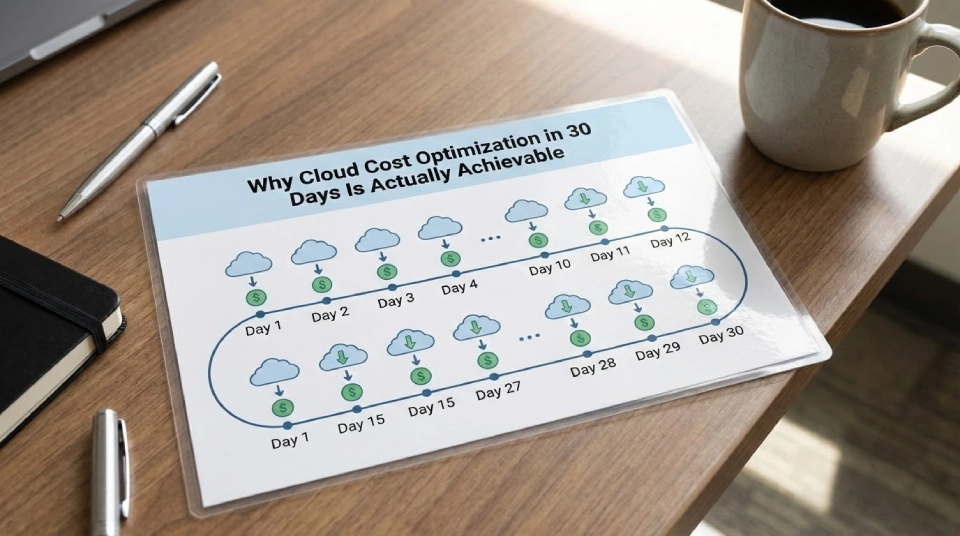
Why Cloud Cost Optimization in 30 Days Is Actually Achievable
Organizations implementing systematic FinOps practices are consistently achieving 30% or greater cloud cost reductions, often within just six weeks of starting according to research compiled across major cloud environments.
The reason 30 days works is not because cloud optimization is simple. It is because waste in most cloud environments is concentrated and visible once you know where to look. The first two weeks of any structured effort almost always surface the same patterns: idle development environments, oversized compute instances, unused storage volumes, and forgotten services still billing every month.
84% of organizations say managing cloud spend is their top cloud challenge according to Flexera’s 2025 State of the Cloud Report. That statistic reflects a visibility problem, not a technology problem.
FinOps reframes this from a technical task to a business discipline. The goal is not to cut costs for its own sake. The goal is to eliminate waste so that every dollar spent on cloud delivers measurable business value.
Before Day 1: Get Your Baseline Right
You cannot optimize what you cannot see, and most enterprises begin without an accurate picture of where their cloud money actually goes.
Before the 30-day sprint begins, three things need to be in place:
- Consolidated spend data across all cloud accounts, environments, and providers in a single view
- A clear map of which business units, products, and teams own which workloads
- Defined success metrics for the sprint: target waste reduction percentage, forecast accuracy improvement, and accountability coverage
44% of organizations still report limited visibility into cloud expenditure despite using cloud-native and third-party tools, according to Crayon via TechRadar. If this describes your organization, establishing that baseline is the highest priority before anything else.
Week 1: Find the Waste and Make It Visible
The first week is about exposing what is costing money without delivering value, and making that information visible to the people who can act on it.
Common waste categories that surface immediately in most environments:
- Idle or orphaned resources that no longer serve an active workload
- Development and testing environments running around the clock when they are only needed during business hours
- Oversized compute instances provisioned for peak loads that never materialize
- Forgotten services and snapshots accumulating storage charges unnoticed
Idle and underutilized resources account for an estimated 28 to 35% of total cloud waste according to multiple FinOps research sources. Eliminating the most obvious waste categories in week one builds momentum and demonstrates early ROI to leadership before the harder optimization work begins.
Build cost allocation reports that show each team, product, and business unit what they are spending. Visibility creates accountability. Teams that cannot see their own costs have no reason to manage them.
Week 2: Fix the High-Impact Workloads
Once waste is visible, week two focuses on optimizing the workloads that drive the largest portion of cloud spend.
Right-sizing is the most impactful action most organizations can take quickly. This means reviewing compute instances against actual utilization data and selecting appropriate sizes. RDS instances can achieve up to 45% cost efficiency through appropriate sizing and feature optimization according to cloud cost management research.
Key actions during week two:
- Review auto-scaling configurations and ensure instances scale down during low-demand periods as effectively as they scale up
- Identify redundant environments that duplicate production systems without clear business justification
- Move infrequently accessed data from high-performance storage tiers to cost-appropriate alternatives
- Decommission services that have not received meaningful traffic within a defined lookback period
The important discipline here is to validate every change with engineering teams before acting. Aggressive right-sizing without performance validation trades a cost problem for a reliability problem.
Week 3: Improve How You Purchase Cloud Capacity
On-demand pricing is the most expensive way to run predictable workloads, and week three is about replacing it with commitment-based purchasing where usage patterns justify it.
Most enterprises have workloads running consistently enough to benefit from reserved instances or savings plans. The challenge is that many teams overpurchase commitments without validating them against actual usage forecasts, creating a different form of waste.
Week three actions:
- Analyze usage patterns over the previous three to six months to identify workloads with consistent demand profiles
- Compare on-demand costs against one-year and three-year commitment pricing to quantify potential savings
- Review any existing commitments to identify underutilized reservations that need adjustment
- Align commitment strategy with finance teams so purchasing decisions reflect accurate business growth forecasts
Automated compute optimization can save enterprises up to 20% annually through real-time right-sizing and commitment management according to cloud cost management research. Week three is where those structural savings get locked in rather than hoped for.
Week 4: Build Governance and Assign Real Accountability
Without governance, every cost saved in weeks one through three will gradually return as new workloads provision without oversight.
Week four shifts from tactical cleanup to structural discipline. The goal is to build the policies and accountability structures that make cloud cost optimization self-sustaining beyond the 30-day sprint.
Governance actions that have immediate impact:
- Define cloud cost ownership at the product and team level so every workload has a named owner responsible for its cost
- Introduce approval workflows for new cloud resource provisioning above a defined cost threshold
- Set up automated alerts for spending anomalies and budget overruns before they become visible on monthly invoices
- Establish consistent resource tagging standards so spend can be attributed accurately across teams
Only 43% of organizations track cloud costs at the unit level according to Gartner. That means most enterprises cannot answer the question of whether their cloud spend is growing for the right reasons. Week four changes that.
Strong Cloud Solution governance structures ensure that the cost discipline built during the sprint continues operating after the 30 days end.
The Meeting Rhythm That Keeps the Sprint on Track
A structured cadence during the sprint prevents optimization work from stalling between weeks and ensures quick decisions when blockers appear.
Three types of sessions sustain momentum during the 30 days:
Weekly engineering cost review meetings keep the team focused on specific workloads, validate recommended optimizations before implementation, and track progress against waste reduction targets. These should be short and action-oriented.
Mid-sprint cross-functional alignment between finance and IT ensures that optimization decisions are consistent with budget commitments and business priorities. Finance visibility prevents optimization work from conflicting with already-agreed-upon spending plans.
A progress report to executive leadership at the two-week mark translates technical progress into business language. Sharing early wins in terms of dollar savings rather than optimization actions builds executive support and protects the sprint from competing priorities.

Common Cost Drivers That Deliver Fast Results
Three categories consistently deliver the fastest ROI in the first two weeks of any cloud cost optimization effort.
Development and test environments are the most reliable quick win. Teams often leave these environments running continuously when they only need them during working hours. Automated scheduling that shuts these environments down outside business hours typically reduces their cost by 60 to 70% with no impact on productivity.
Oversized databases and storage volumes are often overlooked because storage feels inexpensive until it accumulates. Reviewing database instance sizes, storage tier allocations, and snapshot retention policies often surfaces meaningful savings that have been building unnoticed for months.
Data transfer and egress charges are consistently underestimated. Moving data between cloud regions or out of the cloud entirely carries charges that compound quickly in architectures designed without cost awareness. Mapping egress patterns and redesigning data flows where possible reduces these charges significantly.
Communicating Results and Avoiding Short-Term Traps
Translating cloud savings into business language is what sustains leadership support and prevents the optimization sprint from being a one-time event.
When presenting results, connect savings to business outcomes. Show how reduced cloud waste frees budget for product development, how improved forecast accuracy removes the uncertainty that delays infrastructure investment decisions, and how cost accountability improvements reduce risk on future cloud programs.
The traps to avoid after a successful sprint:
- Over-optimizing critical workloads to hit savings targets, then discovering performance problems that cost more to fix than the savings justified
- Cutting costs without establishing the governance structures that prevent them from returning within six months
- Treating the 30-day sprint as the end of the work rather than the beginning of a continuous practice
FinOps maturity programs have reduced cloud waste by up to 40% in early adopters according to compiled FinOps research. That level of reduction only comes through sustained practice, not periodic cleanups.
What Happens After the First 30 Days
The sprint creates momentum. Sustainable FinOps converts that momentum into an ongoing operational discipline.
After 30 days, three transitions determine whether the results hold:
The sprint cadence becomes a standard operational rhythm. Weekly engineering cost reviews, monthly variance analysis, and quarterly executive alignment shift from sprint activities to permanent practices.
Cost awareness gets embedded into product planning. Engineering teams begin factoring cost impact into design decisions, architecture reviews, and feature planning rather than treating cost as someone else’s problem.
The practices proven during the pilot sprint expand to cover additional business units, cloud environments, and spending categories including SaaS, licensing, and private infrastructure, where FinOps scope is rapidly growing according to the FinOps Foundation’s 2025 report.
FinOps adoption grew 46% in 2025 as cost governance became a board-level priority. The organizations leading that growth are the ones that converted a 30-day sprint into a continuous capability rather than a periodic response to a budget crisis.
Contact Webvillee to explore how a structured cloud cost optimization approach can be designed for your organization’s specific environment and business priorities.