

FinOps Operating Model (2026): Roles, Cadence, KPIs & Cloud Cost Accountability
A FinOps operating model is the structured approach enterprises use to bring real financial discipline to cloud spending, and in 2026 it has become one of the most critical governance investments an organization can make. Public cloud spending is projected to surpass $1 trillion this year according to Forrester, yet 30 to 35% of that spend is still wasted on idle, overprovisioned, or untracked resources. Visibility alone is not closing that gap. Structure is.
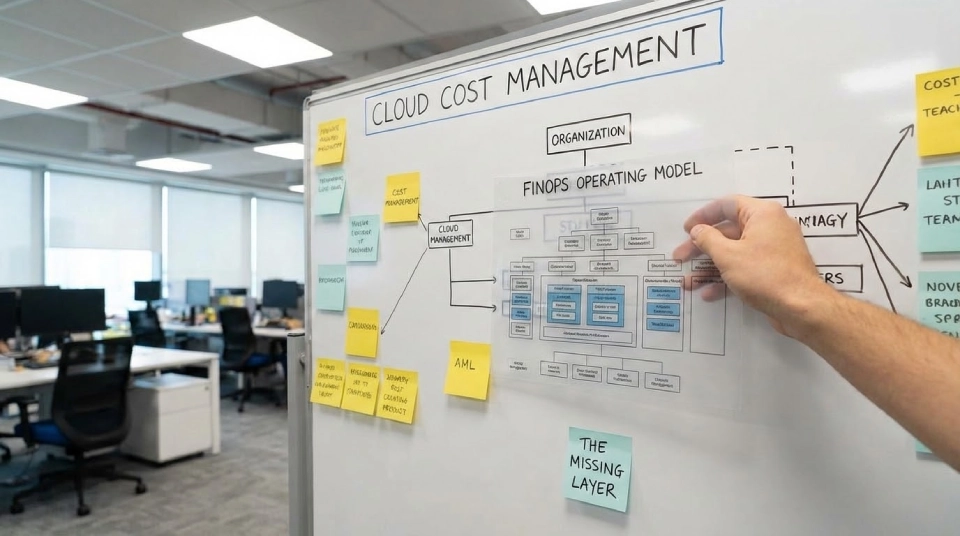
Why a FinOps Operating Model Is the Missing Layer in Cloud Cost Management
A FinOps operating model matters in 2026 because cloud cost visibility without accountability structures consistently fails to produce lasting financial control, regardless of which tools an organization uses.
89% of IT professionals say that lack of cloud cost visibility directly impacts their ability to do their job effectively, according to CloudZero. But visibility is only the first step. Organizations that stop there still face runaway bills, budget surprises, and teams that have no sense of ownership over what they spend.
The real problem is accountability gaps. Without a clear model that defines who owns cloud costs, how often those costs are reviewed, and what success looks like, cloud spend drifts upward with every new workload, feature release, or AI integration.
What Has Changed Between Early FinOps and 2026
Early FinOps efforts focused almost entirely on rate optimization. Teams chased reserved instance discounts, rightsized obvious resources, and called it done.
2026 demands something more formal. AI workloads are accelerating cloud complexity, with 82% of organizations acknowledging that AI initiatives are making their cloud costs harder to manage. The FinOps Foundation’s 2025 framework now recognizes a much broader set of personas and scopes, reflecting the reality that FinOps has grown from a small team’s side project into an enterprise-wide discipline requiring executive structure.
What a FinOps Operating Model Actually Looks Like
A FinOps operating model moves beyond tools and dashboards into structured financial governance that aligns engineering, finance, and business teams around shared cost ownership.
The FinOps Foundation defines FinOps as an operational framework that “creates financial accountability through collaboration between engineering, finance, and business teams.” The operating model is how that collaboration gets organized in practice.
Three core shifts define a mature model:
- Cost ownership moves from a central finance team to the engineering and product teams generating the spend
- Financial review becomes a regular operational rhythm, not a monthly surprise after invoices arrive
- Business value, not just cost reduction, drives cloud investment decisions
Core Roles in a FinOps Operating Model
Without clearly defined roles, FinOps becomes everyone’s vague responsibility and no one’s specific accountability.
A functioning FinOps operating model typically includes four key roles:
The FinOps Lead: Acts as the translator between finance and engineering. This person understands both cost mechanics and business priorities, and owns the FinOps practice across the organization. They are responsible for the tools, the reporting cadence, and the governance policies.
Engineering Teams as Cost Owners: Engineers are not just cost consumers in a mature FinOps model. They own the financial outcome of their architectural and deployment decisions. This shift is central to the FinOps principle that “everyone takes ownership of their technology usage.”
Finance Partners: Responsible for forecasting, budget variance analysis, and connecting cloud spend to financial reporting. Finance keeps FinOps grounded in business reality and ensures numbers are accurate before they reach leadership.
Executive Sponsors: Without visible executive involvement, FinOps teams lack the authority to enforce accountability across competing business units. Executive sponsors ensure cloud cost priorities align with broader business strategy and protect FinOps from being deprioritized when delivery pressure rises.
Cloud Cost Accountability: Who Owns What
Only 43% of organizations track cloud costs at the unit level, meaning most enterprises cannot translate what they spend into business language like cost per product, feature, or customer. (Gartner, May 2025)
This statistic captures exactly where accountability breaks down. Centralized budgeting creates the illusion of control while leaving individual teams with no visibility into the cost of their own decisions.
A mature FinOps operating model defines accountability at the right level:
- Product teams own the cloud cost of the products they ship
- Platform teams own shared infrastructure costs and allocate them transparently
- Business units receive clear, timely cost reporting tied to outcomes they recognize
Making accountability measurable means tagging cloud resources consistently, building chargeback or showback processes, and giving each team a dashboard that shows their actual spend alongside their budget in near real time.
Strong Cloud Solution governance practices, including tagging standards and cost allocation frameworks, are what make this level of accountability operationally sustainable at scale.
The Cadence That Keeps FinOps Working
A FinOps operating model without a regular meeting rhythm collapses into occasional conversations that produce little action.
The FinOps Foundation’s framework recommends a structured cadence across three timeframes:
Weekly: Engineering teams review current spend against expectations, investigate anomalies, and act on optimization recommendations before costs compound. These sessions are short, focused, and directly tied to active workloads.
Monthly: Finance and FinOps leads conduct variance analysis, review forecast accuracy, and identify patterns that weekly reviews miss. Budget holders receive reporting that connects cloud spend to business outcomes.
Quarterly: Executive sponsors review strategic cloud investments, approve or reprioritize major workloads, and assess whether the FinOps model itself needs to evolve. These sessions prevent strategic drift and keep cloud investment decisions aligned with business priorities.
KPIs That Reflect Real FinOps Performance
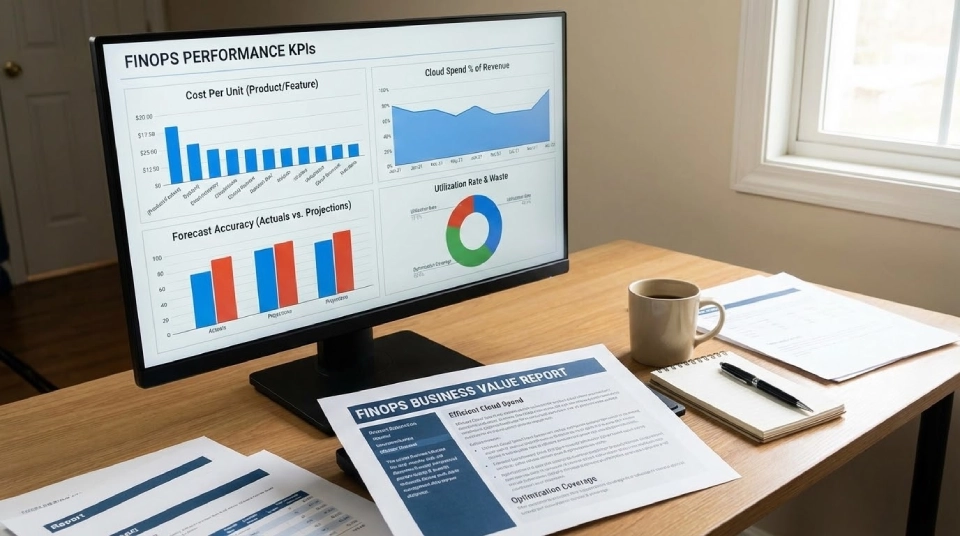
FinOps KPIs should measure business value, not just cost reduction. The goal is efficient cloud spend, not the lowest cloud bill.
The most useful KPIs across a mature FinOps model include:
- Cost per unit: Cloud spend per product, per feature, or per customer. This metric makes cost tangible in business terms.
- Cloud spend as a percentage of revenue: A normalized metric that separates growth-driven spend increases from inefficiency.
- Forecast accuracy: How closely monthly actuals match projections. High variance indicates either poor visibility or undisciplined provisioning.
- Utilization and waste rates: Percentage of provisioned resources actively used. Enterprises waste an estimated $44.5 billion annually in unused cloud infrastructure according to Harness.
- Optimization coverage: The proportion of eligible workloads with active optimization strategies in place.
Governance, Multi-Cloud Challenges, and Common Pitfalls
FinOps governance prevents cost drift by establishing approval workflows, provisioning guardrails, and clear policies that balance innovation speed with financial discipline.
Without governance, every new workload becomes an unreviewed cost commitment. Teams provision resources for experimentation and never decommission them. AI projects launch without any tracking infrastructure in place, which is why only 63% of organizations could track AI spend in 2025 despite rapid adoption.
Governance policies that work in practice include:
- Approval requirements for new cloud workloads above a defined spend threshold
- Automated alerts when spending exceeds defined limits
- Tagging enforcement before resources can be provisioned
- Regular reviews to decommission idle or underused infrastructure
Multi-cloud environments add complexity. Organizations running across AWS, Azure, and Google Cloud face fragmented billing formats, different pricing models, and inconsistent tagging across providers. The solution is a unified reporting layer that normalizes spend data and applies consistent accountability standards regardless of which cloud a workload runs on.
Three common pitfalls consistently derail FinOps operating models:
- Treating FinOps as a finance side project with no authority over engineering decisions
- Overloading teams with metrics without clear guidance on which actions those metrics should drive
- Building a model that fits current cloud usage but fails to adapt as workloads, AI spend, and SaaS costs expand
How to Build a FinOps Operating Model in 2026
Start with an honest maturity assessment, run a focused pilot with a willing team, and then scale proven practices across the organization through policy and culture.
The FinOps Foundation’s “Crawl, Walk, Run” maturity model reflects how organizations should approach this. Most enterprises trying to stand up enterprise-wide FinOps from scratch fail because they attempt too much too fast.
A more effective approach:
Begin with a maturity assessment that identifies where cost visibility, accountability, and governance are weakest. Focus the first pilot on one product team or business unit where leadership is willing and cloud spend is significant enough to demonstrate results quickly.
Use the pilot to prove what works: the right cadence, the right KPIs, the right governance policies. Then expand those practices with the confidence of demonstrated outcomes rather than theory.
34% of FinOps practitioners report needing to invest in automation and tooling to sustain their priorities at scale, according to the FinOps Foundation’s State of FinOps report. Automation is not optional as cloud environments grow. Manual cost management cannot keep pace with the speed and volume of modern cloud consumption.
What Sustainable Cloud Cost Accountability Looks Like
Sustainable FinOps success means cloud economics are predictable, shared responsibility is embedded in how teams work, and optimization is a continuous capability rather than a periodic initiative.
Organizations that reach this point no longer fight about cloud bills. Engineering teams understand the financial impact of their design decisions before they make them. Finance can forecast cloud spend accurately and connect it to business growth. Leadership has confidence that cloud investment is disciplined and delivering value.
The FinOps operating model is not a one-time project. Cloud environments change continuously. New services launch, AI workloads scale, and business priorities shift. The operating model must adapt alongside them.
Contact Webvillee to explore how a structured FinOps operating model can bring predictable cloud cost accountability to your organization in 2026 and beyond.