


Why Product Engineering Matters for Modern Teams and How It Drives Better Outcomes
Product engineering for enterprise teams transforms how organizations build software by focusing on business outcomes rather than just meeting technical specifications. This approach reduces time to market, prevents expensive rework, and ensures teams actually adopt the systems you build.
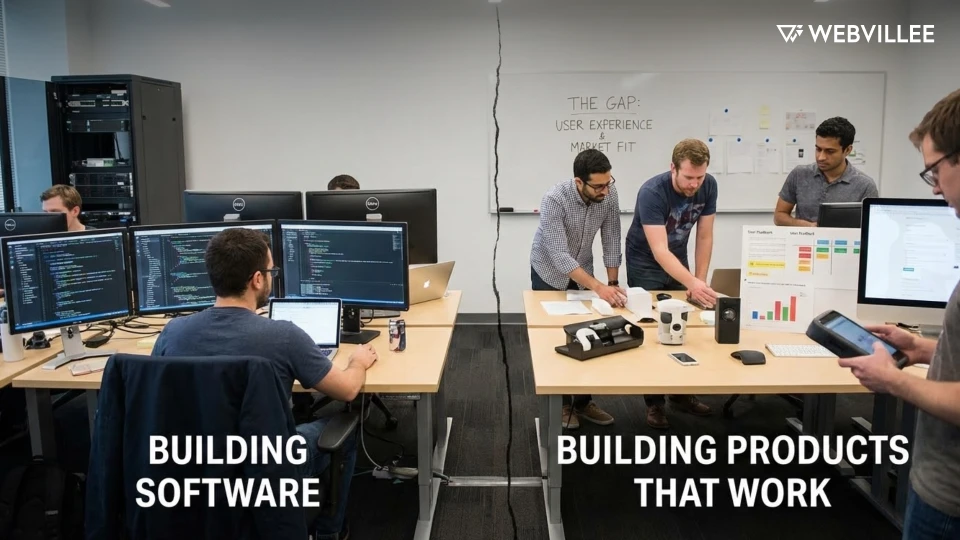
The Gap Between Building Software and Building Products That Work
Most enterprise software projects deliver on time but fail to deliver business value. Your team launches the system, users struggle to adopt it, and six months later you are planning a costly rebuild.
The problem is not the developers. The problem is treating software development as a technical exercise instead of a business solution.
Product engineering for enterprise teams bridges this gap by connecting technical decisions to business outcomes from day one.
Why Most Custom Development Projects Miss Business Goals
Custom development fails when teams focus on building features instead of solving business problems. You end up with software that meets every requirement on paper but does not improve efficiency, reduce costs, or create competitive advantage.
Three patterns consistently appear in failed projects:
- Feature lists without business context: Requirements documents list what to build but not why it matters to operations
- Disconnected teams: Developers work in isolation without understanding daily workflows or pain points
- Success measured by delivery dates: Projects close when code ships, not when business value appears
These projects meet technical specifications while missing the entire point of the investment.
What Product Engineering Actually Means for Enterprise Teams
Product engineering treats every software project as a product that needs to deliver measurable business value. This approach combines business analysis, user research, and technical architecture before writing a single line of code.
The distinction matters because products evolve with your business while traditional software becomes technical debt.
Key differences include:
- Business outcome focus: Every feature connects to efficiency gains, cost reduction, or revenue impact
- User centered design: Workflows match how teams actually work, not how processes look on paper
- Scalability planning: Architecture supports growth from the start instead of requiring expensive rewrites later
- Continuous improvement: Products adapt to changing needs rather than becoming obsolete
The Problem with Traditional Software Development Approaches
Traditional development treats software as a one time project with a clear beginning and end. This mindset creates systems that work on launch day but struggle to adapt as your business changes.
Feature Lists That Don’t Solve Real Business Problems
Requirements documents capture what stakeholders say they want. But what people request and what actually solves their problems are often completely different things.
You end up building features that looked good in planning meetings but sit unused after launch.
Disconnected Development Teams That Don’t Understand Your Operations
When developers never talk to the people who will use the system, they make assumptions about workflows, priorities, and pain points.
The result is software that technically works but does not fit how your teams actually operate.
Delivery Dates Met But Business Value Missing
Project success gets measured by whether you shipped on time and on budget. Nobody asks if the system improved efficiency, reduced errors, or created competitive advantage.
This creates systems that check boxes without moving business metrics.
What Modern Product Engineering Actually Involves
Modern product engineering starts with understanding your business before designing technical solutions. This front loaded approach prevents expensive rebuilds and ensures the final product actually solves the problems you are trying to address.
Business Analysis Before a Single Line of Code
Engineers spend time understanding your operations, identifying bottlenecks, and mapping how different teams interact with systems.
This analysis reveals which features will create the most value and which are nice to have distractions.
User Research That Prevents Expensive Rebuilds Later
Talking to actual users before building anything exposes workflow realities that never appear in requirements documents.
You discover that the feature everyone requested would actually slow down daily work or that a completely different approach would solve multiple problems at once.
Architecture Decisions That Support Growth, Not Just Launch
Technical architecture gets designed to handle future business needs, not just current requirements.
This means your system scales when transaction volume doubles or supports new product lines without requiring complete rewrites.
How Product Engineering Reduces Time to Market
Product engineering gets you to market faster by launching with core value instead of every possible feature. This approach prioritizes what drives business outcomes and defers everything else.
| Traditional Approach | Product Engineering Approach |
|---|---|
| Build every feature before launch | Launch with core value, add features based on real usage |
| Long development cycles with big reveals | Iterative releases with continuous feedback |
| Perfect product on paper that ships late | Good enough product that improves based on actual needs |
You start generating value months earlier while learning what features actually matter to users.
Why Product Engineering Prevents Costly Rework
Proper product engineering eliminates the expensive rebuilds that plague enterprise software projects. By making smart architectural decisions upfront and building scalability from the start, you avoid technical debt that requires complete rewrites later.
Three areas where product engineering saves significant money:
- Scalability built in from day one: Systems handle growth without performance degradation or architectural overhauls
- Clean technical foundation: Code quality and structure support ongoing development instead of creating maintenance nightmares
- Flexible design: Architecture adapts to changing business needs without requiring rip and replace projects
The initial investment in proper product engineering costs less than rebuilding broken systems every two years.
The User Adoption Advantage of Engineered Products
Products built with user centered engineering achieve adoption rates 60 to 80 percent higher than traditional enterprise software. When systems match how people actually work, training time drops and productivity increases immediately.
Systems Your Teams Actually Want to Use
User research during development creates interfaces and workflows that feel intuitive rather than requiring constant reference to documentation.
Employees choose to use the new system because it makes their jobs easier, not because management mandates it.
Workflows Designed Around Real People, Not Just Processes
Process documentation shows ideal workflows. Real work involves exceptions, workarounds, and context that never appears in official procedures.
Product engineering captures these realities and designs systems that support how work actually happens.
Reducing Training Time and Support Tickets
When interfaces make sense and workflows feel natural, new users get productive in days instead of weeks.
Support ticket volume drops because the system prevents common mistakes and provides clear guidance when users need help.
How Product Engineering Delivers Measurable ROI
Product engineering creates measurable return on investment through faster feature delivery, lower maintenance costs, and competitive advantage from superior user experience. These benefits compound over the product lifecycle.
Financial impact appears in three key areas:
- Development efficiency: Release new features without breaking existing functionality or requiring regression testing marathons
- Operational savings: Lower maintenance costs because clean architecture prevents technical debt accumulation
- Revenue impact: Better user experience creates competitive advantage that drives customer retention and acquisition
Organizations typically see ROI within 12 to 18 months as efficiency gains and reduced rework compound.

Integration and Ecosystem Thinking in Product Engineering
Product engineering treats integration as a core requirement, not an afterthought. Your new system needs to connect seamlessly with existing tools, share data across platforms, and support future business needs.
Products That Connect to Your Existing Systems Seamlessly
Integration architecture gets designed upfront so your product works with CRM platforms, ERP systems, and other business tools from day one.
This prevents the data silos that force teams to manually copy information between systems.
API Design That Supports Future Business Needs
Well designed APIs let your product connect to tools and platforms that do not even exist yet.
When business needs change or new technologies emerge, your system adapts without requiring architectural rewrites.
Avoiding Isolated Tools That Create New Data Silos
Isolated systems force teams to maintain duplicate data, reconcile conflicting information, and waste time on manual data entry.
Product engineering prevents this by treating data flow and system integration as primary requirements from the beginning.
What to Look for in a Product Engineering Partner
The right product engineering partner brings industry expertise, proven processes, and transparent communication to every project. Technical skills matter, but understanding your specific business challenges matters more.
Evaluate potential partners across these dimensions:
| Evaluation Area | What to Look For |
|---|---|
| Domain Expertise | Experience with your industry’s specific challenges and compliance requirements |
| Track Record | Successful projects with similar business problems, not just technical complexity |
| Process Transparency | Clear communication throughout development with regular business value reviews |
| Partnership Approach | Collaborative relationship focused on long term success, not just project completion |
Common Misconceptions About Product Engineering
Product engineering is not just agile development with different terminology. The distinction lies in the focus on business outcomes, user research depth, and architectural decisions that support long term growth.
Three misconceptions that prevent organizations from adopting product engineering:
- More upfront planning means slower delivery: Proper planning actually accelerates delivery by preventing rework and ensuring you build the right things first
- Only for customer facing applications: Internal tools benefit even more because user adoption directly impacts operational efficiency
- Too expensive for mid sized projects: Product engineering prevents the costly rebuilds that make traditional development more expensive over time
When Your Team Needs Product Engineering, Not Just Development
Your organization needs product engineering when development projects consistently deliver on time but fail to improve business metrics. This pattern indicates a fundamental mismatch between technical delivery and business value creation.
Warning signs that signal the need for product engineering:
- Users complain that new systems slow down their work instead of speeding it up
- Projects succeed technically but fail to reduce costs or improve efficiency
- Systems require complete rewrites every 24 to 36 months
- Feature requests pile up faster than development teams can address them
- Integration between systems requires constant manual intervention
These problems do not stem from poor developers. They indicate a need for product engineering approaches that connect technical work to business outcomes.
Building Products That Grow with Your Business
Product engineering is an investment in systems that adapt and scale as your business evolves. The upfront focus on business outcomes, user needs, and architectural flexibility costs less than repeatedly rebuilding systems that cannot keep pace with growth.
Organizations that adopt product engineering see faster time to market, higher user adoption, and measurable ROI within the first year.
Contact Webvillee to explore how product engineering can transform your next development project from a technical exercise into a business value driver.