

How to Identify and Eliminate Shadow IT Before It Drains Your Budget
Shadow IT refers to unauthorized software and cloud applications employees adopt outside of IT’s control. The average enterprise loses $2M+ annually through shadow IT, making identification and elimination essential for budget protection and risk management.
What is shadow IT and why do employees adopt it?
Shadow IT is unauthorized software and cloud applications employees adopt because approved tools are slow, expensive, or poorly designed for their workflows, costing enterprises millions annually in redundant licenses, security risk, and compliance violations.
Most employees don’t deliberately circumvent IT policy. They adopt unsanctioned tools because their immediate work problems aren’t solved by official systems. A marketing team might use personal Dropbox accounts instead of enterprise file sharing because deployment takes three weeks. Finance teams might adopt unofficial spreadsheet tools because the approved solution lacks required functionality.
The gap between what IT provides and what business teams need creates the Shadow IT problem. Employees want to be productive. When official tools don’t enable that productivity, they find alternatives. Shadow IT adoption accelerates when IT procurement moves slowly and business teams face deadlines.
This adoption pattern means Shadow IT isn’t rogue behavior; it’s rational response to systemic gaps between technology supply and business demand. Understanding this driver is essential for both elimination and prevention.
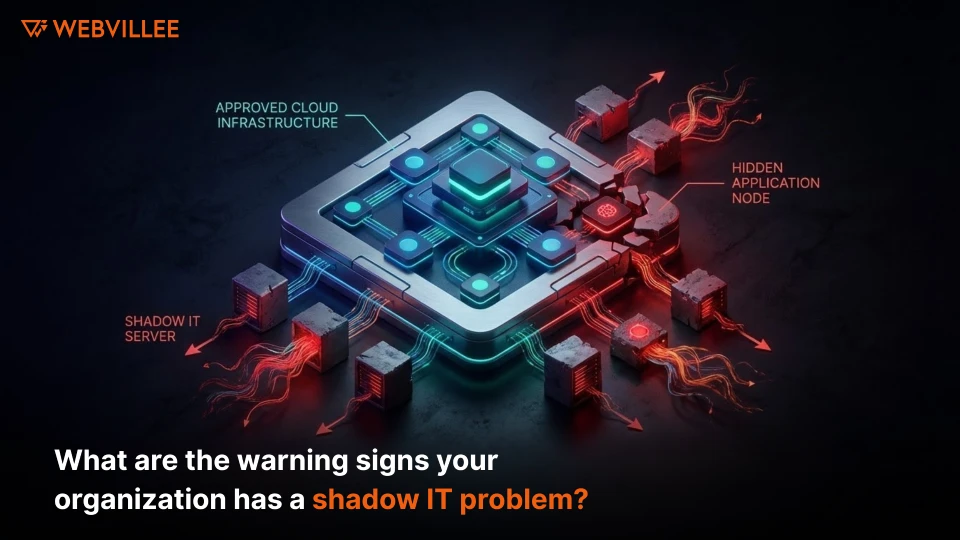
What are the warning signs your organization has a shadow IT problem?
Organizations with Shadow IT show clear warning signs including IT discovering unknown systems during audits, high personal cloud account usage, frequent requests for better tools, and data inconsistencies across departments.
- Audit discoveries where IT uncovers applications and data storage locations nobody tracked officially, indicating systems operating entirely outside governance
- Employee cloud account adoption showing up on network monitoring, revealing employees storing business data on personal Google Drive, Dropbox, or OneDrive accounts
- Repeated “better tool” requests from business teams asking for systems IT didn’t evaluate, suggesting they already use alternatives unofficially
- Data inconsistencies across departments where the same customer or financial information differs depending on which system you check
- Duplicate software purchases appearing on invoices, indicating multiple teams buying similar tools because they don’t know others use similar solutions
- Help desk tickets mentioning tools IT doesn’t support or recognize, revealing systems running without IT knowledge
- Employee surveys revealing tool usage numbers far exceeding official applications, exposing widespread Shadow IT adoption
These warning signs compound over time. Early detection enables deliberate elimination strategy. Late detection forces reactive crisis response under budget pressure.
If your organization exhibits multiple warning signs, working with managed IT services and continuous visibility partners helps identify the full scope of Shadow IT and develop elimination strategy before costs escalate further.
How much is shadow IT actually costing your business?
The average enterprise loses $2M+ annually through Shadow IT via redundant licenses, security incident costs, compliance fines, lost productivity from tool sprawl, and administrative overhead managing unsanctioned systems.
| Cost Category | Description | Annual Impact |
|---|---|---|
| Duplicate Licenses | Multiple teams buying similar tools because they don’t know about others using them (5 project management tools, 3 document storage systems) | $300K-$500K+ |
| Security Incidents | Data breaches from unsecured personal accounts storing business data, requiring incident response and notification costs | $400K-$800K+ |
| Compliance Violations | Audit failures, regulatory fines, and remediation costs from unsanctioned systems lacking proper controls | $250K-$600K+ |
| Lost Productivity | Employees spending time switching between tools, relearning different interfaces, and managing data across fragmented systems | $350K-$700K+ |
| IT Administrative Overhead | Support teams managing unsanctioned systems, hunting for data storage locations, and attempting integration of tool sprawl | $200K-$400K+ |
| Data Loss Risk | Intellectual property and customer data lost when employees leave and take Shadow IT accounts with them | $150K-$300K+ |
A mid-sized enterprise with $10M IT budget typically dedicates 15-20% of spending ($1.5M-$2M annually) to managing Shadow IT without reducing the problem. Larger enterprises with $50M+ budgets may lose $5M+ annually.
The financial case for Shadow IT elimination is clear: redirecting even half of Shadow IT costs toward approved alternatives generates immediate payback while reducing risk exposure.
What compliance and security risks does shadow IT create?
Unsanctioned systems expose organizations to data breaches, compliance violations, audit failures, and regulatory fines when employee-chosen tools lack proper security controls and data governance frameworks.
Security Risk Exposure
Unsanctioned tools often lack enterprise-grade security controls. Personal cloud accounts have weak password policies. Third-party applications lack encryption and access controls. Shadow IT systems become attractive targets for attackers because they operate outside monitoring and detection systems.
Employee-chosen tools frequently store business data in unauthorized locations. Customer information might live in personal Google Drive accounts. Financial data might reside in unofficial spreadsheets on cloud storage. When employees leave, these data repositories disappear with them or remain accessible to people without authorization.
Compliance Violations
Regulated industries including finance, healthcare, and government face specific compliance requirements about where data lives and how it’s protected. Shadow IT systems operating outside these controls create automatic violations. IT audit teams discovering unsanctioned systems flag them as non-compliant, triggering remediation requirements.
Data residency regulations including GDPR and CCPA require knowing exactly where customer data lives. Shadow IT systems storing data in uncontrolled cloud services violate these requirements. The compliance gap between approved systems and Shadow IT creates regulatory risk.
Audit and Regulatory Consequences
External auditors discovering Shadow IT systems during reviews flag them as control deficiencies. These findings appear in audit reports triggering executive concern and board discussion. Regulatory bodies examining compliance posture view Shadow IT systems as evidence of poor governance.
Fines from regulatory violations start at 4% of revenue and escalate based on data sensitivity and violation severity. A $100M company facing GDPR violation could face $4M+ in fines plus remediation costs. The compliance risk from Shadow IT extends far beyond operational inconvenience.
How does shadow IT fragment your customer data and business insights?
Shadow IT systems store customer and business data outside enterprise systems, preventing unified customer view, blocking accurate reporting, and leaving critical information invisible to decision-makers requiring complete visibility.
Most enterprises use CRM systems to store customer information, manage relationships, and track sales pipeline. Shadow IT undermines this investment. Customer information stored in personal spreadsheets, unofficial databases, and unsanctioned tools never reaches the official CRM. Sales teams maintain customer information in email folders outside the CRM system.
This data fragmentation creates fragmented business reality. Your CRM shows customer X has purchased twice with revenue of $500K. Email folders show three additional interactions and a pending $2M opportunity. Neither system sees the complete customer. Decision-makers analyzing CRM data make choices based on incomplete information.
The integrated CRM and ERP solutions that drive business value depend on data completeness. Shadow IT fragments this data, reducing CRM effectiveness and distorting business insight. Organizations implementing integrated CRM and ERP solutions see significant benefits only when Shadow IT is eliminated and data flows through official systems.
Financial reporting becomes unreliable when actual transactions live in unofficial spreadsheets. Project teams track work in unauthorized systems outside official project management tools. Marketing tracks campaign results in separate databases. Each system contains partial truth, and nobody sees the complete business picture.
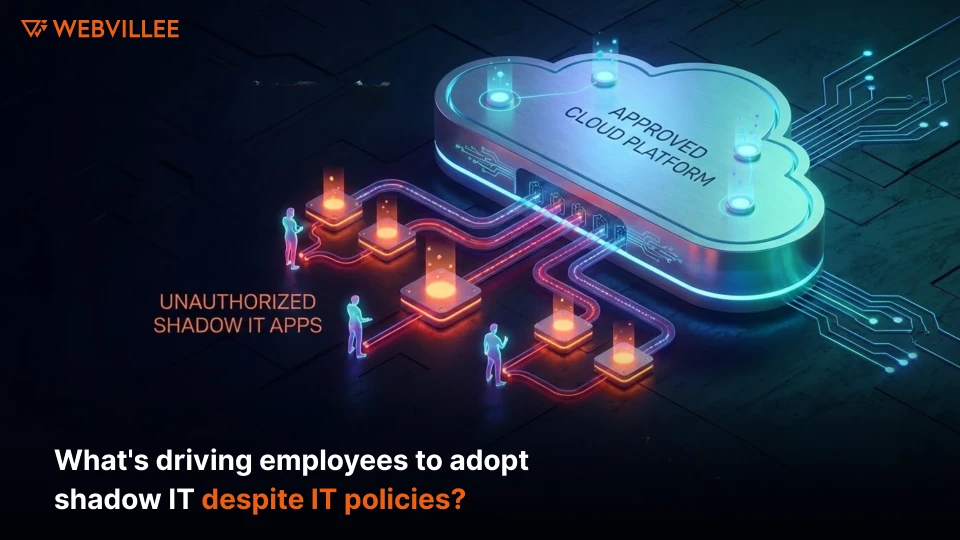
What’s driving employees to adopt shadow IT despite IT policies?
Employees adopt Shadow IT because approved tools take weeks to deploy, cost too much, require excessive security restrictions, or simply don’t solve their immediate workflow problems effectively.
- Slow deployment timelines where IT procurement and setup takes weeks or months, forcing employees to find immediate solutions to urgent problems
- Excessive cost of approved solutions making them financially inaccessible for small teams, driving adoption of cheaper alternatives
- Poor user experience of approved tools that feel slow, complicated, or poorly designed compared to intuitive consumer alternatives
- Restrictive security controls that prevent legitimate productivity by requiring excessive approvals, complicated access procedures, or feature limitations
- Lack of business input where IT selects tools without understanding what business teams actually need, resulting in poor fit for workflows
- Limited integration where approved solutions don’t connect with other systems employees rely on, forcing manual data transfer and duplicate work
- Feature gaps where official tools lack specific capabilities that unauthorized alternatives provide, making alternatives more valuable despite policy violations
The common thread across all drivers is that employees perceive unauthorized tools as solving their problems better than official alternatives. Eliminating Shadow IT requires making approved tools faster, cheaper, easier to use, and more capable than unauthorized alternatives.
How do you identify and measure shadow IT in your organization?
Shadow IT identification requires network analysis to detect unsanctioned cloud services, employee surveys to understand tool adoption, financial audits to find duplicate licenses, and security reviews of data storage locations.
- Conduct network traffic analysis to identify unsanctioned cloud services employees use, examining data flowing to external systems and storage locations outside approved solutions
- Deploy cloud access security brokers that monitor and log all cloud service usage, providing visibility into which applications employees access and how frequently
- Survey employees directly asking which tools they use for specific workflow tasks, comparing responses to official tool inventory to identify adoption gaps
- Audit financial statements for duplicate software subscriptions and charges for tools IT didn’t approve, tracing charges back to departments using unauthorized solutions
- Examine file storage locations through active directory and cloud audit logs to find where business data actually lives versus where it should live
- Review data exfiltration patterns looking for unusual amounts of data copied to external accounts or devices, indicating data moving to Shadow IT systems
- Interview IT support teams asking what off-label tools they hear about in help desk tickets or from employees requesting workarounds
- Perform security scanning of employee devices to find installed applications and cloud account connections that fall outside official systems
Most organizations discover their Shadow IT problem is larger than expected. Initial findings of 10-15 unauthorized systems often expand to 50+ as comprehensive discovery continues.
What’s your elimination and prevention strategy before shadow IT returns?
Eliminating Shadow IT requires replacing unsanctioned tools with faster-deploying alternatives, simplifying access controls, building IT partnerships with business teams, and implementing governance policies that prevent future adoption.
Replace Unsanctioned Tools with Better Alternatives
Don’t simply ban unauthorized tools. Instead, provide approved alternatives that address why employees adopted Shadow IT in the first place. If teams use personal cloud storage because file sharing takes weeks to deploy, implement cloud storage with instant user provisioning. If they use unauthorized project tools because approved solutions are expensive, find affordable alternatives that fit budgets.
IT needs to match the speed and capability of Shadow IT solutions. Consumer alternatives like Slack, Dropbox, and Google Workspace succeed because they’re fast to deploy and easy to use. Enterprise alternatives must match this simplicity while adding security and governance features.
Simplify IT Access and Approval Processes
Slow IT processes drive Shadow IT adoption. If approving new tools takes three months, employees find alternatives in weeks. Streamline IT approval to business speed by providing rapid evaluation, clear decision timelines, and fast deployment for approved solutions.
Create clear categories of approved tools with automatic approval for low-risk solutions. Allow business teams to select from pre-approved options rather than waiting for IT to make choices. Balance governance with responsiveness.
Build IT-Business Partnerships
Shadow IT thrives in organizations where business teams don’t trust IT to meet their needs. Build partnerships where business teams share requirements before choosing tools, and IT teams respond rapidly with approved solutions.
Create cross-functional teams with business and IT members evaluating new tool requests together. Schedule regular business-IT meetings discussing upcoming needs and opportunities. Make IT partners in business success rather than gatekeepers preventing progress.
Implement Governance That Prevents Return
With Shadow IT identified and eliminated, implement policies preventing recurrence. Shadow IT returns without active governance because the conditions that created it remain. Continuous monitoring, regular tool audits, and clear policies about unsanctioned systems create accountability.
Establish clear guidelines about which tools are approved, which are prohibited, and which are pending evaluation. Communicate consequences of adopting unsanctioned tools. Reward teams that use approved solutions and request new capabilities through official channels.
Partnering with digital transformation and IT strategy experts helps organizations design elimination and prevention approaches that actually address root causes rather than simply enforcing restrictions that drive Shadow IT underground.
Contact Webvillee to explore how Shadow IT elimination can free up budget and reduce risk in your organization. Our IT strategy specialists help enterprises identify Shadow IT scope, develop elimination roadmap, and implement governance that prevents recurrence.