


The Hidden Cost in Your Cloud Bill
DevOps practices can reduce cloud spend by up to 30-40%, yet most organizations never capture these savings. Most organizations overspend on cloud by 20-30% because they’re not optimizing effectively. DevOps practices and cloud cost optimization aren’t just engineering initiatives; they’re business decisions that directly impact profitability and competitive advantage.
The gap between what you’re paying for and what you’re actually using represents money leaving your organization every month. A CTO paying for unused database capacity, over-provisioned servers running at 10% utilization, and manual resource management that prevents rapid optimization is essentially burning cash. The challenge isn’t that cloud is expensive; it’s that most organizations don’t have the visibility or methodology to control spending.
This guide walks you through how DevOps practices enable cloud cost optimization systematically. You’ll discover why organizations overspend, what specific practices reduce costs, and how to implement sustainable cost management that captures 30-40% savings without sacrificing quality or agility.
What Is Cloud Cost Optimization and Why Does It Matter?
Cloud cost optimization is the practice of right-sizing cloud infrastructure, eliminating waste, and automating resource management so you pay only for what you actually use. It’s not about cutting corners on quality; it’s about eliminating waste and inefficiency that nobody intentionally created.
Most organizations have no idea how much they overpay for cloud infrastructure. They provision resources conservatively to avoid downtime. And don’t monitor spending closely. They leave unused resources running. The result is cloud spending that’s 20-30% higher than necessary.
Why Cloud Cost Optimization Matters:
- Direct Financial Impact: 30-40% reduction in cloud spending translates to hundreds of thousands of dollars annually for mid-sized organizations
- Competitive Advantage: Organizations optimizing cloud costs reinvest savings in innovation and growth
- Operational Excellence: Cost optimization forces visibility into infrastructure usage and efficiency
- Scalability Without Extra Costs: As workloads grow, optimized systems stay cost-efficient instead of costs spiraling
Cloud cost optimization is essential business practice, not optional technical work. It directly affects profitability and enables better resource allocation across the organization.

Why Do Most Organizations Overspend on Cloud?
Organizations overspend because they lack visibility into cloud spending, don’t understand which departments drive costs, provision resources conservatively, and don’t optimize after initial deployment. Understanding why overspending happens helps prevent it from becoming your organization’s pattern.
When cloud migration first happens, organizations move workloads to cloud exactly as they ran on-premises. They provision servers with the same capacity they had before, never asking whether that capacity was actually needed. Downtime was expensive on-premises, so conservative provisioning became habit.
Why Organizations Overspend:
- Lack of Visibility: No clear understanding of which applications cost most or where waste exists
- Monitoring Blind Spots: Cloud spending isn’t tracked daily; surprises arrive in monthly bills
- Conservative Resource Provisioning: Over-provisioning to guarantee performance, not based on actual usage
- No Post-Deployment Optimization: Resources provisioned during migration stay unchanged for years
- Manual Resource Management: Without automation, optimization is impossible to scale
- Multi-Cloud Complexity: Multiple cloud accounts and platforms make spending tracking difficult
- Lack of Ownership: Nobody is clearly accountable for cloud cost management
Each of these factors contributes to cloud overspending. Organizations addressing all of them typically capture 30-40% in annual cost savings within 6-12 months.
How Does DevOps Enable Cloud Cost Optimization?
DevOps practices enable cloud cost optimization by embedding efficiency into how infrastructure is managed, deployed, and monitored continuously. DevOps practitioners understand infrastructure deeply and use automation to reduce waste rather than tolerating it.
Traditional approaches separate infrastructure teams from development teams. Infrastructure provisions resources and maintains them. Development builds applications. Nobody owns the efficiency gap between allocated resources and actual usage. DevOps bridges this gap through shared responsibility and automated management.
How DevOps Practices Drive Cloud Cost Reduction:
- Infrastructure as Code: Resources are defined in code, versioned, audited, and easily modified. This enables rapid optimization and consistent, cost-efficient deployment
- Automated Testing: Problems are caught in development, not after expensive production deployment
- Continuous Deployment: Small, frequent changes are safer and easier to optimize than large quarterly releases
- Monitoring and Observability: Real-time visibility into resource usage enables immediate right-sizing decisions
- Automation: Manual resource management is error-prone and expensive. DevOps automates everything, including cost optimization
- Configuration Management: Standard configurations ensure resources are deployed consistently and efficiently
DevOps practices reduce cloud spend by treating cost as a shared engineering concern. When teams understand both performance and cost, they make choices that optimize both. Infrastructure standardization, automated testing, and continuous deployment all directly reduce cloud costs.
When you DevOps reduce cloud spend through these practices, you’re not just cutting costs; you’re improving engineering velocity, reliability, and agility. Cost reduction becomes a side benefit of better practices.
What Are the First Steps in Cloud Cost Optimization?
Begin with visibility into your cloud spending through detailed cost analysis, identify where money goes by department and application, find obvious waste like idle resources, then systematically optimize. Most cost reduction comes from simple practices implemented consistently, not complex engineering changes.
Many organizations jump immediately to technical optimization. They focus on code changes or architecture redesigns. This is backwards. The biggest cost savings come from eliminating obviously wasteful resources, consolidating similar workloads, and establishing basic monitoring and accountability.
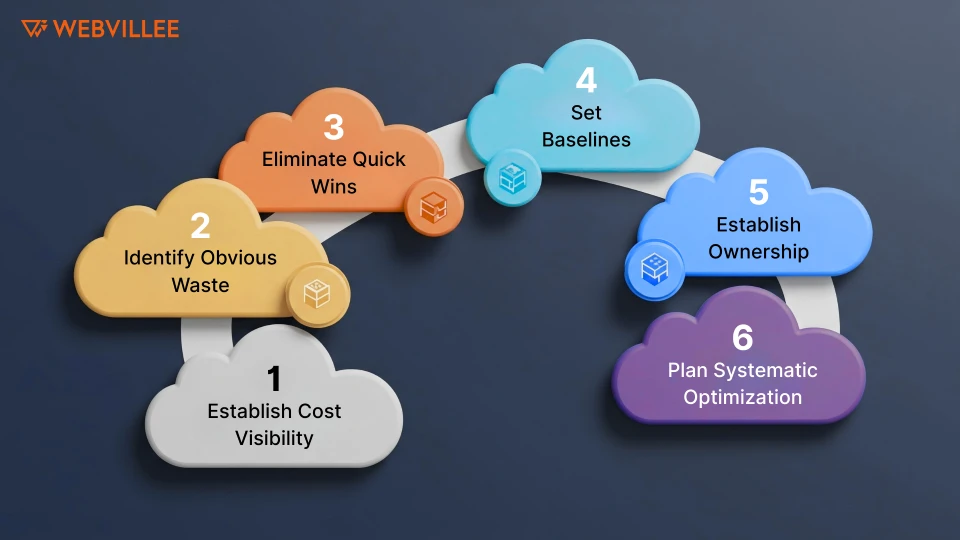
First Steps Toward Cloud Cost Optimization:
- Step 1: Establish Cost Visibility: Implement detailed billing analysis showing spending by department, application, and resource type
- Step 2: Identify Obvious Waste: Find idle resources, unattached storage, unused databases running without purpose
- Step 3: Eliminate Quick Wins: Delete unused resources, consolidate databases, terminate test environments left running
- Step 4: Set Baselines: Establish current spending as baseline for measuring future optimization
- Step 5: Establish Ownership: Assign clear accountability for optimization within departments and engineering teams
- Step 6: Plan Systematic Optimization: Move beyond quick wins to structural changes
These first steps typically yield 10-15% cost reduction with minimal technical effort. They also establish the visibility and accountability necessary for deeper optimization.
If you’re building your cloud cost optimization strategy, working with an experienced partner who has a proven cloud cost optimization approach and tools can help you avoid expensive mistakes and accelerate results. The right partner brings best practices, tool expertise, and proven methodologies that compress your optimization timeline.
How Do You Right-Size Cloud Resources?
Right-sizing means selecting the smallest cloud instance or resource that meets actual performance requirements instead of provisioning conservatively to guarantee excess capacity. Most cloud waste comes from over-provisioned resources that use only 10-20% of allocated capacity while charging for 100%.
Over-provisioning feels safe. You guarantee performance by allocating more than needed. But “safe” is expensive. A database instance provisioned for twice actual peak load costs twice what it should. A compute instance sized for worst-case scenario but running at 15% average utilization is wasteful.
How to Right-Size Resources:
- Analyze Historical Usage: Monitor CPU, memory, storage, and network usage over 1-3 months to understand actual patterns
- Understand Peak vs Average: Peak usage might be 60% utilization, but average might be 20%. Size for actual usage patterns
- Implement Monitoring: Use cloud native monitoring tools to track real-time utilization and identify sizing mismatches
- Right-Size Incrementally: Reduce resource allocation, monitor performance, increase if needed. This prevents both waste and performance issues
- Automate Scaling: Use autoscaling groups and load balancers to match resource allocation to actual demand
- Regular Reviews: Quarterly or semi-annual reviews catch new wasteful allocations before they become expensive
Right-sizing is the single highest-return optimization tactic. Organizations typically save 20-30% on compute costs through proper right-sizing alone. It requires discipline and monitoring but delivers substantial financial returns.
What Role Does Infrastructure as Code Play in Cost Optimization?
Infrastructure as code enables consistent resource provisioning, automated teardown of unused resources, and rapid optimization cycles. It transforms cloud cost optimization from manual effort to automated, repeatable practice that scales across thousands of resources.
When infrastructure is defined in code, optimization becomes a code change, not a manual process. You can change resource types, sizes, and configurations across dozens of applications through code changes. Also you can test optimization changes before deploying them. And you can enforce cost controls automatically.
How Infrastructure as Code Enables Optimization:
- Consistency: All resources of a type are provisioned identically, eliminating inconsistent over-provisioning
- Rapid Changes: Optimization improvements are rolled out across all resources quickly through code deployment
- Automated Cleanup: Infrastructure as code enables automatic deletion of unused resources without manual intervention
- Version Control: All infrastructure changes are tracked, versioned, and reviewable before deployment
- Standardization: Organization-wide standards ensure resources are provisioned efficiently across all teams
- Automation: Cost controls and optimization rules are enforced automatically in infrastructure definitions
Infrastructure as code is foundational for sustainable cloud cost optimization. Without it, optimization is one-time manual work. With it, optimization is continuous and scales.
How Can Automation Reduce Cloud Spend?
Automation eliminates manual resource management, prevents human error, enables rapid response to cost opportunities, and scales cost optimization across thousands of resources that manual processes cannot reach. Manual cost optimization doesn’t scale; automation does.
Consider the difference between manual and automated resource management. Manually, a person decides to rightsize a resource. They access the cloud console, change the resource type, monitor performance, and verify the change. This takes 30 minutes per resource and can only happen occasionally.
Automated, a policy detects under-utilized resources, changes them automatically, and alerts the team. This happens continuously across thousands of resources simultaneously. The same person now manages hundreds of resources instead of a handful.
How Automation Drives Cloud Cost Reduction:
- Continuous Monitoring: Systems constantly monitor utilization and flag optimization opportunities
- Automatic Rightsizing: Resources are automatically adjusted based on utilization patterns without human intervention
- Scheduled Shutdowns: Development and test resources shut down automatically outside business hours
- Resource Cleanup: Unused resources are tagged and deleted automatically after grace periods
- Cost Alerting: Teams are immediately notified when spending deviates from expected patterns
- Compliance Enforcement: Cost controls and policies are enforced automatically through infrastructure as code
- Scaling: Optimization that would take weeks manually happens in minutes automatically
When you DevOps reduce cloud spend through automation, you enable optimization at scale. What was possible for 5 resources becomes possible for 500. Cost reduction becomes continuous rather than episodic.

What Cloud Cost Optimization Tools and Practices Should You Use?
Organizations should combine cloud provider native tools like AWS Cost Explorer and Azure Cost Management with third-party optimization platforms and internal monitoring practices. The right tool selection depends on your cloud platforms, organizational complexity, and specific optimization priorities.
Tool selection matters because cloud cost optimization requires visibility, analysis, and enforcement across multiple systems. No single tool handles everything. Most organizations end up with a combination of native provider tools, third-party platforms, and custom monitoring.
Cloud Cost Optimization Tools and Approaches:
- Native Cloud Provider Tools: AWS Cost Explorer, Azure Cost Management, Google Cloud Cost Analysis provide deep visibility into spending patterns
- Third-Party Optimization Platforms: Tools like CloudHealth, CloudCheckr, Flexera provide cross-cloud analysis and automated optimization recommendations
- Automation Tools: Infrastructure as code tools (Terraform, CloudFormation) automate resource provisioning and deprovisioning
- Monitoring and Alerting: Tools like Datadog, New Relic provide usage monitoring and performance data critical for right-sizing decisions
- Cost Allocation: Tag management and cost allocation tools ensure spending is accurately assigned to departments
- Governance: Policy-as-code tools enforce cost controls and prevent wasteful resource provisioning
The best approach combines multiple tools focused on visibility, analysis, automation, and governance. Start with native provider tools for immediate visibility, then add third-party tools if needed for deeper analysis or cross-cloud management.
How Do You Establish Accountability for Cloud Spending?
Cost optimization requires clear ownership, budget allocation by department, regular cost reviews, and accountability for optimization results. Without organizational structure around cost management, optimization initiatives fail because nobody is specifically responsible for maintaining improvements.
Technical optimization is temporary without organizational accountability. Costs creep back up when nobody owns monitoring and enforcement. Waste reappears when nobody is accountable for resource management. Organizations that succeed at sustainable cost optimization make cost management somebody’s job.
Establishing Cost Accountability:
- Clear Ownership: Assign a person or team responsible for overall cloud cost management and optimization
- Departmental Budgets: Allocate budgets to business units or departments and hold them accountable for staying within budgets
- Cost Transparency: Make cost data visible to teams so they understand the financial impact of their resource decisions
- Regular Cost Reviews: Monthly or quarterly reviews of spending patterns and optimization progress
- Chargeback Models: Charge departments for cloud resources they use so they’re incentivized to optimize
- Governance Policies: Establish policies about resource types, sizes, and configurations allowed to prevent costly decisions
- Automation Enforcement: Implement policies that prevent wasteful resource provisioning automatically
Accountability structures ensure that cost optimization is ongoing concern, not one-time project. When teams know their spending is visible and they’re accountable for efficiency, they make better choices about resource allocation.
What Does Sustainable Cloud Cost Optimization Look Like?
Sustainable optimization requires ongoing monitoring, continuous improvement, treating cost management as permanent practice rather than one-time project, and building cost awareness into engineering culture. One-time optimization creates short-term savings; sustainable practice creates lasting value.
Many organizations approach cost optimization as project. They reduce spending 30%, declare victory, then move on. Over the next 12-18 months, costs creep back up as new resources are provisioned, optimization practices fade, and cost discipline disappears. Sustainable optimization is different; it’s permanent and integrated into how the organization operates.
Sustainable Cloud Cost Optimization Practices:
- Continuous Monitoring: Real-time cost tracking shows trends before they become problems
- Regular Reviews: Monthly cost reviews identify new wasteful patterns early
- Optimization Cycles: Quarterly optimization initiatives continue improvement rather than stopping after initial gains
- Cost Awareness Culture: Engineers understand cost implications of architectural and resource decisions
- Automation Enforcement: Policies prevent wasteful provisioning automatically so manual discipline isn’t required
- Skill Development: Teams gain expertise in cost optimization so knowledge isn’t dependent on external consultants
- Tool Evolution: Organizations invest in tools and automation that scale cost optimization
- Continuous Learning: Teams stay updated on new cost optimization opportunities and cloud capabilities
Organizations building sustainable cost optimization see continuous 3-5% annual improvement after initial 30-40% optimization. They maintain savings because cost management is ongoing practice, not one-time effort.
Your Cloud Cost Optimization Path Forward
Cloud cost optimization is achievable and significant, with organizations systematically capturing 30-40% in annual cost reduction without sacrificing quality or agility. DevOps practices make this possible by automating resource management, enforcing cost controls, and enabling rapid optimization cycles. The money is there; you just need the right approach to capture it.
Here’s your path forward: Start this week with Step 1 from our first steps section. Establish detailed visibility into your cloud spending. Identify where money goes and where waste exists. Find quick wins within the first 30 days. Then move systematically through deeper optimization: right-sizing resources, implementing infrastructure as code, automating management, and establishing organizational accountability.
Organizations that treat cloud cost optimization as ongoing practice rather than one-time project realize compounding benefits. Month 1: eliminate obvious waste. 2-3 Months: right-size major resources. 4-6 Months: automate optimization. 6-12 Months: establish sustainable practices. By month 12, you’ve captured substantial savings and built sustainable processes that maintain them.
If your organization is ready to systematically optimize cloud costs but needs expert guidance, connect with Webvillee. Our team brings real-world experience from dozens of cloud cost optimization projects across multiple cloud platforms. We help you assess your current spending, identify optimization opportunities, implement changes, and establish practices that maintain savings long-term. Contact Webvillee today to schedule a consultation with our cloud cost optimization specialists.