


Microsoft Dynamics 365 in 2025 is evolving to deliver stronger automation, seamless integration, better compliance, and improved scalability that help businesses operate more efficiently.
For decision makers, the platform is no longer just an ERP or CRM system. It has become a connected ecosystem that supports business efficiency with Dynamics 365 updates in 2025. By improving workflows, insights, and compliance, it ensures that enterprises can focus on growth instead of daily operational struggles.
Why should this matter to you? Because investing in the right platform directly affects efficiency, customer satisfaction, and risk management. Businesses that rely on outdated systems often face delays, compliance challenges, and missed opportunities. Dynamics 365 offers an answer with tools designed for real time visibility and smarter decision making.
This blog will walk through six ways the platform is changing in 2025 and what those changes mean for your business.
What new automation features does Microsoft Dynamics 365 offer in 2025?
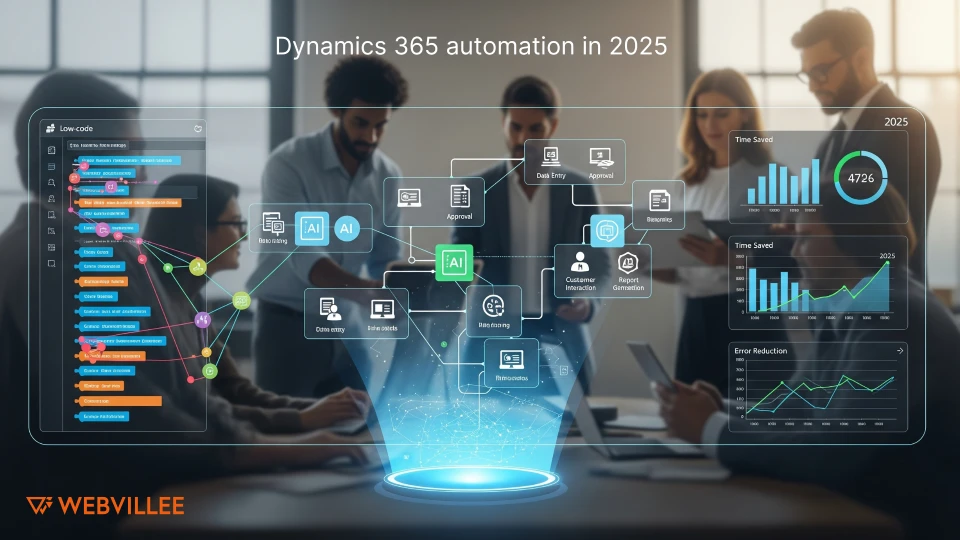
Dynamics 365 automation in 2025 introduces AI-powered workflows and low code tools that cut manual tasks and save valuable time.
The system focuses on helping teams remove repetitive tasks so they can spend more time on work that drives results. This matters because manual entry and approval chains often create delays and errors in enterprise environments.
Key updates in automation include:
- AI-driven workflows that automatically assign tasks, send reminders, and track completion.
- Low code workflows that allow business users to design automation without technical support.
- Process automation for enterprises that links finance, sales, and operations in a unified flow.
These updates improve accuracy and reduce bottlenecks in processes like invoice approvals, customer support, and employee onboarding. Instead of waiting for multiple checks, tasks move seamlessly across departments.
For business leaders, the benefit is measurable efficiency. Imagine:
- A sales order that moves from request to approval in hours, not days.
- Automated notifications that prevent missed compliance steps.
- Integrated approvals that remove the need for constant follow-ups.
Automation is not only about saving time. It also improves compliance by ensuring that processes follow defined rules without human error. For example, expense reports can be automatically flagged if they cross budget limits.
When linked with Digital Transformation, these automation features provide a solid foundation for growth. They help businesses move away from siloed systems and toward a connected environment where data and workflows support one another.
The true value lies in how these features scale. Businesses can start small with simple workflows and expand into advanced automation as needs grow. This makes Dynamics 365 a flexible solution for mid-sized and enterprise companies alike.
In 2025, automation within Dynamics 365 is not a luxury, it is a necessary tool for staying competitive and compliant in a fast-changing business world.
How is Dynamics 365 improving business insights in 2025?
Dynamics 365 analytics in 2025 provides better predictive dashboards and real time insights that give decision makers clarity on business performance.
For enterprises, information overload is common. Data comes from multiple sources but rarely aligns into actionable insights. Dynamics 365 now brings together structured data from sales, finance, operations, and marketing to offer a unified view of the business.
Key improvements in insights include:
- Predictive dashboards that forecast sales trends, demand, and customer needs.
- Real time business insights powered by advanced reporting and visual analytics.
- Automated alerts for unusual patterns, helping leaders take faster action.
These features help leaders answer critical questions: Which products are most profitable? Where are costs rising? What risks are emerging in compliance or supply chains?
The advantage is not just speed but also accuracy. Traditional reporting often lags by weeks, while Dynamics 365 dashboards update instantly. This helps teams adapt to changes without waiting for end-of-month reports.
Practical examples include:
- Retailers predicting demand spikes before peak seasons.
- Manufacturers monitoring equipment performance to prevent downtime.
- Finance leaders tracking budget consumption against real time revenue.
By delivering clarity, Dynamics 365 turns raw data into business intelligence that supports confident decision making. It also reduces reliance on external reporting tools by centralizing insights inside one platform.
For business leaders, this means less guesswork and more evidence-based choices. The result is faster decisions, better compliance, and improved customer outcomes.
In 2025, Dynamics 365 is no longer about storing information, it is about translating information into clear, actionable strategies.
Does Dynamics 365 offer stronger compliance and security in 2025?
Yes, Dynamics 365 compliance in 2025 includes enhanced data governance, privacy tools, and regulatory features that reduce enterprise risk.
Every business faces rising pressure from regulators and customers to protect sensitive data. Non-compliance can lead to heavy fines and reputational damage. Microsoft has focused on strengthening Dynamics 365 to address these challenges.
Key updates in compliance and security include:
- Enterprise data governance tools that enforce consistent data handling policies.
- Advanced encryption and privacy settings that protect sensitive information.
- Automated regulatory compliance tools that track evolving requirements across regions.
These updates matter because global businesses often work across multiple compliance frameworks. With built-in tools, companies can meet requirements without building custom processes.
For example:
- Healthcare organizations can manage patient records with stronger privacy settings.
- Financial services can meet reporting standards more efficiently.
- Manufacturing firms can align operations with environmental and safety regulations.
Beyond compliance, stronger security features reduce risks from cyber threats. Multi-factor authentication, role-based access, and automated threat monitoring ensure that sensitive data stays protected.
When paired with Managed IT Services, these features create a layered approach to enterprise security. Businesses can reduce manual oversight, limit exposure, and prove compliance more easily during audits.
The value here is both defensive and proactive. By addressing compliance automatically, businesses avoid penalties. By enhancing security, they also maintain customer trust and protect operational continuity.
In 2025, Dynamics 365 gives enterprises a secure foundation where compliance and security are embedded, not added on later.
How does Dynamics 365 integrate with other business tools in 2025?
Dynamics 365 integration in 2025 enables deeper connections with Microsoft 365, Azure, and third party applications, streamlining enterprise workflows.
In the past, integration often required complex custom coding. Today, Dynamics 365 simplifies connections so that businesses can unify processes without delays.
Key integration improvements include:
- Native integration with Microsoft 365 for smoother collaboration in Outlook, Teams, and Excel.
- Tighter connections with Azure for advanced cloud computing and storage capabilities.
- Third party integration tools that make it easier to connect external CRMs, ERPs, or specialized apps.
For decision makers, this translates into smoother operations. Imagine a sales representative updating an opportunity in Dynamics 365 and instantly syncing data with finance, supply chain, and customer service.
Practical benefits include:
- Faster collaboration between departments.
- Reduced duplication of data across multiple platforms.
- Lower costs for maintaining separate software solutions.
By using Cloud Solution capabilities, businesses can integrate services in a secure and scalable environment. This ensures that as the company grows, connections remain stable and efficient.
For global teams, the integration also improves communication. Microsoft Teams, for example, becomes a central hub where updates from Dynamics 365 appear in real time.
In 2025, integration is no longer a technical challenge. It is a business advantage that allows enterprises to operate as a connected system instead of a collection of disconnected tools.
Is Dynamics 365 more scalable for growing businesses in 2025?
Yes, Dynamics 365 scalability in 2025 is designed to support mid-sized and enterprise growth with modular ERP systems and cloud-first design.
Scalability is essential because every business faces evolving demands. Systems that cannot adapt often limit growth. Microsoft Dynamics 365 addresses this by making expansion simple and cost-effective.
Key scalability improvements include:
- Modular ERP systems where businesses can start with essential features and add more as they grow.
- Cloud-first design that eliminates the need for expensive on-premise infrastructure.
- Enterprise growth tools that support multiple regions, currencies, and compliance frameworks.
This flexibility allows businesses to match investment with growth. A company expanding into new markets can quickly add capabilities without a major system overhaul.
For example:
- Retailers opening new stores can scale inventory and sales management seamlessly.
- Manufacturers expanding operations can add supply chain features without disrupting existing workflows.
- Service providers growing internationally can adapt compliance and financial modules to new regions.
By adopting Microsoft Dynamics 365, enterprises gain a system that grows with them. Instead of replacing outdated software every few years, they build on a platform that evolves continuously.
The result is lower total cost of ownership and fewer disruptions. Leaders can focus on strategy and customer experience while knowing that their technology can support expansion.
In 2025, scalability is not optional. Dynamics 365 ensures that as your business grows, the system scales without compromise.
How is Dynamics 365 supporting industry-specific needs in 2025?
Dynamics 365 industry solutions in 2025 deliver tailored features for finance, retail, manufacturing, and healthcare, aligning with compliance and efficiency requirements.
Generic software often struggles to meet sector-specific needs. Microsoft has addressed this by building modules that directly reflect industry processes.
Examples of industry solutions include:
- Finance: Enhanced compliance reporting and risk management.
- Retail: Inventory management and personalized customer engagement.
- Manufacturing: Supply chain tracking and equipment maintenance tools.
- Healthcare: Patient data privacy, scheduling, and care coordination.
These solutions reduce the need for costly customization. Businesses can adopt pre-configured tools that already reflect their sector’s challenges.
For leaders, this means faster deployment and better alignment with compliance frameworks. A healthcare provider can adopt modules built with patient data regulations in mind. A manufacturer can monitor supply chains with features designed for operational efficiency.
By leveraging CRM & ERP capabilities, industries can unify customer and operational data, creating seamless experiences for both staff and customers.
The value lies in customization without complexity. Enterprises get features that match their needs without long development cycles. This supports efficiency, compliance, and long-term growth.
In 2025, Dynamics 365 proves that industry focus is not an add-on but a central design principle.
Why should businesses consider Dynamics 365 in 2025?
Businesses should consider Dynamics 365 in 2025 because it enhances automation, delivers real time insights, strengthens compliance, and scales with growth.
The platform combines efficiency with security, helping companies reduce risks while improving decision making. It supports industry-specific requirements and integrates seamlessly with tools that teams already use. This makes it more than just software, it is a foundation for future-ready business operations.
For decision makers, the choice comes down to efficiency, compliance, and growth. Dynamics 365 ensures all three are achievable without constant upgrades or disruptions.
The question is no longer whether to adopt but how to maximize its benefits.
Get in touch with Webvillee to explore how Microsoft Dynamics 365 can support your digital transformation journey.