

What Is Agentic AI Governance? Why CTOs Are Building Control Frameworks Before Launch
Agentic AI governance is the set of policies, controls, and oversight mechanisms that keep autonomous AI systems safe, compliant, and aligned with business objectives as they make decisions and take actions across your enterprise.
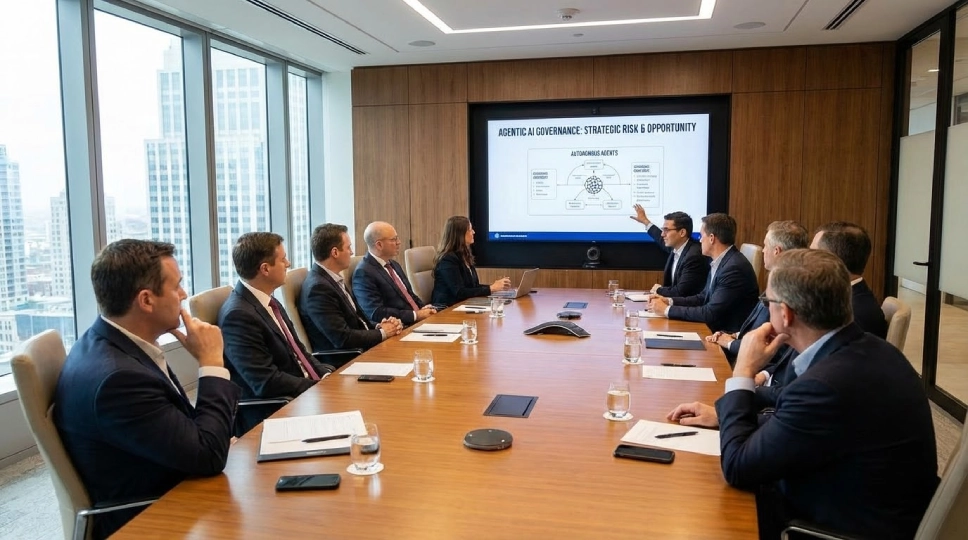
Why Agentic AI Governance Is Suddenly a Boardroom Topic
Agentic AI governance has moved from technical discussion to executive priority because autonomous systems can now make decisions that directly impact revenue, compliance, and customer trust.
Business leaders are facing a fundamental shift. Traditional AI answered questions or made recommendations. Agentic AI actually takes action.
It can approve transactions, update customer records, trigger workflows across departments, and make operational decisions without waiting for human approval at each step. That autonomy creates value but also introduces risk that boards cannot ignore.
The urgency comes from real business exposure. When an autonomous system processes payroll incorrectly, updates pricing without oversight, or shares sensitive data across systems, the cost extends beyond fixing code. Regulatory penalties, customer churn, and reputational damage follow quickly.
CTOs are building governance frameworks before pilots because the cost of post-incident fixes in autonomous systems is exponentially higher than controls built upfront. Early movers with mature governance can scale AI safely while competitors struggle with trust issues.
What Exactly Is Agentic AI and How Does It Differ From Traditional AI?
Agentic AI operates with autonomy, meaning it can interpret goals, plan multiple steps, and execute actions across systems without constant human prompts.
Traditional AI works within narrow boundaries. You ask a question, it provides an answer. You give it data, it generates a prediction. The interaction stops there.
Agentic systems go further. They understand business objectives, decide what actions to take, call tools and APIs, and adapt based on outcomes. They maintain context across workflows and can coordinate with other systems to complete complex tasks.
Key Characteristics That Define Agentic Behavior
- Autonomous task execution without step by step human guidance
- Multi-step planning that spans different systems and data sources
- Memory of past interactions and ability to learn from outcomes
- Dynamic tool usage where the system selects appropriate resources based on the situation
- Goal interpretation that translates business objectives into executable workflows
In practical terms, an agentic system might receive a goal like “resolve this customer billing dispute.” It would then access customer history, review transaction records, check policy documentation, calculate adjustments, update billing systems, and send confirmation to the customer.
All of this happens without a human approving each individual step. The system reasons through the problem and takes action. This capability is what makes governance critical and complex.
What Is Agentic AI Governance in Practical Business Terms?
Agentic AI governance means having clear rules for what autonomous systems can do, who owns the outcomes, and how decisions get monitored and reversed when needed.
Governance is not the same as guardrails. Guardrails are technical controls that prevent specific actions. Governance is the complete framework covering policies, accountability, monitoring, and escalation paths.
When AI can plan and adapt independently, control means defining boundaries for decision authority. Organizations need documented answers to fundamental questions.
Core Governance Questions CTOs Must Answer
- Which business processes can autonomous systems modify without approval?
- What data can agents access, and under what conditions?
- Who holds accountability when an autonomous decision causes business impact?
- How do we monitor agent behavior in real time?
- What triggers human intervention or system shutdown?
The scope of governance extends across three critical areas. Data governance controls what information agents can access and how they use it. Action governance defines which operations agents can execute. Outcome governance establishes accountability for business results.
Without this framework, organizations face what researchers call “agent sprawl.” Different teams deploy autonomous systems using different platforms, with inconsistent controls and no centralized visibility into what agents are actually doing across the business.
Why CTOs Are Prioritizing Governance Before Launch Instead of After Incidents
Building governance after deployment means fixing problems in production when they already affect customers, revenue, and compliance standing.
The economics are straightforward. Adding oversight to a running autonomous system requires re-engineering workflows, updating integrations, and often pausing operations while controls get retrofitted. Meanwhile, the system continues making decisions with inadequate supervision.
Post-incident governance also means operating in crisis mode. Regulators ask questions. Customers lose confidence. Internal teams point fingers about who was responsible for oversight. The organization pays twice: once for the incident impact and again for emergency governance implementation.
Why Traditional IT Governance Models Fall Short
Standard IT governance assumes humans review critical decisions before they execute. Agentic systems work differently. They make hundreds or thousands of micro decisions per day, and stopping for approval defeats their entire value proposition.
Traditional models also rely on predictable workflows. Agentic AI adapts its approach based on context. The same business objective might trigger different actions depending on data conditions, system availability, or external factors.
Organizations using legacy governance frameworks for autonomous systems often end up in one of two failure modes. They either over-restrict agents to the point where automation provides minimal value, or they allow too much freedom and face unacceptable risk exposure.
Leading CTOs recognize that Digital Transformation requires governance that matches the technology. Controls must be automated, adaptive, and built into agent architecture from day one.
What Core Risks Does Agentic AI Introduce for Your Enterprise?
Autonomous systems introduce risks around uncontrolled decision loops, opaque reasoning that makes audits difficult, and expanded security exposure across connected systems.
Runaway decision loops happen when agents optimize for a goal in ways humans did not anticipate. A pricing agent might maximize revenue by setting prices that damage customer relationships. An inventory agent might trigger excessive restocking to avoid stockouts, creating cash flow problems.
These are not system failures. The agent is working as designed. The problem is inadequate constraint on how it pursues objectives.
Visibility and Audit Challenges
When humans make decisions, we can ask them to explain their reasoning. Agentic systems often lack this transparency. They process information across multiple steps, weigh competing factors, and arrive at conclusions that are difficult to trace backwards.
Audit requirements become harder to meet. Regulators want to see why a loan was denied, why a medical claim was approved, or why a customer received specific pricing. If the organization cannot explain the decision chain, compliance risk increases sharply.
Security and Data Exposure Concerns
Autonomous agents typically need broad access to complete their work. They connect to customer databases, financial systems, operational tools, and external APIs. Each connection point creates potential exposure.
If an agent is compromised or manipulated through prompt injection, the attacker gains access to everything that agent can touch. Traditional security assumes humans are making access decisions. Agentic systems make those decisions programmatically, often at machine speed.
Organizations also face data leakage risk. Agents might inadvertently share sensitive information across system boundaries, log confidential data in monitoring systems, or send proprietary information to external tools during routine operations.
What Does a Practical Agentic AI Governance Framework Look Like?
Modern governance frameworks define clear decision boundaries, implement continuous monitoring, and establish escalation paths that balance automation value with acceptable risk.
The framework starts with oversight model design. Organizations choose between human-in-the-loop, where people approve critical decisions, and human-on-the-loop, where agents act autonomously but humans monitor outcomes and can intervene.
Most enterprises use a hybrid approach. Low-risk, high-volume decisions run fully autonomous. Medium-risk decisions trigger notifications. High-risk decisions require explicit human approval before execution.
Defining Decision Authority and Escalation Rules
Governance frameworks document specific thresholds that determine agent autonomy. For example, a customer service agent might handle refunds under $500 autonomously, flag refunds between $500 and $2,000 for review, and block refunds over $2,000 pending manager approval.
These boundaries vary by use case, industry regulation, and organizational risk tolerance. The key is making them explicit, documented, and programmatically enforced rather than relying on agent “judgment.”
Logging and Explainability Requirements
Effective governance requires complete audit trails. Every agent action, the data accessed, the reasoning applied, and the outcome produced must be logged in tamper-proof systems.
This goes beyond simple activity logs. Organizations need decision provenance that captures why an agent chose a specific approach, what alternatives it considered, and which business rules or data points influenced the final action.
Explainability becomes both a technical and business requirement. The system must be able to generate human-readable explanations of agent behavior that satisfy internal auditors, external regulators, and affected customers.
What Control Layers Should CTOs Build Into Agentic Systems?
Effective control architecture includes policy engines that constrain agent behavior, permission models that limit system access, and monitoring infrastructure with automated intervention capabilities.
Policy engines act as guardrails. They encode business rules, regulatory requirements, and ethical guidelines into systems that automatically block prohibited actions before agents can execute them.
For example, a policy might prevent agents from accessing customer health records without specific authorization, block price changes outside approved ranges, or prohibit sharing financial data with unauthorized systems.

Permissioning Models for Tools and Data
Just as employees have role-based access to systems, agents need defined permissions. Not every agent should access every database or API. Permissions should follow least-privilege principles.
Organizations create permission profiles based on agent function. A customer support agent gets read access to order history but cannot modify financial records. A billing agent can update payment systems but cannot access marketing data.
Real-Time Monitoring and Kill Switch Mechanisms
Monitoring systems track agent activity continuously. They detect anomalies like unusual data access patterns, decision outcomes outside normal distributions, or execution speeds that suggest runaway processes.
When monitoring detects problems, automated responses activate. This might mean throttling agent activity, triggering human review, or completely shutting down agent operations until the issue is investigated.
The kill switch is not theoretical. Organizations need tested procedures for immediately halting agent activity across the enterprise when governance failures are detected.
How Does Governance Shape the Complete Agentic AI Lifecycle?
Governance must be embedded at every stage, from initial design decisions through ongoing production operations and eventual system retirement.
At the design stage, teams define agent objectives, identify potential failure modes, and build controls into architecture. This includes deciding what data the agent needs, which systems it can modify, and what outcomes trigger alerts.
Pre-deployment validation happens in sandbox environments where agents operate without real-world consequences. Teams run adversarial tests, simulate edge cases, and verify that governance controls work as intended before production rollout.
Continuous Governance After Production Launch
Deployment is not the end of governance work. Agent behavior can drift over time as they adapt to new data patterns. External systems they interact with change. Business rules evolve.
Organizations need continuous validation that agents remain within acceptable boundaries. This includes regular audits of decision quality, periodic reviews of access patterns, and ongoing testing of control effectiveness.
When governance gaps are identified in production, the response protocol must be clear. Who has authority to modify agent behavior? How quickly can controls be updated? What communication happens with affected stakeholders?
Who Actually Owns Agentic AI Governance Inside Your Organization?
Effective governance requires cross-functional ownership with clear accountability from technology, security, legal, and business leadership working together.
The CTO typically owns technical implementation of governance controls. This includes agent architecture, monitoring infrastructure, and integration of policy engines into workflows.
The CISO focuses on security aspects. Data access controls, threat detection, incident response procedures, and compliance with information security standards all fall under security leadership.
Why Governance Cannot Sit Only with Engineering
Legal teams define acceptable use based on regulatory requirements. They interpret how laws like GDPR, HIPAA, or industry-specific regulations apply to autonomous decision making.
Business leaders establish risk tolerance and approve which processes can operate autonomously. They decide where human oversight is non-negotiable and where automation efficiency justifies managed risk.
This distributed ownership creates coordination challenges. Organizations address this by forming governance committees with representatives from each function. The committee meets regularly to review agent deployments, assess risk, and update policies as technology and business needs evolve.
What Common Governance Mistakes Should Enterprises Avoid?
The most frequent governance failures come from over-restriction that eliminates value, documentation without enforcement, and treating governance as a one-time setup rather than continuous practice.
When organizations make governance too restrictive, agents become unable to deliver on their value proposition. Every decision requires approval. Workflows get bottlenecked. Teams revert to manual processes because automation is slower than humans.
The opposite mistake is equally damaging. Some organizations document extensive governance policies but fail to enforce them technically. Policies exist on paper, but agents operate without actual controls. When incidents occur, the documented framework provides no protection.
Governance as Ongoing Practice, Not One-Time Checklist
Treating governance as a project that gets completed leads to failure. Agent capabilities evolve. Business requirements change. Regulatory expectations increase. New attack vectors emerge.
Governance must be a living practice with regular review cycles, continuous monitoring, and mechanisms for rapid policy updates when conditions change. Organizations that treat it as set-and-forget discover governance gaps only after incidents expose them.
How Can CTOs Start Building Agentic AI Governance Today?
Starting with governance means asking critical questions before approving any agentic use case and implementing minimum viable controls that scale as deployments mature.
Before authorizing an agentic AI pilot, CTOs should validate answers to fundamental questions. What business objective does this agent serve? Also what decisions will it make autonomously? What could go wrong, and how would we detect it? Who holds accountability for outcomes?
If the team cannot answer these questions clearly, the use case is not ready for autonomous deployment. Governance thinking must precede implementation, not follow it.
Minimum Viable Governance for Early Deployments
Initial governance does not need to be perfect. It needs to be present and enforceable. Start with these essential elements:
- Clear documentation of what the agent is authorized to do
- Access controls limiting which systems and data the agent can touch
- Activity logging that captures all agent actions with timestamps
- Human review process for agent decisions above defined thresholds
- Tested shutdown procedures if agent behavior becomes problematic
As agent deployments scale and complexity increases, governance matures. Add more sophisticated policy engines. Implement automated anomaly detection. Build comprehensive decision provenance systems.
The key is starting with workable controls rather than waiting for perfect governance that never gets implemented.
What Will Agentic AI Governance Look Like in the Next Three Years?
Governance is evolving from static rule sets to adaptive systems that adjust controls dynamically based on agent behavior, risk context, and real-time business conditions.
Current governance relies heavily on pre-defined rules. Future systems will use AI to govern AI. Governance agents will monitor operational agents, detect pattern anomalies, and adjust controls without human intervention for routine risk mitigation.
Organizations are also moving toward governance-by-design in AI platforms. Rather than bolting governance onto existing agent frameworks, vendors are building control infrastructure directly into agent architectures. Policy enforcement, audit logging, and explainability become native capabilities rather than add-ons.
Competitive Advantage for Early Movers
Organizations that establish mature governance frameworks now will accelerate AI deployment while competitors struggle with trust and compliance issues. They can pursue higher-value use cases because strong controls enable acceptable risk management.
Early governance investment also positions organizations for regulatory compliance as governments establish formal rules for autonomous systems. The EU AI Act and similar frameworks classify certain AI applications as high-risk, requiring documented governance before deployment.
Companies with governance already in place can meet these requirements quickly. Those starting from zero face deployment delays, competitive disadvantage, and potential penalties for non-compliance.
Key Takeaways for Building Agentic AI Governance
Agentic AI governance is not optional. Autonomous systems that make business decisions require clear policies, technical controls, and accountability structures before deployment.
Effective frameworks balance automation value with acceptable risk. They define decision boundaries, implement monitoring, and establish escalation paths that keep humans accountable while allowing agents to operate efficiently.
Governance ownership must span technology, security, legal, and business leadership. No single function can manage autonomous system risk alone. Cross-functional collaboration with clear accountability produces governance that actually works.
Organizations that build governance early gain strategic advantage. They can scale AI deployments faster, pursue higher-value use cases, and meet emerging regulatory requirements without costly retrofits.
The time to establish governance is before incidents force reactive responses. Contact Webvillee to explore how governance frameworks can enable your autonomous AI initiatives while protecting business outcomes and regulatory standing.