

Schedule Your Free System Health Check: What Webvillee Reviews in a 2026 Technology Audit
Most CTOs believe their systems are running fine until they stop running at all. A professional technology audit reveals hidden costs, security gaps, and optimization opportunities before they become expensive crises. Schedule your free system health check to get honest assessment of your technology stack without sales pressure.
Why Smart CTOs Schedule Technology Audits Before Problems Become Crises
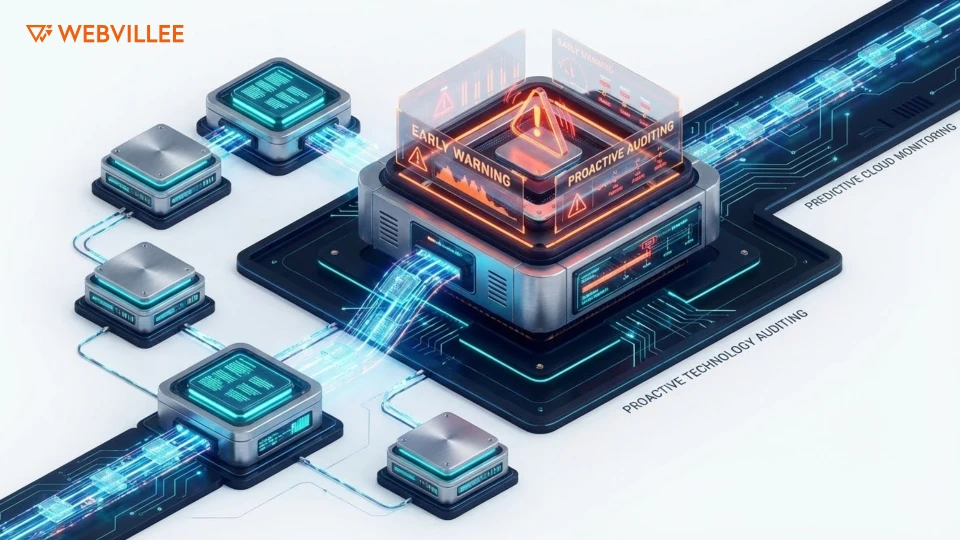
CTOs who schedule technology audits proactively discover hidden costs, security vulnerabilities, and inefficiencies before they become expensive emergencies requiring emergency fixes.
You manage technology budgets based on what you know. But most organizations don’t know what they don’t know. Your systems seem fine until they don’t. By then, emergency response costs 3-5x more than preventive assessment.
Smart CTOs schedule technology audits on regular basis, treating system health the way organizations treat facility maintenance. Preventive inspection catches problems early. Reactive response handles disasters expensively.
The Hidden Costs of Everything Seems Fine
Organizations believing their systems are fine typically have $500K-$2M in hidden costs from over-provisioned cloud infrastructure, manual workarounds, security vulnerabilities, and underutilized technology investments.
- Over-provisioned cloud resources consuming budget unnecessarily costing $100K-$400K annually
- Manual workarounds and shadow IT systems duplicating capabilities and wasting staff time
- Security vulnerabilities exposing organization to breach risk and compliance violations
- Underutilized technology investments not delivering promised ROI
- Disconnected systems creating manual handoffs and data errors
- Outdated software creating maintenance burden and limiting innovation
- Poor disaster recovery capabilities creating business continuity risk
- Vendor lock-in preventing flexibility and driving costs upward
Most CTOs underestimate these hidden costs by 50-70% until comprehensive audit reveals true picture.
What a Comprehensive Technology Audit Actually Reveals
Technology audits analyze eight core areas: system performance, integration gaps, security compliance, cloud optimization, legacy modernization, user adoption, disaster recovery, and vendor relationships.
Each area reveals specific risks and opportunities. Performance analysis identifies bottlenecks slowing business operations. Integration review shows where data gets trapped or requires manual transfer. Security assessment exposes vulnerabilities and compliance gaps.
Cloud optimization audit finds over-provisioned resources and right-sizing opportunities. Legacy system review quantifies technical debt and modernization investment. User adoption analysis identifies systems teams have stopped using and why.
Disaster recovery audit assesses how quickly you could recover from failure. Vendor relationship review evaluates whether you’re receiving promised support and value.
What Makes Webvillee’s Technology Audit Different
Webvillee’s technology audit prioritizes business outcomes over technical details, providing honest assessment without sales pressure, and delivers a roadmap you can actually use.
Most technology audits produce massive reports filled with technical jargon. You don’t know what matters or what to do first. Our audit focuses on business impact: what costs you money, what creates risk, what limits competitiveness.
We deliver honest assessment without pushing solutions we want to sell. You get recommendations you can take anywhere. If Webvillee solution is right fit, that becomes obvious. If competitors are better fit, we tell you.
Your roadmap prioritizes by business impact, not technical complexity. You know which items address revenue, which address risk, which address efficiency. You make informed investment decisions.
Review Area 1: System Performance and Scalability Gaps
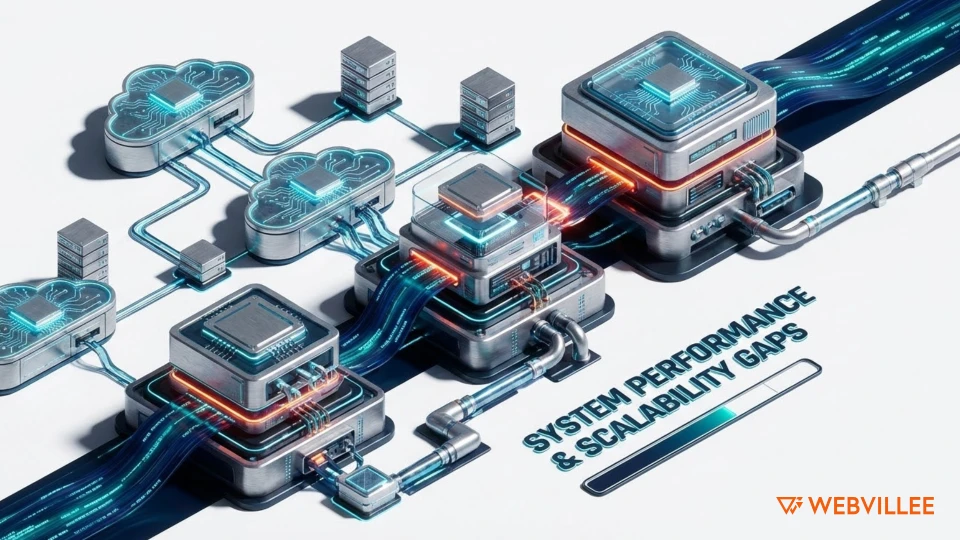
Performance audit reveals whether current systems handle peak demand without bottlenecks, identifies growth limitations slowing business expansion, and quantifies scalability investment needed.
We measure system performance under real workloads, not theoretical capacity. How fast does your CRM respond during quarter-end crunch? Does your infrastructure handle peak transaction volume without degradation?
Bottlenecks that create slowdowns during critical business periods get identified and quantified. Growth limitations preventing business expansion get exposed. You learn exactly what infrastructure investment is needed to support planned growth.
Review Area 2: Integration and Data Flow Analysis
Integration audit maps where data gets trapped between systems, identifies manual handoffs creating errors and delays, and calculates true cost of disconnected tools.
Most organizations accumulate tools without connecting them properly. Customer data lives in CRM but not in billing system. Financial transactions live in accounting but not in business intelligence. Manual transfers move data between systems, creating errors and consuming staff time.
Integration audit shows these gaps clearly. You see exactly which system connections are missing and what business impact results. Data trapped between systems costs money through errors, delays, and manual workarounds.
Review Area 3: Security Vulnerabilities and Compliance Risks
Security audit identifies outdated systems exposing your business, compliance gaps that could cost customers and revenue, and access control weaknesses allowing unauthorized data access.
Outdated software no longer receiving security patches becomes increasingly vulnerable over time. Compliance gaps with regulations including GDPR, CCPA, and industry-specific requirements expose organization to fines and customer trust damage.
Access controls determine who can see what data. Weak controls allow employees inappropriate access. Strong controls limit visibility appropriately. Audit identifies where controls need strengthening.
Review Area 4: Cloud Cost Optimization Opportunities
Cloud audit identifies where you’re overpaying for infrastructure, shows right-sizing opportunities reducing costs 20-40%, and recommends multi-cloud strategies reducing vendor lock-in.
Most organizations provision cloud resources conservatively to guarantee performance, resulting in over-provisioned infrastructure consuming budget unnecessarily. Audit identifies under-utilized resources and right-sizing opportunities.
Multi-cloud strategies provide flexibility and cost leverage preventing vendor lock-in. Audit recommends which workloads should run on which platforms for optimal cost and performance.
Review Area 5: Legacy System Modernization Assessment
Modernization audit quantifies technical debt slowing competitive edge, determines when to replace versus modernize systems, and provides realistic timeline and investment estimates.
Legacy systems create technical debt that limits innovation velocity. Modernization assessment determines which systems are candidates for replacement, which can be upgraded, and which might be retired.
You learn realistic investment needed, timeline for modernization, and competitive advantage gained. Modernization becomes strategic investment with clear business case rather than vague ambition.

Review Area 6: User Adoption and Workflow Efficiency
Adoption audit identifies systems your team has stopped using despite significant investment, distinguishes between training gaps and design flaws, and reveals workflow inefficiencies limiting productivity.
Systems your team abandoned create sunk costs and ongoing maintenance burden. Audit reveals why adoption failed: was the system poorly designed, was training inadequate, or were user needs not understood?
Workflow efficiency assessment identifies where systems create friction. Are processes forcing manual workarounds? Are systems requiring unnecessary steps? Audit reveals where simplification is possible.
Review Area 7: Disaster Recovery and Business Continuity Readiness
Disaster recovery audit assesses how quickly you could recover from system failures, evaluates backup strategies under real failure scenarios, and identifies single points of failure in infrastructure.
Most disaster recovery plans look good on paper but fail under real failure conditions. Audit tests recovery capability with realistic failure scenarios. How quickly could you recover from ransomware attack? Data center failure? Network outage?
Single points of failure in infrastructure create vulnerability. Audit identifies critical systems with no redundancy. You learn which infrastructure changes would most improve business continuity.
Review Area 8: Vendor Relationship and Support Quality
Vendor audit evaluates whether you’re receiving promised support, identifies lock-in risks limiting future flexibility, and calculates total cost of ownership beyond license fees.
Vendor relationships sometimes drift over time. Support quality decreases. Pricing increases. Audit assesses what you’re actually receiving versus what you’re contracted to receive.
Lock-in risk assessment shows whether you could switch vendors if needed, or whether switching costs would be prohibitive. Total cost of ownership calculation includes not just licenses but support, maintenance, and staff time.
What You’ll Receive After Your Technology Audit
Audit delivers prioritized action plan based on business impact, clear cost estimates and timeline expectations, and no-obligation recommendations you can take to any technology partner.
- Action plan prioritizes by business impact: what addresses revenue, what addresses risk, what addresses efficiency
- Cost estimates and timelines are realistic and based on your specific situation, not generic benchmarks
- Recommendations come without obligation to use Webvillee services
- You can take recommendations to other vendors for comparison
- Most clients choose Webvillee because we’ve proven assessment accuracy and approach value
Who Should Schedule a Technology Audit
CTOs managing technology budgets, Product Owners responsible for system performance, and Business Leads evaluating technology investment should schedule audits if their systems haven’t been professionally reviewed in 2+ years.
Signs your systems need professional review include cloud bills increasing faster than usage, teams using workarounds instead of approved systems, system performance degradation during peak periods, security concerns, and technology investments not delivering promised ROI.
The right time to audit is before major investments. Audit findings should inform investment decisions, not validate decisions already made.
How the Free System Health Check Works
Free audit includes 90-minute discovery session gathering information from your team, no sales pressure or obligation, and initial assessment highlighting top opportunities.
- We conduct discovery sessions with CTOs, operations leaders, and technical teams to understand your environment comprehensively
- We review documentation about current systems, infrastructure, and support arrangements
- We ask about pain points, frustrations, and ambitions for technology evolution
- We provide initial assessment within one week highlighting top opportunities and estimated impact
- No obligation to proceed further after initial assessment
From discovery and documentation review, we provide clear picture of where you stand and what matters most for your business.
Real Results from Recent Technology Audits
Manufacturing company reduced cloud costs 40% through right-sizing and multi-cloud strategy. Financial services firm closed critical security gaps before compliance audit. Retail business eliminated data silos connecting 12 locations.
- Manufacturing Client: Over-provisioned AWS infrastructure was consuming $400K annually. Audit identified $160K in unnecessary spending through right-sizing and reserved instance recommendations.
- Financial Services Client: Security audit revealed compliance gaps that would have triggered significant fines in upcoming regulatory review. Addressing gaps before external audit prevented penalties.
- Retail Client: 12-location retail business had data fragmented across regional systems with manual consolidation for reporting. Unified data platform provided single customer view across all locations.
The Cost of Not Knowing What’s Wrong with Your Systems
Waiting until systems fail costs 3-5x more in emergency response than preventive assessment. Organizations that audit proactively avoid expensive crises and capture optimization opportunities competitors miss.
Emergency response when systems fail is expensive and disruptive. Preventive assessment costs fraction of emergency response while avoiding disruption entirely.
Organizations understanding their technology landscape make better investment decisions. Competitors still guessing at their environment make reactive decisions that cost more and deliver less value.
Working with technology audit and digital transformation strategy experts helps you understand your technology landscape comprehensively before investments are made.
Next Steps: Schedule Your Free Technology Audit
If your organization hasn’t had professional technology review in two or more years, schedule your free system health check now. Discover hidden costs, identify security gaps, and get prioritized roadmap for technology evolution.
The audit is free with no obligation. You receive honest assessment and actionable recommendations you can implement with any partner. Most CTOs find the discoveries alone justify the time invested.
Contact Webvillee to schedule your free technology audit today. Our audit specialists will work with your team to assess your current environment, identify opportunities, and provide clear roadmap for technology optimization. Let’s uncover what you don’t know about your systems before it becomes expensive.