

How Webvillee Handles Change Management: 7 Ways We Get Your Team to Actually Use New Systems
Most digital transformation projects fail because change management is treated as afterthought, not strategy. Webvillee’s change management methodology ensures your team actually adopts new systems rather than resisting them.
Why Most Digital Transformations Fail (And It’s Not the Technology)
Digital transformations fail not because technology is poor, but because change management is inadequate and teams refuse to abandon familiar systems for unfamiliar alternatives.
You’ve invested millions in new CRM, cloud infrastructure, or enterprise platform. Technical implementation succeeds. System goes live on schedule. Then nothing changes. Your team continues working around the new system using legacy workarounds because adoption training was minimal and change management was absent.
Technology doesn’t transform organizations; people using technology differently transforms organizations. Poor change management means teams never make that shift. Your expensive new system becomes expensive legacy overhead.
Webvillee’s approach treats change management as core project component, not optional activity. We ensure your team isn’t just trained on new systems; they’re equipped and motivated to actually use them.

The Real Cost of Poor User Adoption
Poor user adoption costs enterprises $500K-$2M+ annually through continued manual workarounds, system underutilization, lost productivity, and failed ROI on technology investments.
- Continued manual processes despite new automation capabilities costing $200K-$600K annually in preventable labor
- Workarounds and shadow IT systems created when teams refuse approved solutions, duplicating functionality
- Lost productivity during extended learning curves and resistance periods lasting weeks or months
- Failed ROI as promised business benefits don’t materialize because teams won’t use the system
- Repeated implementation attempts and system replacements when initial adoption fails
- Hidden IT costs from supporting both old and new systems simultaneously during extended transition periods
- Opportunity costs from innovation delayed because teams focus on managing transition instead of business growth
- Employee turnover as talented staff leave due to frustration with poorly managed change
Organizations with strong change management realize 60-70% of promised technology ROI. Those without change management realize 20-30% of projected benefits.
What Happens When Your Team Refuses the New System
Team resistance creates shadow IT environments, continued manual processes, hidden costs, and organizational dysfunction where formal and informal systems operate simultaneously.
- Teams continue using legacy systems for actual work while pretending to use new system for compliance
- Manual spreadsheets and workarounds replace automated processes, creating hidden IT and operational burden
- Data exists in multiple locations, creating inconsistency, compliance risk, and unreliable reporting
- IT support burden increases managing two systems instead of transitioning cleanly to new platform
- Decision-makers rely on incomplete information from manual systems because teams don’t input data into new system
- Training investment is wasted when trained teams revert to legacy methods immediately after training
- Implementation costs escalate as “go live” becomes extended transition dragging on for months or years
- Competitive disadvantage widens as competitors with adopted systems move faster and smarter
Organizations experiencing adoption resistance typically spend 12-24 months in dysfunctional transition state instead of 3-6 months with proper change management.
Way 1: We Start Before the Code Does
Change management begins during discovery phase, not after implementation, ensuring teams understand transformation rationale and feel ownership before resistance forms.
Discovery Sessions with Your Actual Users, Not Just Leadership
We conduct discovery sessions with frontline employees who will actually use the system, not just executive sponsors. These sessions reveal how real work happens, what frustrations teams face with current systems, and what capabilities matter most to daily productivity.
Frontline users become change advocates because they shaped the solution. Leadership input matters but can’t replace understanding how the organization actually operates daily.
Building the Business Case Your Team Can Rally Behind
We translate technology changes into business benefits that mean something to your team. Not “we’re implementing new CRM system,” but “this system reduces data entry time so you spend more time on client relationships and close deals faster.”
When teams understand why change is happening and what’s in it for them, resistance decreases dramatically. Business case becomes conversation opener, not change announcement.
Identifying Champions and Resisters Early
Discovery identifies natural champions who will embrace change and early resisters who need different engagement approach. Champions become your internal advocates. Resisters get addressed individually with customized communication before large-scale change begins.
Way 2: We Design for Your Team’s Current Reality
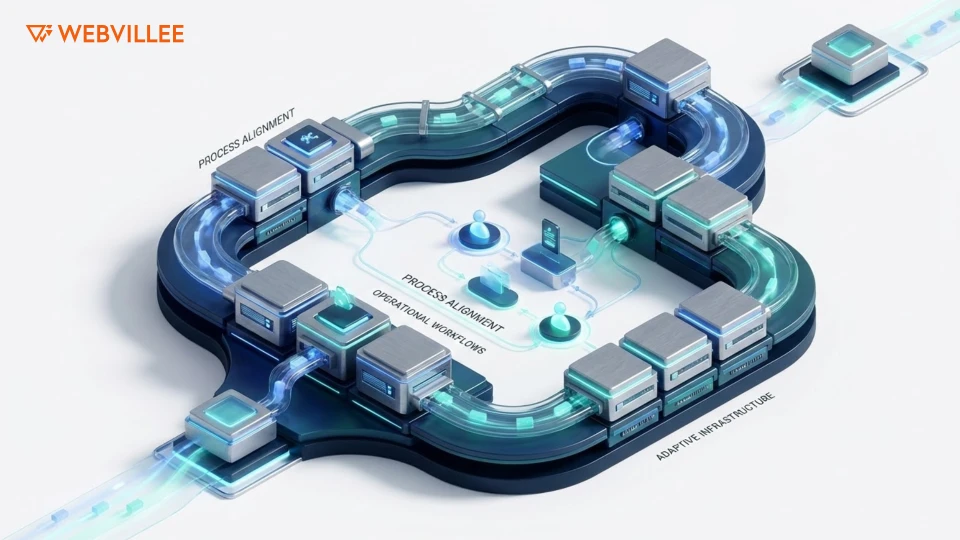
System design accounts for how your team actually works today, bridging from familiar workflows to new processes rather than forcing teams to abandon everything and start over.
Most implementations force teams to completely change how they work. We design for incremental workflow evolution where familiar elements remain while inefficient steps are replaced. This reduces adoption friction dramatically.
New system mirrors current workflow structure, then gradually introduces efficiencies. Teams experience continuity rather than complete disruption, reducing learning curve and resistance.
No Assumptions About Technical Comfort Levels
We design interfaces and workflows for the least technical user in your organization, not assuming everyone is comfortable with technology. Icons are clear. Navigation is intuitive. Terminology matches how your business actually talks about processes.
Workflows That Match How Your People Actually Work Today
We observe how your team currently completes daily work. The system is customized to match that workflow, not force radical change. Familiar steps remain. Redundant steps are eliminated. New capabilities are added to existing flow.
Bridging the Gap Between Old Habits and New Processes
Transition doesn’t mean abandonment of everything familiar. We build bridges from old processes to new, maintaining continuity while introducing improvements. Teams feel supported rather than abandoned.
Way 3: Phased Rollouts That Don’t Overwhelm
Big bang launches overwhelm support teams and create resistance. Phased rollouts start small with high impact areas, prove value before expanding, and build confidence gradually.
- Start with department or user group most ready to adopt, creating early success stories
- Expand to adjacent teams once initial group demonstrates success and becomes internal advocates
- Address process refinements discovered during initial phases before expanding further
- Build momentum through successive phases where each group sees success before their own rollout
- Focus on high impact areas first where benefits are immediately visible to users
- Maintain parallel systems during transition, allowing safe fallback if issues emerge
- Complete full rollout over 6-9 months rather than forcing organization-wide change simultaneously
Phased approaches reduce adoption resistance by 40-50% compared to big bang implementations because teams see proof of concept before committing.
Way 4: Training That Sticks (Not Just One Time Sessions)
Single training sessions create illusion of preparedness without actual capability. We deliver role-based training, hands-on practice with real data, and just-in-time resources that enable continuous learning.
- Role-based training for different user groups rather than one-size-fits-all sessions that feel irrelevant to most participants
- Hands-on practice with real data scenarios from your actual business, not generic examples
- Just-in-time learning resources available when teams need help on specific tasks, not weeks after training
- Peer learning where experienced users train colleagues, building internal capability
- Refresher training before major system updates preventing capability loss over time
- Microlearning modules delivering specific skills in 5-10 minute sessions rather than hour-long sessions teams can’t remember
- Knowledge capture from training so learnings aren’t lost when trainers leave organization
Organizations using comprehensive training approach see 70-80% adoption rates. Those using single training session see 30-40% adoption rates.
Way 5: We Build Internal Champions, Not Dependency on Us
We transfer knowledge to your super users and empower them as internal support network, creating sustainable adoption independent of external consultants.
Identifying and Empowering Your Super Users
We identify natural system champions within your organization, train them deeply, and empower them as first line support for colleagues. Super users have credibility your team trusts and availability your team values.
Creating a Support Network Inside Your Organization
We help super users establish peer support structure where experienced users help newer users, building community around the system. Support network becomes self-sustaining after we leave.
Transfer of Knowledge, Not Vendor Lock In
We document everything your internal team needs to support the system independently. You’re not dependent on our consultants; your team owns the system. This builds organizational capability that persists long-term.
Way 6: Feedback Loops That Actually Lead to Changes
We establish mechanisms for rapid user feedback and implement improvements based on actual usage patterns, making your team feel heard throughout the process.
Early frustrations with new systems create resistance that hardens over time. We capture feedback rapidly, address legitimate issues quickly, and show users their feedback led to changes. This transforms perception from “they imposed this on us” to “we shaped this together.”
Iterative improvements based on real usage patterns continue post-launch, preventing adoption problems from calcifying into permanent workarounds.

Way 7: We Measure Adoption, Not Just Deployment
Success isn’t deployment; success is usage. We track real adoption metrics, identify where adoption stalls, and address drop-off points before they become permanent habits.
- Track system usage metrics showing who’s using which features and how frequently
- Identify usage drop-off points where adoption stalls for specific departments or user groups
- Measure adoption velocity showing progress toward target adoption rates
- Benchmark against industry standards so you know if adoption is on track or lagging
- Address drop-off points immediately with targeted support and process improvements
- Celebrate adoption wins publicly, building momentum and peer pressure for adoption
- Adjust training and support based on adoption data showing where teams struggle
Organizations measuring adoption see 25-35% better adoption rates than those measuring only deployment completion.
What This Means for Your ROI
User adoption determines whether technology delivers promised ROI. Poor adoption means investing millions without realizing benefits. Strong adoption makes investments genuinely profitable.
- Strong adoption enables promised productivity gains to actually materialize instead of remaining theoretical
- Teams using system as designed realize automation benefits that drive cost reduction
- Complete customer data from system usage enables accurate reporting and better decisions
- Faster decision-making from reliable system data becomes possible rather than delayed by data gathering
- Competitive advantage from system capabilities actualizes only if teams use system
- ROI payback timeline compresses from 24+ months to 12-18 months with strong adoption
- Hidden costs from workarounds disappear when teams abandon legacy methods
Organizations investing in change management realize 60-70% of promised technology ROI. Organizations skipping change management realize 20-30% of promised benefits.
How Webvillee’s Approach Is Different
Most implementations treat change management as check-box activity. Webvillee treats change management as core transformation strategy ensuring human success, not just technical success.
| Aspect | Standard Implementation | Webvillee Approach |
|---|---|---|
| Change Management | Afterthought after technical build | Core strategy from discovery forward |
| Training | Single sessions before go-live | Role-based, hands-on, ongoing learning |
| User Involvement | Executive sponsors define requirements | Frontline users shape solution |
| Rollout | Big bang across organization | Phased approach with early wins |
| Support | Limited post-launch | Extended adoption support post-launch |
| Success Metric | System deployment | User adoption and ROI realization |
| Knowledge Transfer | Consultants retained as ongoing support | Internal team capability building |
| Feedback Integration | Ignored after go-live | Rapidly implemented improvements |
The difference isn’t complexity; it’s prioritizing people as much as technology. Systems succeed when people choose to use them, not because they’re forced to.
Technology Doesn’t Transform Businesses, People Do
Enterprise technology fails when it’s treated as technical project. It succeeds when it’s treated as organizational transformation requiring change management as essential as implementation.
Your team is the implementation success factor. Invest in helping them succeed rather than assuming new system is self-explanatory. Strong change management converts skeptics into advocates and workarounds into productivity gains.
If your organization is planning technology transformation or struggling with adoption of recent implementation, contact Webvillee. Our change management specialists help enterprises ensure technology investments actually deliver business value through strong user adoption. Schedule a consultation to discuss your transformation approach.