

What Is Application Portfolio Rationalization? Why CTOs Are Doing It Before 2026
Application Portfolio Rationalization is the systematic assessment of all enterprise applications to identify which to keep, modernize, replace, or retire. The 2026 deadline for legacy system support ending makes this strategic decision critical for CTOs managing IT budgets and competitive positioning.
What is application portfolio rationalization and why does it matter now?
Application Portfolio Rationalization is the systematic assessment of all enterprise applications to identify which to keep, modernize, replace, or retire. The 2026 deadline for legacy system support ending makes this assessment critical now.
Most enterprises operate 200 to 400 applications simultaneously. Many overlap, some are obsolete, and others are unsupported legacy systems creating compliance risk and consuming budget that could drive innovation instead.
Application Portfolio Rationalization cuts through this complexity by answering a simple question: which applications actually deliver business value? The answer unlocks 25-35% in IT cost reduction, faster innovation, and reduced operational risk.
The 2026 deadline intensifies this urgency. SAP extended support ends, Oracle licenses become more expensive, and dozens of legacy platforms lose vendor backing. Waiting until 2026 forces reactive decisions under vendor pressure. Acting now enables strategic decisions that align technology with business priorities.
If you’re planning modernization, partnering with experienced advisors on comprehensive digital transformation strategy helps you assess your portfolio strategically and identify which applications drive competitive advantage versus which drain resources.

Why the 2026 deadline is forcing CTO decisions
The 2026 deadline marks the end of extended support for major legacy systems and the inflection point where maintaining unsupported applications becomes exponentially more expensive.
- SAP ECC support ends January 2027 leaving organizations with unsupported systems facing escalating maintenance costs and security vulnerability exposure
- Oracle Java licensing changes continue pricing pressure, making legacy Java-based applications increasingly expensive to operate
- Vendor lock-in costs spike after support ends, with replacement options suddenly appearing necessary and budget intensive
- Compliance violations accelerate when systems leave support, triggering audit failures and regulatory risk that demand urgent remediation
- Replacement costs inflate as dozens of enterprises simultaneously need new solutions, eliminating competitive negotiating leverage on pricing
The competitive advantage goes to organizations deciding their rationalization strategy NOW, not in 2025 when deadline pressure forces expensive emergency decisions.
What’s consuming 30-40% of your IT budget?
Your bloated application portfolio drains 30-40% of annual IT spending through maintenance, duplicate licenses, integration overhead, and compliance complexity for applications delivering minimal business value.
| Expense Category | Problem | Impact |
|---|---|---|
| Redundant Licenses | Multiple applications serving same business function (5+ CRM systems, 3+ HCM platforms) | License costs multiplied for overlapping capability |
| Maintenance Overhead | Support teams spending 60% of time on legacy systems instead of innovation | Annual support spending $500K-$2M+ for declining systems |
| Integration Complexity | Each application requires custom integrations to other systems | Every new application adds integration debt and maintenance burden |
| Compliance Burden | Unsupported or outdated applications trigger audit findings requiring remediation | Compliance team overhead increases, audit risk escalates |
| Staff Context Switching | Engineers managing dozens of systems with different architectures, languages, platforms | Knowledge fragmentation, slower response times, higher error rates |
Most CTOs could eliminate 30-40% of this spending by retiring applications that add complexity without delivering business outcome.
How to assess which applications to keep, replace, or retire
Assessment framework uses four criteria: business criticality, technical health, cost-to-operate, and modernization potential to make objective retire-replace-modernize decisions.
Business Criticality Assessment
Determine whether the application directly supports revenue, customer experience, or strategic business capability. Applications supporting none of these are candidates for retirement.
Core revenue systems and customer-facing applications score high. Back office and administrative systems score lower. Redundant applications supporting functions already handled by other systems score zero.
Technical Health Evaluation
Evaluate whether the application runs on supported platforms, receives regular security updates, and integrates cleanly with other systems. Legacy systems on unsupported databases or languages are modernization or retirement candidates.
Older systems requiring custom maintenance, running obsolete programming languages, or lacking vendor support are technical debt that drains resources.
Cost-to-Operate Analysis
Calculate total cost of ownership: licenses, maintenance, support staff, infrastructure, integration overhead, compliance burden, and operational risk from security vulnerability. Compare against business value delivered.
Applications costing more to maintain than they contribute to business outcomes are retirement candidates.
Modernization Potential Assessment
Determine whether the application should be modernized, replaced with a modern package, or retired based on strategic importance and modernization cost compared to replacement cost.
Strategic applications with poor technical health may justify modernization. Redundant applications should be retired. Non-strategic applications should be replaced with modern cloud solutions.
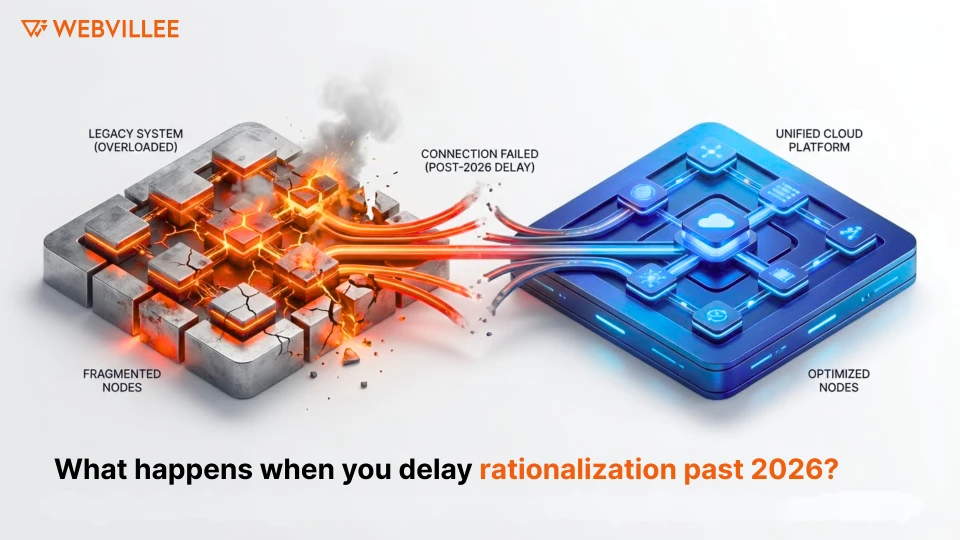
What happens when you delay rationalization past 2026?
Delayed action locks you into vendor pressure pricing, compliance violations, slower innovation cycles, and IT teams spending 60% of time maintaining legacy systems instead of building competitive advantage.
- Vendor negotiating leverage disappears after support ends, forcing you to accept whatever pricing and terms remain available for replacement systems or emergency maintenance
- Compliance violations mount when IT auditors flag unsupported systems as non-compliant, requiring emergency remediation that diverts budget and staff
- Security vulnerability exposure increases exponentially, with every month past 2026 increasing risk of breach from unpatched legacy systems
- Innovation slows substantially as engineering resources consumed by maintaining legacy infrastructure cannot be allocated to competitive product improvements
- Cost escalation accelerates when emergency decisions replace strategic thinking, resulting in over-sized, over-featured replacement systems purchased under deadline pressure
- Staff retention suffers as engineers and operations teams spend careers maintaining obsolete technology instead of working with modern platforms and methods
- Competitive disadvantage widens as competitors modernize and innovate while you maintain technical debt and slow response times
The cost of delay compounds monthly after 2026, making rationalization before the deadline a financially and strategically rational decision.
How rationalization enables 15-20% faster time-to-market
Streamlined portfolios eliminate technical debt, reduce integration complexity, and free IT resources to deploy features significantly faster than competitors with bloated application ecosystems.
- Reduced integration overhead from fewer systems means features deploy without navigating dozens of integration points and dependency chains
- Faster decision cycles because engineering teams work with 20 well-designed systems instead of 200+ systems with unclear purposes and interactions
- Eliminated context switching allows engineers to specialize in fewer platforms and master those technologies, increasing productivity and reducing errors
- Accelerated feature deployment as IT operations teams focus on continuous improvement instead of managing legacy system patches and workarounds
- Improved DevOps velocity when deployment pipelines serve modern systems instead of requiring manual processes for legacy systems unable to support automation
Organizations completing accelerated product engineering and deployment processes report 15-20% reduction in time-to-market for new capabilities, providing sustained competitive advantage against slower competitors maintaining technical debt.
- Better resource allocation enables investment in competitive capabilities instead of legacy system maintenance
- Faster incident response when IT teams manage smaller portfolios with fewer complex interactions and failure points
What ROI should you expect from rationalization?
Enterprises achieve 25-35% IT cost reduction, improved compliance posture, eliminated vendor lock-in risk, and increased competitive agility within 12-18 months of completing rationalization.
A mid-sized enterprise with $5M annual IT spending realizing 30% cost savings captures $1.5M in annual cost reduction. For enterprise organizations with $20M+ IT budgets, rationalization delivers $5M-$7M in annual savings.
These savings emerge from multiple sources working together. License cost reduction from eliminating redundant applications typically accounts for 40% of savings. Maintenance cost reduction from retiring legacy systems accounts for another 35%. Infrastructure cost reduction from consolidating systems accounts for the remaining 25%.
Beyond financial ROI, rationalization delivers strategic benefits. Compliance risk reduction from eliminating unsupported systems prevents audit failures and regulatory violations. Vendor lock-in elimination from retiring single-vendor platforms provides negotiating leverage for future replacements. Innovation acceleration from freed IT resources enables competitive differentiation through faster product improvement.
Most organizations begin seeing ROI within 6-9 months as quick wins produce immediate savings. Full ROI realization across the entire portfolio typically takes 12-18 months as complex applications complete migration or retirement.
How to start rationalization before 2026 deadline pressure hits
Successful rationalization requires assessment completion within 6 months and implementation planning within 9 months to avoid 2026 deadline pressure and resulting cost escalation from urgent decisions.
- Month 1: Inventory and categorize your complete application portfolio by department, business unit, and technology stack to understand the scope of rationalization work
- Month 2-3: Assess each application using the four-criterion framework (business criticality, technical health, cost-to-operate, modernization potential) to establish retire-replace-modernize categories
- Month 4-5: Develop detailed roadmap showing implementation sequence, timeline, budget requirements, and resource allocation for each rationalization decision
- Month 6: Complete assessment with stakeholder alignment on rationalization decisions and executive sign-off on implementation plan and budget
- Month 7-9: Design implementation approach including data migration planning, integration architecture, vendor selection for replacements, and change management strategy
- Month 10: Begin execution starting with lower-risk applications and quick wins that demonstrate value and build organizational momentum for larger rationalization efforts
- Months 11-24: Continue implementation in phases, completing complex rationalization decisions before 2026 deadline pressure and cost escalation
Organizations beginning assessment immediately capture the strategic advantage of deliberate decision-making. Those waiting until 2025 respond to deadline pressure with reactive decisions that typically cost 20-30% more.
If your organization is ready to evaluate application portfolio rationalization or develop detailed implementation strategy, Webvillee can help. Our digital transformation specialists bring experience rationalizing portfolios across manufacturing, finance, healthcare, and retail organizations. We assess your portfolio objectively, identify cost reduction opportunities, and execute implementation that delivers expected financial and operational benefits. Contact Webvillee to schedule a consultation with our rationalization specialists.