

What Prevents Enterprise Systems from Failing After Implementation?
System failures after implementation occur when organizations treat launch as an ending rather than a beginning. Post-launch management is where investments are protected or lost.
Why Do Most Enterprise Systems Fail in the First 90 Days After Launch?
Most enterprise systems fail in the first 90 days because organizations shift resources away immediately after go-live, leaving critical systems without monitoring, support, or governance.
Implementation teams disband. Budget moves to the next project. Your operations team inherits a system they didn’t build and don’t fully understand.
This handoff gap is where failures happen. Systems fail silently for days before anyone notices. Performance degrades undetected. Security gaps go unpatched. Integrations break without escalation.
The 90-day window is critical. This is when unexpected issues surface. Your organization either catches them with proper monitoring, or customers do.
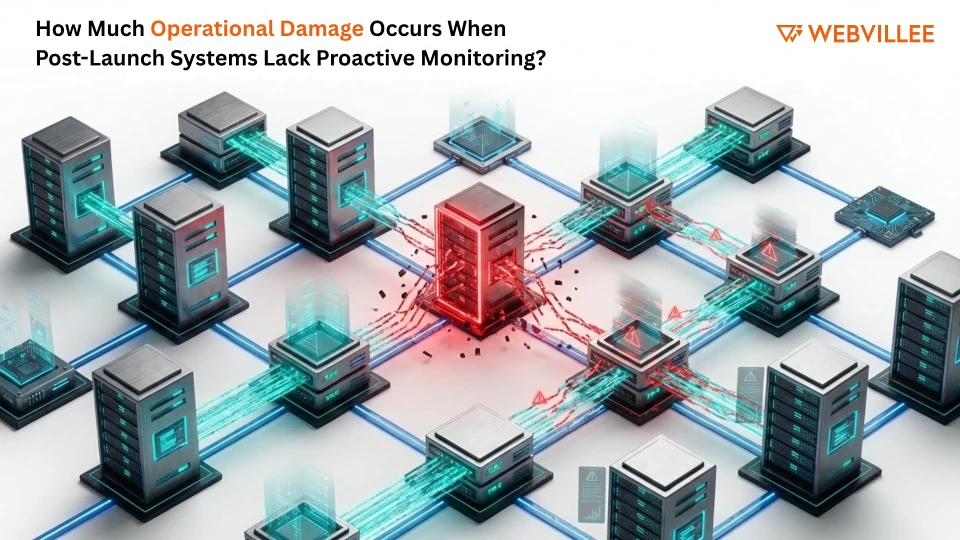
How Much Operational Damage Occurs When Post-Launch Systems Lack Proactive Monitoring?
Unmonitored systems fail unpredictably, causing revenue loss, customer frustration, and emergency repair costs that vastly exceed the cost of preventive oversight.
Without proactive monitoring, operational damage multiplies:
- A database performance issue goes unnoticed for hours, slowing customer transactions and eroding confidence.
- Integration between systems fails silently, causing data silos and forcing teams to manually reconcile information.
- Security vulnerabilities remain unknown, exposing customer data and your organization to breach liability.
- System capacity fills gradually without alerting anyone, until users experience slowdowns or complete outages.
- Error logs accumulate without being analyzed, hiding patterns that reveal systemic problems before they become crises.
- Compliance monitoring gaps create audit failures and regulatory exposure that weren’t part of the implementation plan.
What Hidden Operational Costs Drain Budgets After System Implementation?
Post-launch operational costs exceed expectations because organizations underestimate staffing, emergency support, compliance overhead, and productivity loss that follow go-live.
Budget surprises emerge quickly after launch:
- Emergency support staffing costs spike when you don’t have proactive monitoring. Your team becomes reactive, fixing problems instead of preventing them.
- Training and knowledge transfer costs grow as your teams struggle with systems they weren’t prepared to operate independently.
- Compliance and audit costs increase without sustained security monitoring, patch management, and access control oversight.
- Lost productivity from system slowdowns, failed integrations, and unplanned outages reduces ROI on your technology investment.
- Vendor escalation costs accumulate when your team lacks capability to handle issues independently, forcing expensive emergency support contracts.
- Data remediation costs mount when manual workarounds and error corrections become necessary because systems don’t work as expected.
Why Do Enterprises Struggle to Transition from Implementation to Ongoing Operations?
The transition from implementation to operations fails because implementation and operations teams work with different priorities, timelines, and success metrics.
| Implementation Approach | Operations Reality |
|---|---|
| Focus on launch success on a specific date | Systems run continuously, 24/7, every day |
| Team highly trained on new systems | Operations team must support legacy and new systems simultaneously |
| Problem-solving is urgent and resourced | Problems must be solved with existing staff and budgets |
| Documentation created for go-live | Documentation must guide long-term operation and troubleshooting |
| Success measured by launch completion | Success measured by uptime, performance, and cost management |
| Vendor engaged throughout implementation | Vendor disengages after launch; operations team owns systems |
| Budget dedicated to implementation | Budget must cover operations, support, and unexpected issues |
| Change is managed and communicated | Systems must operate with minimal disruption to business |
Implementation teams optimize for launch. Operations teams must optimize for reliability. These goals conflict without proper planning and handoff structure.
How Does Continuous System Monitoring Prevent the Downtime That Disrupts Business Growth?
Continuous system monitoring identifies problems hours or days before they impact users, allowing your teams to fix issues during maintenance windows instead of responding to outages.
What Proactive Monitoring Accomplishes
Managed IT services detect anomalies before they become failures. Your database reaches 85% capacity before users experience slowness. A security update becomes available and is applied automatically. An integration begins failing and triggers an alert.
The Business Impact of Early Detection
Your team fixes these issues on your schedule, not during a crisis. Maintenance windows are planned, tested, and communicated. Customers experience zero disruption.
The Cost of Reactive Response
Without monitoring, the database fills to 100% and crashes. Users can’t access the system. Your team pages on-call staff in the middle of the night. Emergency repairs cost 5-10 times what preventive action would have cost. Customer trust is damaged.
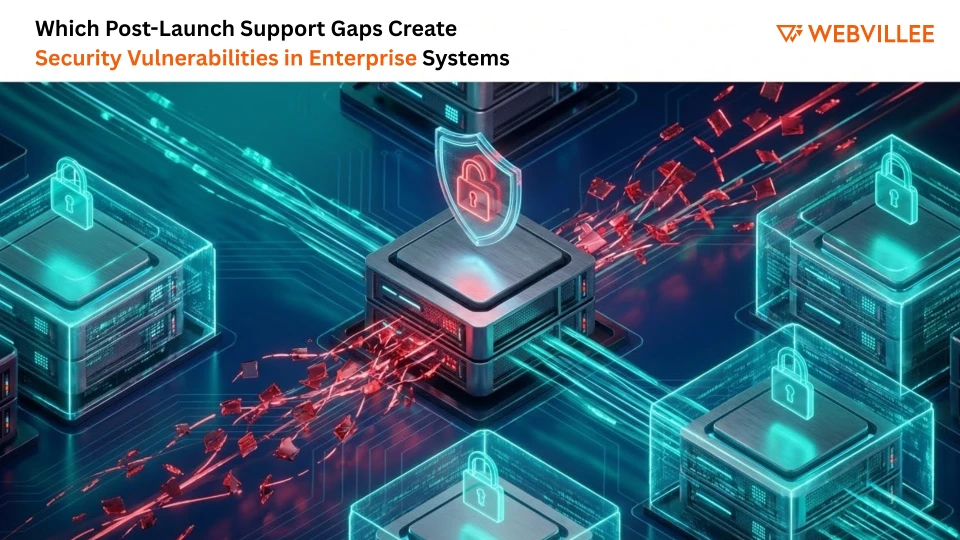
Which Post-Launch Support Gaps Create Security Vulnerabilities in Enterprise Systems?
Systems launched without sustained security monitoring become vulnerable to breaches, unauthorized access, and compliance violations that expose your organization to liability.
Security vulnerabilities emerge after launch because implementation focuses on functionality, not long-term protection. Patch management lapses when no one owns ongoing security updates. Your systems run outdated software with known vulnerabilities. Attackers exploit these gaps.
Access controls degrade over time as staff changes, roles shift, and old accounts aren’t deactivated. Former employees retain system access. Contractors maintain credentials after projects end.
Compliance monitoring stops after launch audits conclude. Your organization loses visibility into whether systems meet regulatory requirements for data handling, encryption, and access logging.
Security logs accumulate without being analyzed. Potential breaches go undetected for weeks or months while attackers access systems unnoticed.
What Measurable Improvements Result from Managed IT Services After System Launch?
Organizations with proper post-launch management see reduced downtime costs, faster problem resolution, improved system performance, and protected technology investments that deliver sustained ROI.
Post-launch management delivers measurable outcomes:
- System uptime improves from 95-97% to 99% or higher through proactive monitoring and preventive maintenance.
- Problem resolution time drops from hours to minutes when your team has proper tools, documentation, and support.
- Emergency support costs decrease dramatically when fires are prevented instead of fought.
- Security breach risk decreases through continuous monitoring, patch management, and access control oversight.
- Compliance audit results improve when systems maintain proper documentation, logging, and control evidence.
- Staff productivity increases when systems perform reliably without unexpected outages disrupting work.
- Technology ROI extends across years instead of months when systems remain stable and performant.
How Should You Structure Post-Launch Support to Ensure Long-Term System Success?
Successful post-launch structures define ownership, establish service level agreements, invest in team capability, plan for growth, and maintain vendor partnerships beyond implementation.
Organizations that sustain system success after launch do these things:
- Establish clear ownership and accountability for system health, performance, and security with assigned teams.
- Define service level agreements that specify uptime targets, response times, and resolution expectations so everyone understands what success looks like.
- Invest in team capability through training and knowledge transfer so your staff can operate and troubleshoot systems independently.
- Build runbooks and documentation that guide your team through common issues, escalation procedures, and emergency responses.
- Plan for scaling from day one, assuming your business will grow and systems will need capacity increases, performance optimization, and architectural evolution.
- Maintain vendor partnerships beyond implementation so you have expert support available for complex issues and long-term evolution planning.
- Schedule regular reviews of system performance, security, and cost to identify improvements before problems escalate.
Moving Forward
System failures after implementation aren’t inevitable. They’re preventable through proper planning, monitoring, and sustained support.
The difference between systems that thrive and systems that fail isn’t the technology. It’s the commitment to ongoing management after launch.
Contact Webvillee to discuss post-launch support strategies that protect your technology investment and ensure long-term system success.