

The Integration Gap That’s Costing You Revenue
Most organizations have CRM systems but fail to maximize their value through proper CRM integration customer retention strategies. Your sales team uses Salesforce or Microsoft Dynamics 365, but your accounting system, customer service platform, and marketing automation tools operate independently. This integration gap costs you customers and sales velocity every single month.
Organizations with properly integrated CRMs retain customers 20-30% better and close deals 15-25% faster than those with siloed systems. The difference isn’t in the technology itself; it’s in how completely the technology connects across your business. When customer data lives in isolated systems, service teams can’t see sales history, sales teams don’t know about open support tickets, and marketing doesn’t understand customer purchase patterns.
This guide explores the strategic value of comprehensive CRM integration, explains why organizations struggle with it, and provides a roadmap for capturing the competitive advantage that comes from unified customer data. The money you’re leaving on the table through poor integration is substantial and recoverable.
What Does CRM Integration Actually Accomplish?
CRM integration connects customer data across systems, eliminates manual data entry, ensures sales teams have complete customer context, and enables cross-team visibility into customer needs. Integration transforms CRM from a sales tool into a customer intelligence platform.
When your CRM integrates with your accounting system, sales teams see invoice history and payment status. It integrates with customer service systems, service teams understand the full customer relationship and purchase history. When it connects to marketing automation, everyone understands customer engagement patterns and preferences.
What CRM Integration Enables:
- Unified customer view showing all interactions, transactions, and history in one place
- Eliminated manual data entry and duplicate record creation across systems
- Real-time customer context for every team member who needs it
- Automated data synchronization so information updates immediately across platforms
- Cross-team visibility enabling collaboration based on accurate, complete information
- Data-driven decision making with complete customer understanding
- Reduced administrative overhead from manual data management
A comprehensive CRM integration strategy transforms customer data from a siloed asset into a competitive advantage. Your organization gains customer intelligence that informs better decisions across sales, service, marketing, and leadership.
If you’re planning a CRM integration initiative, working with an experienced partner who understands both the technical and organizational dimensions of integration can accelerate your success. The right CRM and ERP integration partner brings proven methodologies and helps you avoid expensive mistakes that delay integration value realization.

How Does Integration Impact Customer Retention?
Integrated CRM systems improve customer retention by providing customer service teams with sales history, enabling proactive outreach based on customer behavior patterns, and ensuring consistent customer experience across all touchpoints. When your service team understands the customer’s full relationship with your organization, they provide better support and prevent avoidable churn.
Customer churn happens not because of poor products but because customers feel forgotten or undervalued. Service teams addressing problems don’t know about recent large purchases. They’re unaware of customer loyalty patterns. They don’t see that a customer is at risk of leaving because of subtle behavior changes. Fragmented customer data leads to these service failures.
How CRM Integration Supports Customer Retention:
- Service teams access sales history so they understand customer context and relationship value
- Behavior pattern monitoring identifies at-risk customers early for proactive intervention
- Consistent messaging across all teams reinforces customer value and appreciation
- Personalized service becomes possible because service teams understand individual customer needs
- Reduced customer satisfaction surprises because nothing falls through the cracks
- Faster issue resolution because problems are resolved with full customer understanding
- Retention metrics improvement as organizations systematically address churn drivers
Customer retention CRM strategies depend on complete customer information. Without integration, retention efforts are reactive and miss opportunities. With integration, service teams become retention teams actively working to maintain relationships.
What’s the Connection Between CRM Integration and Sales Velocity?
Integrated CRM systems accelerate sales cycles by providing sales teams with complete customer context, automating routine tasks, enabling rapid customer handoffs between teams, and reducing time spent searching for customer information. Sales velocity increases directly with data completeness and accessibility.
Sales teams spend surprising amounts of time gathering customer information instead of selling. They search for previous emails, dig through old proposals, ask colleagues about prior conversations, and recreate information that already exists somewhere in your organization. Every hour spent gathering data is an hour not spent moving deals forward.
How Integration Accelerates Sales:
- Complete customer context available instantly so sales teams understand needs immediately
- Reduced research time eliminating hours of searching for prior information
- Faster handoffs between teams because information transfers automatically with the customer record
- Automated follow-up tasks prevent deals from stalling due to forgotten steps
- Real-time visibility into customer engagement and buying signals
- Faster deal progression because all customer interactions inform next steps
- Better collaboration between sales, service, and marketing teams based on unified information
When sales teams have integrated customer data, they close deals 15-25% faster. That’s not because customers buy faster; it’s because sales teams work smarter with complete information. Deals progress through cycles without delays from missing information or miscommunication between teams.
What Are Common CRM Integration Failures?
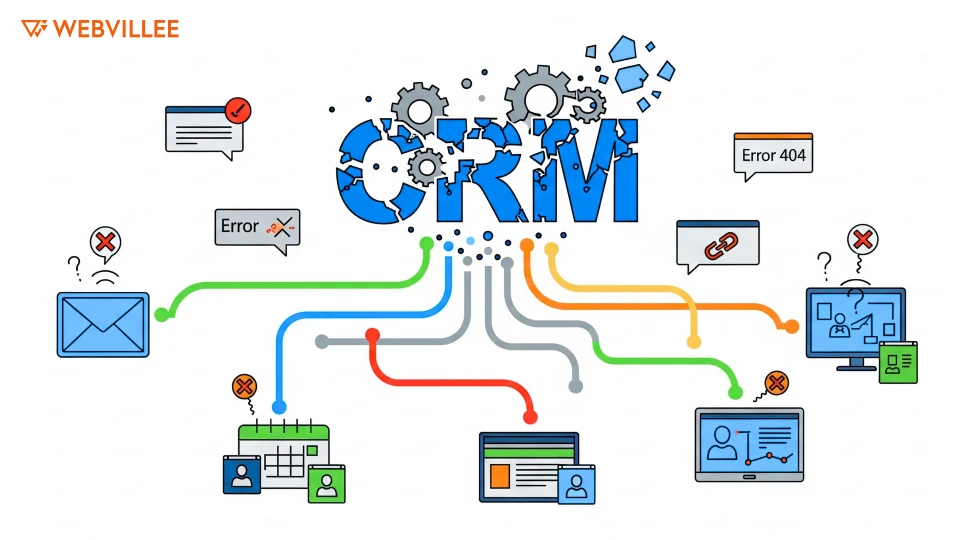
Organizations often implement CRM but fail to integrate it with accounting, customer service, marketing automation, or ERP systems, creating data silos that negate most CRM value. Partial integration is worse than no integration because it creates false confidence while real gaps remain.
Many organizations take a “build as you go” approach. They implement CRM for sales. Later they want customer service visibility. Eventually they add accounting data. This piecemeal approach leaves critical gaps. Data flows from sales to service but not to accounting. Marketing doesn’t see the full customer journey. Finance can’t connect revenue to customer lifecycle.
Common CRM Integration Failures:
- Partial integration where only some systems connect, leaving critical data gaps
- Accounting systems excluded making it impossible to see customer profitability and payment history
- Service systems siloed preventing service teams from understanding customer relationships
- Marketing automation disconnected so marketing doesn’t know customer purchase history or engagement
- Email systems not integrated making communication history incomplete
- No data governance leading to duplicate records and inconsistent information
- Abandoned integration projects where initial attempts failed and organizations gave up
These failures leave organizations with the worst of both worlds: CRM system complexity without CRM benefits. They’ve invested in CRM but don’t realize the value because integration remains incomplete.
Which Systems Should You Integrate With Your CRM?
Prioritize integrations with systems your business relies on daily: accounting systems for invoice and payment history, customer service platforms for support history visibility, email systems for communication tracking, and marketing automation for campaign engagement visibility. Start with the systems that impact your most important business outcomes.
Trying to integrate everything simultaneously overwhelms your organization. Integration projects that attempt too much typically fail from scope creep and complexity. Instead, identify which systems create the most value when connected and start there.
Priority CRM Integration Systems:
- Accounting systems provide invoice history, payment status, customer profitability, and contract details
- Customer service platforms show support history, issue resolution patterns, and customer satisfaction scores
- Email systems capture all customer communication and create communication history
- Marketing automation platforms reveal campaign engagement, lead progression, and customer interests
- ERP systems connect product information, inventory status, and fulfillment information
- Project management systems connect customer project history and engagement
- Business intelligence tools provide real-time views of customer metrics
Start with two or three high-impact integrations rather than attempting comprehensive system integration immediately. Success with early integrations builds organizational momentum and demonstrates value that justifies budget for subsequent work.
What Challenges Do Organizations Face During CRM Integration?
CRM integration challenges include data quality issues with duplicate customer records and incomplete data, different system architectures requiring custom integration work, staff resistance to data standardization, and budget constraints limiting integration scope. Understanding challenges enables better project planning and realistic timelines.
Integration isn’t purely technical work. It’s organizational change that affects how people work and what information they have access to. Technical teams need to connect systems. Business teams need to accept new processes. Finance needs to support budgets. Without addressing all of these dimensions, integration projects stall.
CRM Integration Implementation Challenges:
- Data quality issues in source systems make integrated data unreliable
- Different system architectures requiring custom integration work beyond standard connectors
- Duplicate customer records accumulated over time that must be consolidated
- Incomplete data fields where some systems don’t capture information others need
- Staff resistance to process changes required for data standardization
- Budget constraints preventing comprehensive integration in one project
- Competing priorities preventing dedicated team focus on integration work
- Vendor complexity when systems aren’t designed to integrate easily
These challenges are surmountable with planning but derail projects that ignore them. Organizations that acknowledge challenges upfront allocate resources appropriately and achieve successful integration.
How Does Data Quality Affect CRM Integration Success?
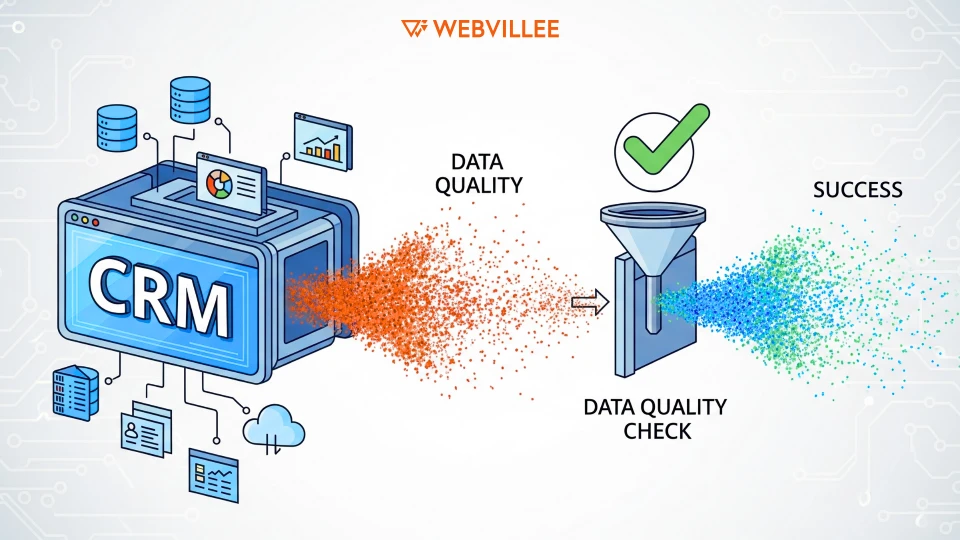
CRM integration only works if underlying data is accurate, complete, and consistent. The garbage-in-garbage-out principle applies directly: poor data quality in source systems becomes worse when integrated. Data cleansing must precede integration projects or integration amplifies data problems.
Most organizations don’t realize their data quality problems until they try to integrate systems. They discover duplicate customer records created from different data entry approaches. And find email addresses in wrong fields. They uncover missing critical information that was never captured consistently. These problems become visible during integration.
Data Quality Factors Affecting Integration:
- Duplicate records for the same customer created through different entry methods
- Inconsistent data entry where the same information is formatted differently in different systems
- Missing critical fields preventing complete customer understanding
- Outdated information from customers who haven’t been contacted recently
- Data in wrong fields making automation and integration impossible
- Unmapped data from systems that collect information no other system uses
- Conflicting information where the same customer appears different in different systems
Organizations addressing data quality before integration see dramatically better results. Projects that skip data cleansing struggle with integration failures and operational problems after go-live.
What’s the ROI of Comprehensive CRM Integration?
Organizations realizing comprehensive CRM integration benefits see improved customer retention of 3-5%, faster sales cycles with 15-25% reduction in time, reduced customer service costs through automation and efficiency, and better decision-making from integrated customer insights. The ROI typically appears within 6-12 months of successful integration deployment.
The financial case for integration is clear when you quantify benefits. A mid-sized organization with 500 customers spending $10K annually per customer sees $5M annual revenue. A 4% retention improvement from integration prevents $200K annual churn. Sales cycle improvements of 15% reduce time-to-revenue on pipeline. Customer service efficiency improvements reduce support costs directly.
Measurable CRM Integration ROI:
- Customer retention improvement of 3-5% annually from better service and engagement
- Sales cycle reduction of 15-25% increasing revenue realization velocity
- Customer service cost reduction of 10-20% through automation and efficiency
- Sales productivity improvement of 20-30% from time saved on information gathering
- Marketing efficiency improvement from better targeting based on integrated customer data
- Decision-making improvement from data-driven insights about customer behavior
- Competitive advantage from capabilities competitors haven’t implemented
These aren’t theoretical benefits; they’re consistently realized by organizations that implement comprehensive integration properly. The investment in integration pays back quickly through improved business outcomes.
How Do You Plan a Successful CRM Integration?
Successful CRM integration requires clear business objectives, data quality assessment, system architecture design, phased implementation approach, strong change management, and commitment to ongoing optimization. Integration is a significant business project, not just an IT initiative.
Too many organizations treat integration as a technical project that IT will handle. This approach fails because integration affects how every team works. Sales teams need to trust data quality. Service teams need training on new processes. Finance needs to understand budget. Success requires business leadership engagement alongside technical expertise.
CRM Integration Planning Components:
- Business objectives defined clearly so success is measurable
- Stakeholder alignment ensuring all affected teams understand and support integration
- Data quality assessment identifying and planning remediation before integration
- System architecture design determining which systems integrate and in what order
- Integration roadmap showing phased approach over 12-18 months
- Change management addressing organizational impact of new processes
- Success metrics defined upfront so progress is tracked
- Executive sponsorship ensuring leadership commitment throughout the project
Organizations that treat integration as strategic initiative involving business and technical leadership succeed consistently. Those treating it as purely IT work struggle with adoption and fail to realize expected benefits.
What Role Does CRM Integration Play in Customer Experience?
Integrated CRM systems enable consistent, personalized customer experience across all touchpoints by providing sales, service, and marketing teams with unified customer view. When all teams understand the full customer relationship, they provide better service and anticipate customer needs before customers articulate them.
Customer experience differentiates organizations in competitive markets. Customers choose vendors who understand them and serve their needs proactively. This understanding comes from complete customer information shared across teams. Without integration, organizations serve customers reactively with incomplete understanding.
Customer Experience Benefits From CRM Integration:
- Consistent messaging across all teams because everyone has same customer information
- Personalized service because teams understand individual customer preferences and history
- Proactive outreach based on customer needs identified from integrated data
- Faster problem resolution because service teams understand customer context completely
- Better recommendations from understanding customer buying patterns and needs
- Reduced customer frustration from not having to repeat information to different teams
- Increased customer loyalty from feeling understood and valued
- Competitive advantage from superior customer understanding compared to competitors
Organizations providing consistently superior customer experience through integrated CRM information win customer loyalty and market share. Their competitors with siloed systems struggle to compete on customer experience dimension.
The Strategic Imperative of CRM Integration
CRM integration is no longer optional. Organizations integrating CRM systems outcompete those with siloed systems in customer retention and sales velocity. The investment in integration pays back quickly through improved business outcomes and competitive positioning.
The competitive landscape has shifted. Organizations with comprehensive CRM integration operate with customer intelligence that competitors without integration cannot match. They retain customers better, close deals faster, and provide superior customer experience. Over time, this advantage compounds as they build deeper customer relationships and expand wallet share.
Your path forward starts with honest assessment of current state. Do your teams have unified customer view? Can sales teams see customer service history? Does service understand purchase patterns? If the answer is no to any of these questions, integration will improve your competitive position and business results.
The organizations winning in your market are likely already integrating their CRM systems. Those that delay integration continue operating with competitive disadvantage that widens over time. The investment in comprehensive CRM integration is investment in competitive advantage and future business success.
If your organization is ready to evaluate CRM integration opportunities or accelerate integration projects in progress, connect with Webvillee. Our CRM integration specialists bring deep experience implementing integrated CRM systems across diverse organizations and industries. We help you assess integration readiness, design comprehensive strategies, and execute implementation that delivers expected benefits. Contact Webvillee today to schedule a free consultation with our CRM integration experts.